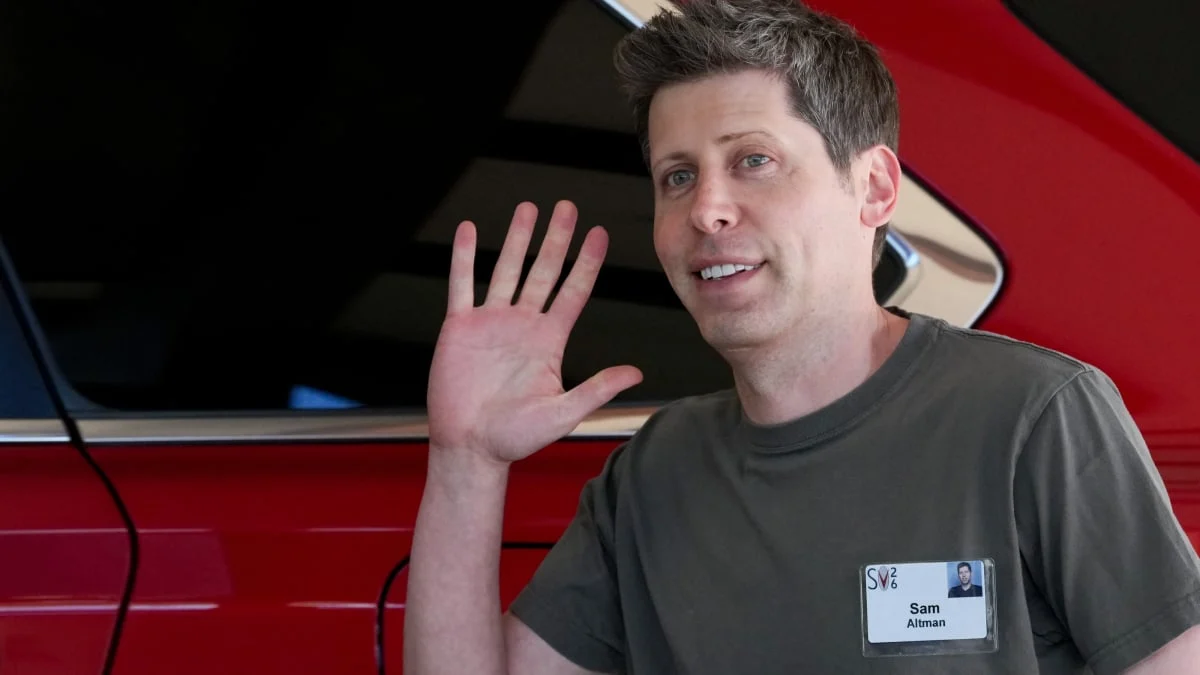
OpenAI Chief Executive Officer Sam Altman sparked a widespread debate across social media after proposing a novel use for ChatGPT that involves automating family updates through personalized audio broadcasts. The suggestion, which Altman shared on the social media platform X, involves utilizing artificial intelligence to synthesize children’s schedules and interests into a daily podcast format for parents and their families.
In a post written entirely in lowercase, the executive described the concept as a "cool use case" of ChatGPT that he had recently encountered. The workflow involves connecting family calendars and feeding specific details about children’s hobbies and upcoming events into the AI model. The system then generates a scripted audio program designed to be played during the morning commute to school.
"Every morning for the drive to school, have it make a podcast that talks about one kid’s soccer game that afternoon, one kid’s upcoming birthday, some news, etc.," Altman wrote. The suggestion immediately ignited a firestorm of criticism from child development experts, creators, and parents who argued that the proposal prioritizes technological efficiency over fundamental human connection.
The Mechanics of How Sam Altman Suggests Parents Generate AI Podcasts About Their Kids
The technical implementation of the idea relies on the multimodal capabilities of OpenAI’s flagship product, ChatGPT. By integrating calendar data and personal notes, the AI can cross-reference multiple data points to create a cohesive narrative. The "Advanced Voice Mode" recently rolled out by OpenAI allows the bot to speak with human-like intonation, making the "podcast" experience feel more like a professional broadcast than a robotic reading of a list.
Under this model, a parent would prompt the AI to look at the family’s shared digital calendar. The AI would identify that a child has a soccer game at 4:00 p.m. and another child has a birthday party on Saturday. It would then weave these facts together with current events or educational trivia to fill the time during a 15-minute car ride.
While proponents of the idea see it as a way to stay organized and keep children engaged with their own schedules, critics view it as a symptom of "optimization culture" reaching into the most private spheres of domestic life. The debate highlights a growing tension between the convenience of generative AI and the traditional values of direct interpersonal communication.
Public Backlash and the Quest for Human Connection
The reaction to the proposal was swift and largely critical. One of the most prominent responses came from Alex Hirsch, the creator of the popular animated series Gravity Falls. Hirsch’s reply, which asked, "What if you just talked to your children?", garnered significantly more engagement than Altman’s original post, a phenomenon often referred to on social media as being "ratioed."
Hirsch’s critique resonated with thousands of users who expressed concern that Sam Altman suggests parents generate AI podcasts about their kids as a substitute for meaningful morning dialogue. For many, the drive to school is a rare window of uninterrupted time for parents to check in with their children, ask about their feelings, or provide encouragement before the school day begins.
Other critics pointed out the irony of using a machine to tell parents about their own children’s lives. The sentiment shared by many online was that if a parent needs an AI to remind them of their child’s soccer game or birthday, the issue may be a lack of presence rather than a lack of a podcast. The backlash reflects a broader cultural anxiety regarding the "dead internet" theory and the fear that human experiences are being increasingly mediated by algorithms.
The Ethical Landscape of Algorithmic Parenting
The suggestion that parents should use AI to narrate their family life raises significant ethical questions regarding privacy and child development. By feeding children’s schedules, interests, and personal milestones into a generative AI, parents are essentially creating a digital footprint for their children that is processed by a commercial entity.
OpenAI and other tech giants have faced ongoing scrutiny regarding how they handle the massive amounts of data used to train and operate their systems. When Sam Altman suggests parents generate AI podcasts about their kids, it implies a level of trust in the data-handling practices of OpenAI that not all users share. There are concerns about how this personal family data might be stored or utilized for future model iterations.
From a developmental standpoint, psychologists have long emphasized the importance of "serve and return" interactions between parents and children. These are the back-and-forth exchanges that build brain architecture and emotional bonds. Replacing these organic conversations with a one-way AI broadcast could, some argue, stifle a child’s social and emotional growth.
Broader Context: OpenAI and the Resistance to Automation
This controversy does not exist in a vacuum. It comes at a time when the public is becoming increasingly wary of the rapid expansion of generative AI into creative and personal fields. OpenAI has been at the center of several recent disputes, including legal battles over copyright and intellectual property.
In April 2025, Ziff Davis, the parent company of Mashable, filed a lawsuit against OpenAI. The litigation alleges that the tech company infringed on Ziff Davis’s copyrights by using its vast library of content to train and operate AI systems without proper authorization or compensation. This legal friction underscores the growing divide between the tech industry and the creators whose data fuels their products.
Furthermore, the backlash against Altman’s suggestion mirrors recent reactions to other tech companies. Google recently faced criticism for integrating AI image generators into Google Earth and its search engine, leading to a "vibe shift" where users are pushing back against the perceived over-automation of everyday tasks. The general public appears to be reaching a saturation point where the "AI for everything" approach is being met with skepticism.
Technological Feasibility and Privacy Implications
Despite the social outcry, the technology to execute Altman’s vision is already largely in place. ChatGPT’s ability to parse complex data sets and generate natural-sounding speech is a cornerstone of OpenAI’s current business strategy. The company has positioned its AI not just as a search tool, but as a "personal assistant" capable of managing a user’s entire digital life.
However, the "privacy-first" crowd argues that the risks outweigh the benefits. Connecting a family calendar—which contains locations, times, and names—to a cloud-based AI presents a target for data breaches or misuse. While OpenAI maintains that it prioritizes user safety, the inherent nature of large language models requires vast amounts of data to function effectively, creating a persistent tension between utility and security.
The suggestion also highlights a shift in how tech leaders view the role of AI. Rather than a tool for professional productivity, Altman’s post frames AI as a tool for "relational outsourcing." This follows a trend where people have begun using chatbots to draft breakup texts, mediate arguments between couples, or even simulate romantic relationships.
The Future of AI in Domestic Life
The debate over whether Sam Altman suggests parents generate AI podcasts about their kids is likely a precursor to even more invasive applications of AI in the home. As smart home devices become more integrated with generative AI, the possibility of a "fully automated household" becomes a technical reality.
Industry analysts suggest that OpenAI’s goal is to make ChatGPT an indispensable part of the human experience. By suggesting use cases that involve children and family routines, the company is testing the boundaries of where society is willing to let AI go. The pushback on X suggests that, for now, the boundary may be the front door of the family home.
While some tech enthusiasts may adopt the AI podcast idea as a way to "gamify" the morning routine, the overwhelming response suggests a preference for human-to-human interaction. The incident serves as a reminder that while AI can process information with incredible speed, it lacks the empathy, context, and genuine connection that define parenting.
The Cultural Impact of the AI Optimization Mindset
The controversy highlights a specific Silicon Valley mindset often criticized as being "out of touch" with the average person’s values. The drive to optimize every minute of the day—even the time spent driving children to school—suggests a worldview where "content consumption" is more valuable than "conversation."
For many, the idea of an AI podcast about their kids is the antithesis of parenting. Parenting is often found in the "boring" or "inefficient" moments: the silence in the car, the random questions a child asks, or the shared observation of something outside the window. By automating this time, parents may be inadvertently signaling to their children that their lives are data points to be summarized rather than experiences to be shared.
As OpenAI continues to develop more advanced versions of its software, the conversation around AI ethics will likely shift from what the machines can do to what they should do. The reaction to Sam Altman’s suggestion indicates that the public is beginning to define those limits, prioritizing the preservation of human intimacy over the convenience of algorithmic assistance.