Conservative media personalities Scott Jennings and Greg Kelly have unleashed strong condemnations against recent criticisms targeting Natalie Harp, a key aide to former President Donald Trump, following remarks made by Senator Jon Ossoff (D-GA). This latest political skirmish, which has intensified the public scrutiny surrounding Harp’s influential role and her personal narrative, underscores the fierce loyalty demanded within Trumpworld and the escalating nature of partisan attacks in contemporary American politics.
Natalie Harp: A Profile in Loyalty and Public Service
Natalie Harp, 35, has become a conspicuous figure by former President Trump’s side, frequently seen in his immediate entourage and serving as an executive assistant. Her public profile significantly rose during the 2020 Republican National Convention, where she delivered a poignant speech attributing her survival from cancer to Trump’s "Right to Try Act." This legislation, signed into law in 2018, aims to provide terminally ill patients access to experimental treatments not yet approved by the Food and Drug Administration (FDA) when no other options are available. Harp’s testimony became a powerful symbol for supporters of the act and a testament to Trump’s perceived compassionate leadership.
However, Harp’s account of her treatment has faced questions. While she has stated the "Right to Try Act" saved her life by granting access to experimental treatments, she has also described receiving an "FDA-approved immunotherapy drug for an unapproved use." This distinction is critical, as the "Right to Try Act" specifically applies to drugs not yet approved by the FDA, rather than approved drugs used for off-label purposes, which falls under different regulatory frameworks. This discrepancy has fueled ongoing debate about the accuracy of her narrative and the act’s direct impact on her care.

Beyond her legislative advocacy, Harp’s close proximity to Trump has drawn considerable media attention. A recent CNN report detailed an incident where Harp reportedly engaged in a "screaming match" after not being assigned a seat in Trump’s vehicle, subsequently opting to ride in the trunk of an SUV to remain near him. Such reports have further amplified interest in her unique position and the dynamics of loyalty within the former president’s inner circle, positioning her as a figure emblematic of dedicated—and sometimes controversial—service to Trump.
The Origin of the Scrutiny: Senator Ossoff’s Atlanta Remarks
The recent wave of intense Natalie Harp scrutiny was triggered by Senator Jon Ossoff (D-GA) during a re-election rally in Atlanta. Ossoff, aiming to underscore what he views as the former president’s misplaced priorities, made a pointed jab at Harp’s frequent presence alongside Trump. Specifically, Ossoff stated, "Trump would rather build his ballroom and travel with Natalie on their apparently defenseless flying palace gifted by the Emir of Qatar."
This comment immediately resonated within political circles, eliciting strong reactions from both sides of the partisan divide. For Ossoff, the remark was likely intended as a sharp piece of campaign rhetoric, highlighting a perceived disconnect between Trump’s public image and his actual focus, particularly concerning the use of resources and the company he keeps. The mention of the Qatari-gifted aircraft adds another layer of opulence and foreign influence to the criticism, aiming to paint a picture of a leader more concerned with personal comfort and luxury than public service. However, the direct naming of an aide, especially a woman, in such a context quickly transformed a political attack into a broader debate about professional conduct and perceived gender-based slights.
Jennings’ Fiery Defense: Professional Standing and Gendered Attacks

Scott Jennings, a conservative commentator for CNN and a rumored frontrunner for the role of White House press secretary, swiftly emerged as one of Harp’s most vocal defenders. Speaking on The Scott Jennings Show, he did not mince words, labeling Senator Ossoff an "absolute weak coward" and a "garbage human" for his remarks. Jennings argued that Ossoff’s jab was not merely a political attack but a "vile" attempt to undermine Harp’s credibility and professional standing.
Jennings’s core accusation centered on the implication he perceived in Ossoff’s language: that a young, professional woman could not achieve a position of trust and power on merit alone. "He thinks the way to cement his path to the Oval Office is to slander a talented young woman as nothing more than a pretty young companion for the president," Jennings asserted, later adding, "The implication is that a professional woman couldn’t possibly have earned her position of trust in the White House without sleeping her way to the top." This strong rebuke positioned Jennings as a defender of professional women in politics, even when the woman in question is an aide to his party’s leader.
Ossoff’s subsequent appearance on MS NOW, where he attempted to perform "damage control" by referring to Harp as Trump’s "security blanket," only further inflamed Jennings. For Jennings, this softened language did not retract the initial perceived slight but rather underscored Ossoff’s cowardice in facing the repercussions of his initial statement. This exchange highlights the intense scrutiny placed on political aides and the readiness of media figures to interpret and amplify such comments through a partisan lens.
Greg Kelly Weighs In: Defending Harp’s Personal Narrative
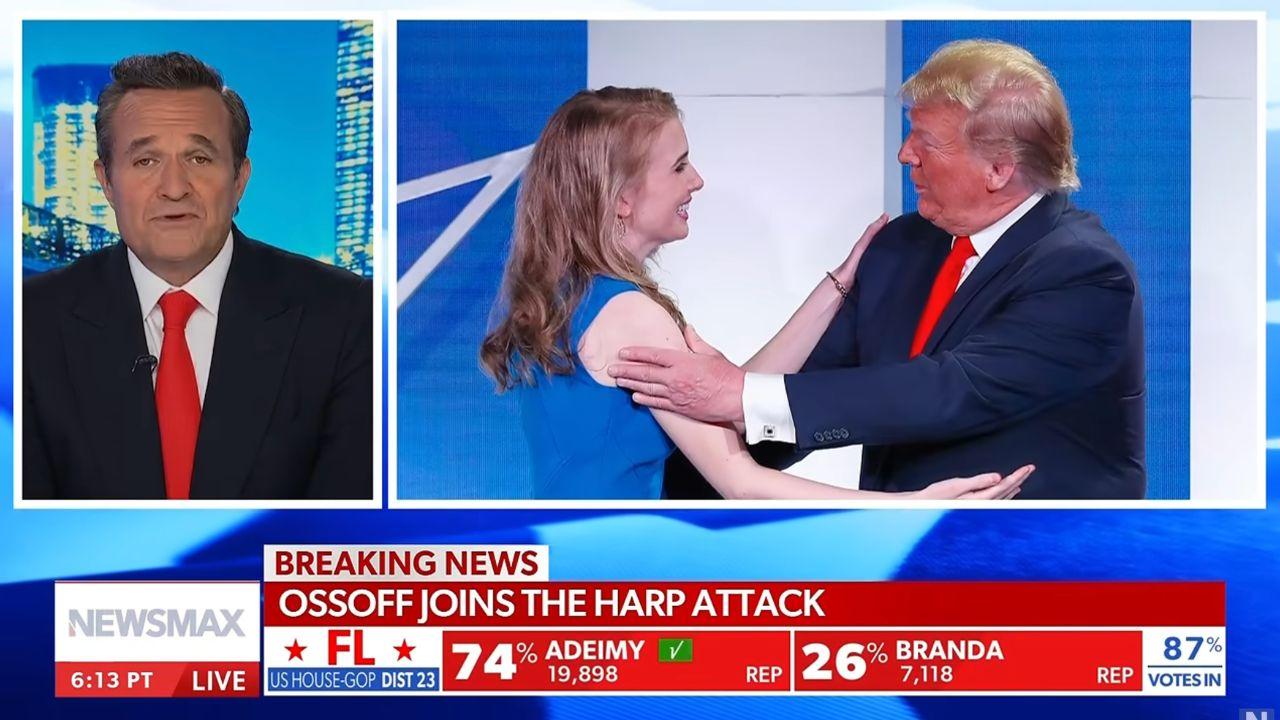
Newsmax host Greg Kelly took a different, yet equally fervent, approach to defending Natalie Harp. His focus gravitated towards the renewed questioning of Harp’s widely publicized claim that Donald Trump’s "Right to Try Act" directly saved her life during her cancer treatment. Kelly, a staunch supporter of Trump and his policies, used his platform to vehemently dismiss any skepticism surrounding Harp’s narrative, framing it as a callous attack on a survivor.

On his Newsmax program, Kelly re-aired Harp’s impactful 2020 Republican National Convention speech, where she emotionally recounted, "They didn’t give me the right to try experimental treatments, Mr. President; you did, and without you, I’d have died waiting for them to be approved." Following the clip, Kelly praised Harp, stating, "I thought she was phenomenal." He then directly addressed the ongoing debate regarding the specifics of her treatment and the act’s applicability, insisting, "And this whole thing about authorizing the experimental drugs for people who have no other option saved her life."
Kelly’s defense escalated into an impassioned outburst, directly confronting those who dared to question Harp’s story. He lambasted critics by exclaiming, "Democrats are like, ‘oh that has not yet been established.’ You sons of—" His unfinished expletive conveyed a deep sense of outrage and frustration, portraying the questioning of Harp’s testimony as an act of bad faith by political opponents. For Kelly, the specifics of medical regulation were secondary to the powerful, human story of a life saved, which he viewed as a definitive success for Trump’s policy. This segment highlighted the stark partisan divide over how personal narratives, especially those tied to policy, are interpreted and weaponized in the media landscape.
The ‘Right to Try’ Act: A Lingering Policy and Personal Controversy
The resurgence of the debate around Natalie Harp’s cancer treatment and the "Right to Try Act" brings to the forefront a complex policy discussion often overshadowed by political rhetoric. The act itself was championed by patient advocates and conservatives who argued for greater access to potentially life-saving treatments for terminally ill individuals, bypassing lengthy FDA approval processes. For former President Trump, signing the "Right to Try Act" was a significant legislative victory, allowing him to portray himself as a champion of individual liberty and medical innovation.
Harp’s personal testimony at the RNC served as powerful anecdotal evidence for the act’s purported success. However, the subsequent clarifications from Harp herself, indicating she received an "FDA-approved immunotherapy drug for an unapproved use," introduce a critical nuance. Treatments involving an FDA-approved drug for an "unapproved use" (often called "off-label use") are distinct from those involving drugs not yet approved by the FDA, which is the primary scope of the "Right to Try Act." Off-label prescribing is a common medical practice, regulated differently than access to experimental, unapproved compounds. This distinction has led medical experts and critics to question the direct causal link Harp asserted between her survival and the specific legislation, rather than other existing medical pathways.
The controversy surrounding Harp’s narrative highlights the ethical complexities of employing personal health stories in political campaigns. While such stories can humanize policy and galvanize support, their accuracy and precise alignment with the promoted legislation are subject to intense scrutiny. For critics, any perceived embellishment or misrepresentation undermines the integrity of both the individual and the policy. For staunch defenders like Greg Kelly, the emotional impact and the message of hope inherent in such stories often outweigh precise legislative definitions, making any challenge to them feel like a personal attack.
Analysis: The Intersection of Loyalty, Gender, and Political Discourse
The public spat over Natalie Harp is a microcosm of the broader political landscape, illustrating several key dynamics at play. First, it underscores the intense loyalty that defines "Trumpworld." Harp’s willingness to go to extreme lengths, such as riding in an SUV trunk, to remain close to the former president, exemplifies the deep personal and political fealty expected and rewarded within his orbit. When such loyalty is challenged or mocked, as Ossoff’s comments were perceived to do, it triggers a fierce defensive reaction from Trump’s media allies.
Second, the controversy highlights the fraught terrain of gendered attacks in politics. Scott Jennings’s forceful argument that Ossoff’s remarks implied Harp "slept her way to the top" taps into a sensitive and historically charged aspect of criticizing women in power. While Ossoff’s initial comment might have been intended as a general political jab, its specific wording, combined with Harp’s gender and close proximity to Trump, allowed it to be interpreted as a demeaning and sexist slight. This incident demonstrates how quickly political critiques can be reframed through the lens of gender, prompting accusations of misogyny and drawing in broader debates about respect for professional women in public life.
Finally, the entire episode showcases the pervasive role of partisan media in amplifying and interpreting political disputes. Commentators like Jennings and Kelly act not merely as reporters but as active participants, framing narratives, defending allies, and attacking perceived adversaries. Their platforms become arenas where political loyalty is tested, personal narratives are fiercely protected, and legislative impacts are debated, often with more passion than precision. The intense Natalie Harp scrutiny is therefore not just about an aide, but about the battle for narrative control in a deeply polarized environment.

Broader Political Ramifications and Public Impact
The fallout from this incident extends beyond the immediate exchanges between Ossoff, Jennings, and Kelly. For Senator Ossoff, the reaction to his remarks could have several implications. While his base might appreciate a strong critique of Trump, the accusation of a gendered attack could alienate some voters who prioritize respectful political discourse. It forces him to either double down on his critique or offer further clarification, potentially distracting from his broader campaign message.
For Scott Jennings and Greg Kelly, their vehement defenses solidify their positions as unwavering Trump loyalists and aggressive media advocates. This approach resonates strongly with conservative audiences, reinforcing their credibility within the "Trumpworld" ecosystem. Their willingness to engage in highly charged rhetoric serves to rally the base and frame any criticism of Trump’s associates as an attack on broader conservative values. This incident further illustrates how personal attacks on political figures, even aides, can be strategically used to energize supporters and define political alliances.
The ongoing Natalie Harp scrutiny ultimately contributes to the public’s perception of political authenticity and the weaponization of personal narratives. In an era where political figures increasingly leverage personal stories to connect with voters and advocate for policies, the veracity and context of those stories become paramount. When such narratives are challenged, and their defenders react with outrage, it underscores the emotional stakes involved and the difficulty of conducting objective policy debates amidst deeply ingrained partisan loyalties.
Conclusion
The heated exchanges between Scott Jennings, Greg Kelly, and Senator Jon Ossoff regarding Natalie Harp underscore the volatile and highly personalized nature of modern American politics. What began as a pointed campaign remark quickly escalated into a full-blown media firestorm, igniting debates about gendered attacks, professional integrity, and the accuracy of personal narratives linked to significant legislation. This episode serves as a powerful reminder of the intense loyalty demanded within the orbit of former President Donald Trump and the readiness of his allies to fiercely defend those associated with him. As the political discourse continues to be shaped by such high-stakes confrontations, the scrutiny of aides and the weaponization of personal stories will undoubtedly remain potent forces in the ongoing battle for public opinion.