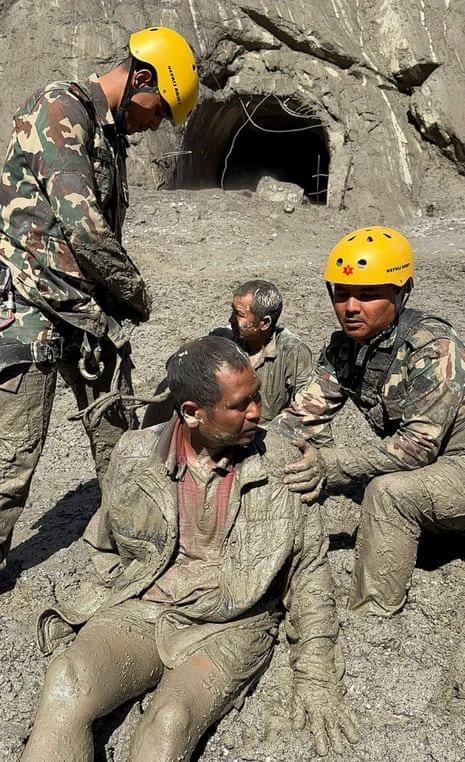
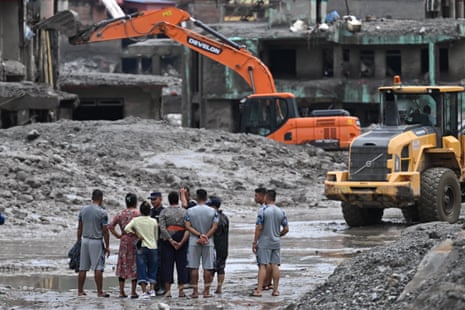
Rescue teams in the Rasuwa district of Nepal are working under grueling conditions to reach workers and civilians believed to be trapped inside a massive, mud-filled hydropower tunnel. The Nepalese government confirmed Saturday that the military and police have intensified excavation efforts as the humanitarian crisis following Wednesday’s catastrophic flash floods continues to escalate. The total number of people reported missing across the Himalayan border region has now surged to nearly 3,000, with officials warning that the window for finding survivors is rapidly closing.

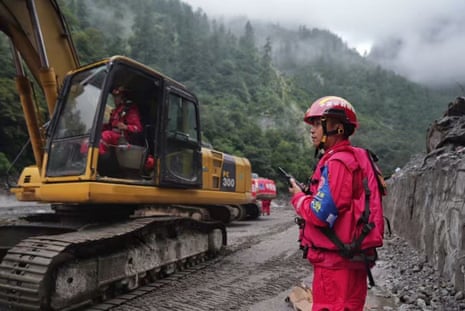
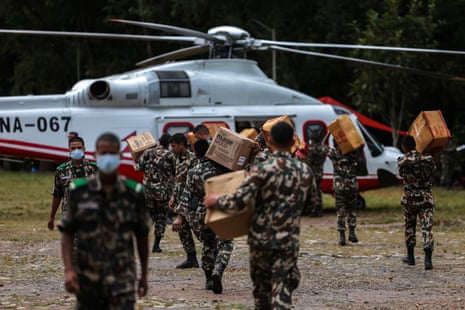
The search and rescue operation at the hydropower site involves a specialized team of 82 personnel from the Nepalese army and police. These crews have been working in continuous shifts since Friday night, using heavy machinery and manual labor to clear thick sludge that inundated the tunnel’s entrance during the initial surge of water. According to a statement from the Nepalese prime minister’s office, the operation is being hampered by "persistently adverse weather," which has limited visibility and made the surrounding terrain unstable for heavy equipment.
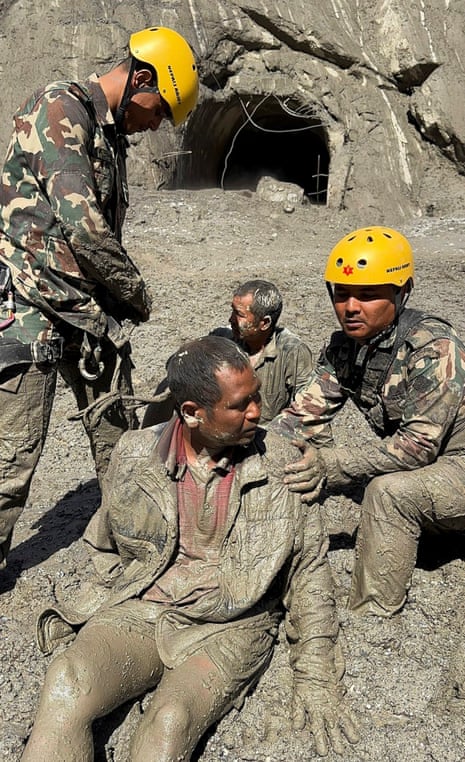
While two survivors were pulled from the mud on Friday in a dramatic rescue captured on social media, the exact number of people remaining inside the tunnel remains unknown. The site, a critical piece of infrastructure for the region’s energy grid, became a deathtrap when a wall of water and debris, triggered by a glacial collapse, swept through the valley without warning.
Death Toll Rises as Search for Missing Enters Fourth Day
The scale of the disaster is becoming clearer as communication is slowly restored to remote mountain villages. Nepal’s disaster management agency reported on Saturday that the confirmed death toll on its side of the border has risen to 626. Meanwhile, China’s state-run Xinhua news agency has confirmed at least seven deaths in the Tibet Autonomous Region. The disparity in reported casualties is partly attributed to the extreme difficulty of obtaining independent information from the Chinese side of the border.
The number of missing persons remains the most staggering statistic of the crisis. Nepalese officials have registered 2,426 people as unaccounted for, while Chinese authorities have reported 554 missing in Tibet. Among the thousands of missing are at least 777 foreigners, a group that includes international tourists trekking in the Himalayas and foreign laborers working on various infrastructure projects in the region. The Red Cross estimates that at least 93,000 people have been directly affected by the floods, many of whom are now homeless and lacking access to clean water or food.
Glacial Collapse and the Science of the Disaster
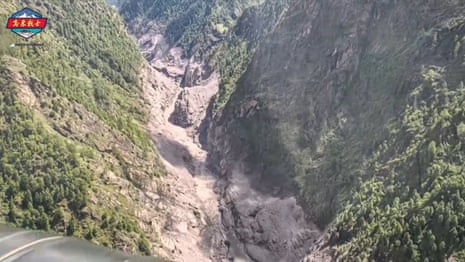
Geologists believe the disaster was triggered by a massive glacial collapse high in the mountains, which was detected by seismic monitors as a magnitude 5.2 event. This collapse likely released millions of cubic meters of water into the valleys below, creating a "deadly cascade" that gathered speed and debris as it moved downstream. This phenomenon, known as a Glacial Lake Outburst Flood (GLOF), is becoming an increasing concern for scientists monitoring the impact of the climate crisis on the Himalayan range.
The warming of the Tibetan plateau has led to the rapid melting of glaciers, causing water to accumulate in unstable lakes held back by natural dams of ice and rock. When these barriers fail—often due to an avalanche, earthquake, or internal pressure—the resulting flood can be catastrophic. In this instance, the Purepu Tsangpo river became a conduit for the surge, which eventually reached the hydropower tunnel in Rasuwa.
India Increases Surveillance of Himalayan Glacial Lakes
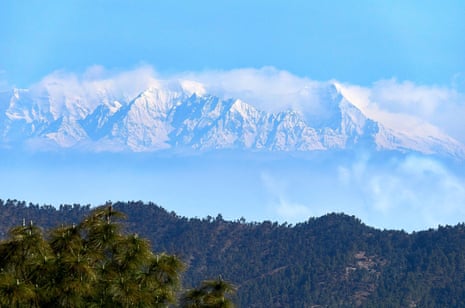
The disaster has sent shockwaves through neighboring India, where officials are now bracing for similar risks. Madan Kaushik, the state disaster management minister for Uttarakhand, announced that the government has ordered increased surveillance of all 1,266 glacial lakes within the state. Uttarakhand, which shares a mountainous border with both Nepal and China, is considered one of the most ecologically sensitive regions in the world and has a history of devastating floods.
"Since we share a border with Nepal and have a similar geographic situation, we have asked our department to monitor all the glaciers and known glacial lakes in the region," Kaushik told reporters. The move reflects a growing regional awareness that the melting of the "Third Pole"—as the Himalayan-Hindu Kush region is often called—is no longer a distant threat but an active emergency requiring real-time monitoring and international cooperation.
Geopolitical Barriers to Disaster Response
Despite the shared risks, geopolitical tensions continue to complicate the regional response. International relations experts note that China’s strict control over information in Tibet has created an "information black hole" that hinders the ability of downstream countries like Nepal and India to prepare for sudden disasters. While Nepal maintains a "One China" policy and enjoys warm relations with Beijing, there is no formal mechanism for the real-time sharing of hydrological or glacial data from the Tibetan plateau.
The region is administered by China as a militarized frontier, where access for foreign journalists, researchers, and even diplomats is strictly regulated. This lack of transparency means that when a glacial lake begins to show signs of instability in Tibet, the warning may not reach Nepalese communities until the water is already crossing the border.
Survivors Recount Horrors of the Flash Flood
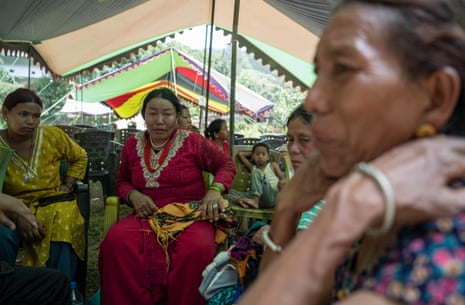
For those on the ground, the geopolitical and scientific explanations offer little comfort. In the town of Bidur, where rescue efforts are being coordinated, survivors have gathered in temporary shelters to mourn the loss of their families and livelihoods. Sangke Dolma Tamang, 61, is one of many who lost everything in a matter of seconds.
Tamang was cooking in her village of Mailung when the floods arrived. She described the terrifying moment she tried to save her husband as they fled uphill. "As I grabbed for my husband, he slipped from my grip and was washed into the dark, fast-moving waters," she said. Her son is also missing, and her village has been entirely erased from the map. "Now I have nothing left to live for," she added. "The whole house is gone. We couldn’t salvage anything."
Economic Impact and the Path to Reconstruction
The financial toll of the disaster is expected to be as devastating as the loss of life. Nepal’s Finance Minister, Swarnim Wagle, provided an initial estimate that the country would need at least $5 billion to rebuild. He cautioned that this figure is a preliminary assessment and that the full extent of the loss and damage is still being calculated.
The destruction includes at least 18 schools completely leveled and another 20 heavily damaged, affecting approximately 10,000 children. The Red Cross has reported that multiple bridges have been washed away and major road networks have been disrupted, leaving many of the hardest-hit communities accessible only by helicopter. The loss of hydropower infrastructure, such as the tunnel currently under excavation, will also have long-term implications for Nepal’s energy security and economic growth.
Monitoring the Barrier Lake at the China-Nepal Border
There is a small glimmer of hope regarding secondary disasters. Chinese authorities reported on Saturday that the risk of a newly formed barrier lake bursting has decreased. The lake, which formed after the initial glacier collapse blocked the flow of the Purepu Tsangpo river, appears to be shrinking. Satellite imagery showed the lake’s surface area at approximately 99,000 square meters on Saturday morning, a significant reduction from previous days.
A 15-member specialized team from China Anneng, a state-owned engineering enterprise, has been deployed to the lake with reconnaissance drones and portable satellite stations. While an overflow on Friday briefly halted rescue work downstream, officials now believe the risk is manageable. However, they continue to warn that the valley remains at "extremely high risk" for further mudslides and debris flows if the weather does not improve.
Political Challenges for Nepal’s Leadership
The timing of the disaster is particularly difficult for the Nepalese government. It comes just before the anniversary of the mass anti-corruption protests that led to the fall of the previous administration. Prime Minister Balendra "Balen" Shah, a 36-year-old former rapper and mayor of Kathmandu, is now facing the first major crisis of his tenure. Having won the election on a platform of radical change and efficiency, his administration’s ability to manage the recovery and reconstruction will be a defining test of his leadership.
As the search for the missing continues, the international community has begun to offer aid, but the logistics of delivering relief to the high-altitude disaster zones remain a formidable challenge. For now, the focus remains on the mud-filled tunnel in Rasuwa, where the 82-person team continues to dig, hoping against the odds to find signs of life beneath the debris.