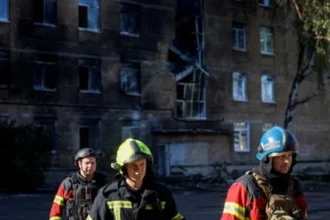
A Russian strike on warehouse near Kyiv kills at least 37 people after a suicide drone targeted an industrial facility in the western suburbs of the Ukrainian capital, triggering a massive secondary explosion that leveled nearby residential structures. The attack, which occurred in the village of Myla within the Bucha district, has ignited a firestorm of controversy within the Ukrainian government regarding the storage of hazardous military materials in close proximity to civilian populations. Emergency crews worked through the night to pull survivors from the rubble of at least 50 damaged buildings, including a specialized care facility for the elderly and disabled that sat in the path of the blast wave.
The regional governor, Tymur Tkachenko, confirmed that the casualty count rose sharply as rescuers reached the epicenter of the fire. In addition to the 37 confirmed fatalities, at least 42 people sustained injuries, including four children who were hospitalized with shrapnel wounds and respiratory issues caused by the thick, acrid smoke. The detonation was felt for miles, shattering windows in neighboring towns and forcing the immediate evacuation of more than 370 residents. President Volodymyr Zelenskyy addressed the nation shortly after the strike, confirming that the warehouse was being used to store "explosive objects" and that the subsequent detonation was responsible for the high death toll.
Detonations and Damage in the Bucha District
The strike in Myla has once again turned the Bucha district into a focal point of tragedy. Witnesses described a low-flying unmanned aerial vehicle (UAV) striking the grounds of a commercial enterprise, followed moments later by a series of massive explosions that sent a mushroom cloud of fire into the sky. The facility was reportedly storing components that were highly combustible, leading to a fire that proved difficult for local brigades to contain. Aerial footage from the scene showed the warehouse completely gutted, with the skeletons of transport vehicles and industrial equipment twisted by the heat.
The damage extended far beyond the industrial site. A nearby care home, which housed dozens of vulnerable citizens, suffered a partial roof collapse and significant structural damage. Staff members at the facility described a scene of chaos as they attempted to move non-ambulatory patients into hallways and basements while the building shook from the nearby blasts. Local authorities noted that the presence of "explosive objects" at the site likely turned a precision drone strike into a localized catastrophe, as the secondary explosions acted as a force multiplier against the surrounding residential neighborhood.
Casualties and Heroism Amidst the Ruins
Among the dead was Taras Didych, the head of the Dmytrivka community, who was reportedly killed while attempting to lead rescue efforts in the immediate aftermath of the initial impact. Didych had become a well-known figure in the region for his leadership during the early months of the full-scale invasion in 2022. Local residents reported that Didych arrived at the scene before the secondary detonations occurred, losing his life while trying to usher families away from the burning warehouse. His death has been met with widespread mourning across the Kyiv region, where he was regarded as a dedicated public servant.
The humanitarian impact of the strike is compounded by the displacement of hundreds of families. The Ukrainian government has set up temporary shelters for the 370 people evacuated from Myla, many of whom have lost their homes entirely. "The evacuation process is still continuing," President Zelenskyy stated, noting that the area remains hazardous due to the potential for unexploded ordnance and the instability of charred buildings. For many in the Bucha district, the strike is a traumatic reminder of the violence they experienced during the initial Russian occupation, reopening deep psychological wounds in a community that was still in the process of rebuilding.
Investigating Charges of Official Negligence
While the Russian military launched the drone, the Ukrainian government is turning its focus inward to determine why hazardous materials were stored so close to a residential zone. President Zelenskyy announced that criminal proceedings have been opened on charges of official negligence. He emphasized that strict regulations govern the storage of ammunition and explosive materials, explicitly prohibiting their placement near homes or care facilities. "There are regulations in place—ammunition cannot be stored near homes or other residential areas," Zelenskyy said in a stern address, signaling that state officials or enterprise managers could face severe legal consequences.
Ukrainian prosecutors have launched a comprehensive investigation into the legality of the operations at the Myla enterprise. Investigators are looking into who authorized the storage of "explosive objects and materials" at the site and whether the facility had been inspected for safety compliance. The presence of such a high-value military target in a civilian area is being viewed by many as a catastrophic lapse in judgment. The probe aims to identify the chain of command that allowed the warehouse to become a de facto munitions depot in the heart of a populated suburb.

The Vyshneve Precedent and Regulatory Failures
The tragedy in Myla has drawn immediate and angry comparisons to a similar incident in July. In that case, a Russian strike on a munitions depot in Vyshneve, also near Kyiv, killed 22 people and destroyed several apartment blocks. An investigation into the Vyshneve disaster revealed that a state-owned company had ignored safety protocols regarding the proximity of explosives to residential zones. Prime Minister Serhii Koretskyi expressed deep frustration that the lessons of the summer had not been applied to prevent the deaths in Myla.
"Unfortunately, we can already see that the terrible tragedy in Vyshneve did not become a lesson," Koretskyi said in a public statement. He characterized the repeated failure to secure hazardous materials as "criminal negligence," particularly given that Ukraine is in the fifth year of a full-scale conflict. The Prime Minister’s comments reflect a growing impatience within the upper echelons of the Ukrainian government regarding bureaucratic incompetence and the failure of state-owned enterprises to prioritize civilian safety during wartime logistics operations.
Russian Military Strategy and Widening Offensives
The Russian Ministry of Defense issued a statement claiming responsibility for the strike, asserting that the warehouse in Myla was a legitimate military target. According to Moscow, the facility was being used to store launch boosters and components for long-range drones, which Ukraine has used to strike targets deep inside Russian territory. The Kremlin also claimed that its forces had successfully targeted logistics centers and warehouses for "Flamingo" cruise missiles in the Kyiv region, though these specific claims have not been independently verified by international observers.
Beyond the capital, the Russian military has intensified its air campaign across southern Ukraine. In the Kherson region, local officials reported that Russian shelling and drone strikes killed two civilians and wounded 27 others on Saturday. The strikes in the south targeted port infrastructure in Mykolaiv and Izmail, which are critical for Ukraine’s grain exports. This multi-pronged aerial offensive suggests a coordinated effort by Moscow to degrade Ukraine’s domestic defense production and logistics capabilities while simultaneously exerting pressure on civilian populations in multiple regions.
The Long-Term Humanitarian Crisis in Kyiv’s Suburbs
The aftermath of the Russian strike on warehouse near Kyiv kills at least 37 will likely be felt for months as the Bucha district grapples with the loss of life and property. The destruction of 50 residential buildings represents a significant setback for a region that has been a symbol of Ukrainian resilience. Local NGOs and international aid groups are pivoting to provide emergency housing and mental health support to the survivors, many of whom are elderly residents of the damaged care home. The logistics of housing hundreds of displaced people in the middle of a conflict zone remains a daunting challenge for regional administrators.
The political fallout is also expected to escalate. As the investigation into the Myla warehouse continues, there are calls for a nationwide audit of all industrial facilities located near residential areas. The Ukrainian public is increasingly vocal about the need for transparency regarding where military assets are housed. While the primary blame for the deaths rests with the Russian forces that launched the attack, the internal debate over "human shields" and the negligent placement of military hardware is becoming a significant point of domestic political tension for the Zelenskyy administration.
Accountability and Next Steps
As the fires in Myla are finally extinguished, the focus turns toward accountability and the prevention of future disasters. The Ukrainian government has vowed that those responsible for the "criminal negligence" at the warehouse will be "severely punished." This promise of justice is intended to reassure a nervous public that the government is capable of policing its own institutions even while fighting a high-intensity war. However, the recurring nature of these incidents suggests systemic issues within the military-industrial complex that may require more than just individual prosecutions to solve.
The international community continues to monitor the situation, with human rights organizations documenting the civilian toll of the strike. The use of explosive-laden warehouses in civilian areas raises complex questions under international humanitarian law, particularly regarding the obligation of defending forces to avoid placing military targets near densely populated zones. As Ukraine continues to bolster its defense capabilities, the balance between military necessity and civilian protection remains a precarious and deadly challenge. The 37 lives lost in Myla serve as a grim reminder of the costs of war and the catastrophic consequences of regulatory failure.