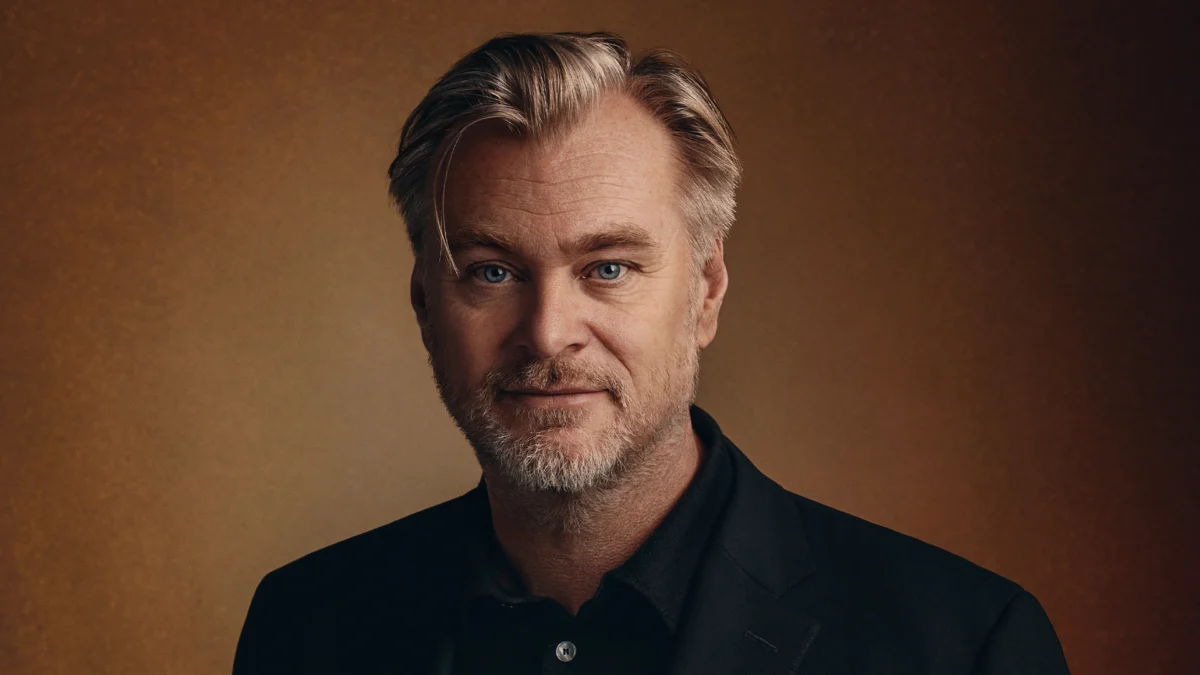
A recent Christopher Nolan China interview has captured global attention, spreading rapidly across social media platforms for its unusually candid and philosophical exploration of art, history, modern film criticism, and the intricate thematic layers within his latest blockbuster, The Odyssey. The British filmmaker, renowned for his intellectually dense narratives, delved into profound subjects typically reserved for academic discourse rather than a promotional press tour, offering an unparalleled glimpse into his creative and philosophical worldview. This deep dive occurred despite The Odyssey recently ceding its top box office position to Spider-Man: Brand New Day, highlighting Nolan’s enduring relevance beyond immediate commercial metrics.
A Candid Conversation Beyond the Usual Press Tour
The wide-ranging discussion took place in Beijing with Chinese podcaster and political philosophy lecturer Zhong Shu, initially appearing on China’s Bilibili video platform before gaining international traction. This particular Christopher Nolan China interview stood in stark contrast to the standard, often superficial, questions posed during his globe-spanning promotional efforts for The Odyssey. Instead of lighthearted anecdotes about production or cast members, Zhong Shu pressed Nolan on his personal philosophy, the underlying worldview informing his cinematic endeavors, and how these elements manifest in his epic adaptation.
The interview’s unexpected depth and Nolan’s unreserved engagement with complex ideas quickly propelled it to viral status. Audiences and critics alike have found themselves captivated by the insights offered by arguably one of the world’s most influential filmmakers operating at the zenith of his career. This rare opportunity to understand the intellectual underpinnings of his work underscores the growing appetite for substantial artistic discourse in a media landscape often dominated by soundbites.
The Odyssey’s Box Office Performance and Nolan’s Enduring Relevance
While The Odyssey has enjoyed considerable success, its recent displacement at the box office by Spider-Man: Brand New Day has not diminished the conversation surrounding Nolan’s artistic contributions. The viral nature of this Christopher Nolan China interview demonstrates that the director’s appeal extends far beyond a film’s immediate commercial performance. His reputation for crafting thought-provoking, high-concept blockbusters ensures that his perspectives on filmmaking, philosophy, and culture remain highly sought after and influential, cementing his status as a significant voice in contemporary cinema.
Exploring the "Bard for a Civilization at Dusk" Metaphor
One of the interview’s most striking moments emerged when Zhong Shu characterized Nolan as a modern-day bard, akin to Homer in Ancient Greece. While Homer’s epic poems often celebrated war and victory, Zhong suggested that Nolan’s adaptation of The Odyssey presented a counter-narrative, reflecting a more introspective and perhaps somber contemporary era. This led to a provocative question: "Are you a bard of a civilization at dusk?"
Nolan embraced the question with a thoughtful laugh, acknowledging its profound implications. He drew parallels between his work and Homer’s, noting the 400-year gap between the events of the Trojan War and Homer’s written account. Nolan posited that Homer, in describing an earlier, more advanced civilization, subtly conveyed a sense of past greatness and subsequent decline. He highlighted historical evidence, such as the "Cyclopian walls" unearthed by later Greeks, which suggested a lost, grander past. This cyclical view of history, Nolan argued, is inherently present in the original poem, albeit subtly.
The filmmaker further connected this sensibility to his previous work, Oppenheimer, which he described as a film "very much about the end of the world, about the end of and collapse of civilization, ultimately." This exploration of civilizational decline, stemming from his experience on Oppenheimer, directly informed his adaptation of The Odyssey, imbuing it with a similar thematic weight. His response painted a picture of a filmmaker deeply engaged with humanity’s historical cycles of ascent and decay.
The Nuance of Atonement and "Christian Themes" in Nolan’s ‘The Odyssey’
The conversation took another intriguing turn when Zhong Shu raised the concept of "atonement" in Nolan’s film, noting its absence in ancient Greek culture, language, and Homer’s original poem. She directly asked if Nolan had "Christianized The Odyssey" and why atonement played such a crucial role in his cinematic interpretation.
Nolan clarified that his philosophical approach wasn’t explicitly conscious but rather stemmed from an intense focus on the ancient Greek concept of "xenia," or "guest-friendship," which he simplified to "Zeus’s Law" for the film. This principle of mutual respect, where one treats others as they wish to be treated – partly out of the belief that a stranger might be a god in disguise – became central to his adaptation. He explained that the violation of xenia by the suitors in Odysseus’s palace serves as the core transgression, leading to the narrative’s central conflict and eventual resolution.
Regarding atonement, Nolan suggested it might be a sensibility that modern viewers "bring as viewers to the story." He questioned whether explicit atonement truly exists in the film or if audiences simply experience catharsis during the long-awaited reunion of Odysseus and Penelope. While acknowledging the potential for a "modern sensibility" to interpret events through this lens, he firmly denied any deliberate attempt to "Christianize" the epic. Instead, he framed it as a "natural conclusion" derived from a deep philosophical inquiry into the consequences of breaking Zeus’s Law, highlighting how ancient concepts can resonate with contemporary moral frameworks.
Christopher Nolan’s Critique of Modern Film Criticism
The discussion pivoted to modern film criticism, particularly in the context of adapting classical narratives for contemporary audiences. Zhong Shu probed whether Nolan’s The Odyssey "apologizes" for a sense of historical greatness to align with modern sensibilities, asking if it functions as "a story of apology that demands repentance, and reflection and self-criticism."
Nolan offered a nuanced response, emphasizing the inherent "conversation with the expectations of the audience" in storytelling. He argued that audience energy significantly contributes to how a story is received. He then critiqued a common flaw in modern, particularly "amateur," film criticism: the belief that identifying a storytelling mechanism invalidates its effectiveness. For example, if a character is intentionally made sympathetic, some critics might dismiss it as manipulative, failing to recognize that this is a fundamental, and often necessary, aspect of engaging an audience.
"The fact that mechanism is identifiable to people doesn’t invalidate it," Nolan asserted. He explained that when crafting a heroic figure, filmmakers must be mindful of audience expectations, including the modern inclination to view people as equals. This often necessitates "apologizing for that greatness," or else the audience might reject the heroic figure. This, he clarified, is part of the "mechanism" of contemporary storytelling, and its identifiability does not diminish its validity or utility.
Later in the Christopher Nolan China interview, he elaborated on his distinction between amateur and professional film criticism. Professional critics, he noted, tend to understand the "necessity for the mechanisms" within storytelling. He described Hollywood’s century-old "lingua franca" of storytelling as a universal language, with its own rules, conventions, and genres that filmmakers can bend or break, but must always be aware of. Amateur critics, however, often misunderstand this, believing that simply identifying a trope or convention somehow renders it ineffective or disingenuous.
Memento as a Case Study in Narrative Innovation
To illustrate his point about balancing convention and innovation, Nolan referenced his early film, Memento. He explained that while the film famously employed a reverse-chronological structure, a highly unconventional narrative device, it simultaneously maintained a "very clear and simple three-act structure" in how it was ultimately received by the audience.
"So the structure of the film as it’s received by the audience is very, very conventional. But the chronology is unconventional," Nolan stated. This deliberate choice allowed him to introduce a radical surface change while providing an underlying familiarity, proving that filmmakers strategically choose which elements to innovate and which to keep conventional to guide the audience effectively. This evolving mechanism, he concluded, is crucial for storytelling to remain fresh yet comprehensible.
Broader Implications: Nolan as a Cinematic Philosopher
The extensive Christopher Nolan China interview offered more than just promotional soundbites; it solidified Nolan’s reputation as a cinematic philosopher. His willingness to engage deeply with questions about historical cycles, moral frameworks, and the art of storytelling positions him not merely as a director but as a cultural commentator. His insights into the Bronze Age collapse, the philosophical underpinnings of The Odyssey, and the evolving nature of criticism underscore his intellectual curiosity and his commitment to using film as a medium for profound inquiry.
This viral discussion highlights the global reach of complex cultural discourse and the demand for artists who can articulate their visions with intellectual rigor. Nolan’s candid remarks will undoubtedly fuel further discussions among audiences, aspiring filmmakers, and academic circles, influencing how his films, and indeed modern blockbusters, are analyzed and appreciated worldwide.
The Christopher Nolan China interview stands as a testament to the filmmaker’s unique position in Hollywood, where artistic ambition and commercial success frequently converge. His frank views on the intricate balance between audience expectations and artistic integrity, coupled with his deep engagement with historical and philosophical themes, reinforce his status as a visionary director who continues to challenge and enrich the cinematic landscape.