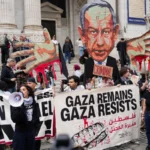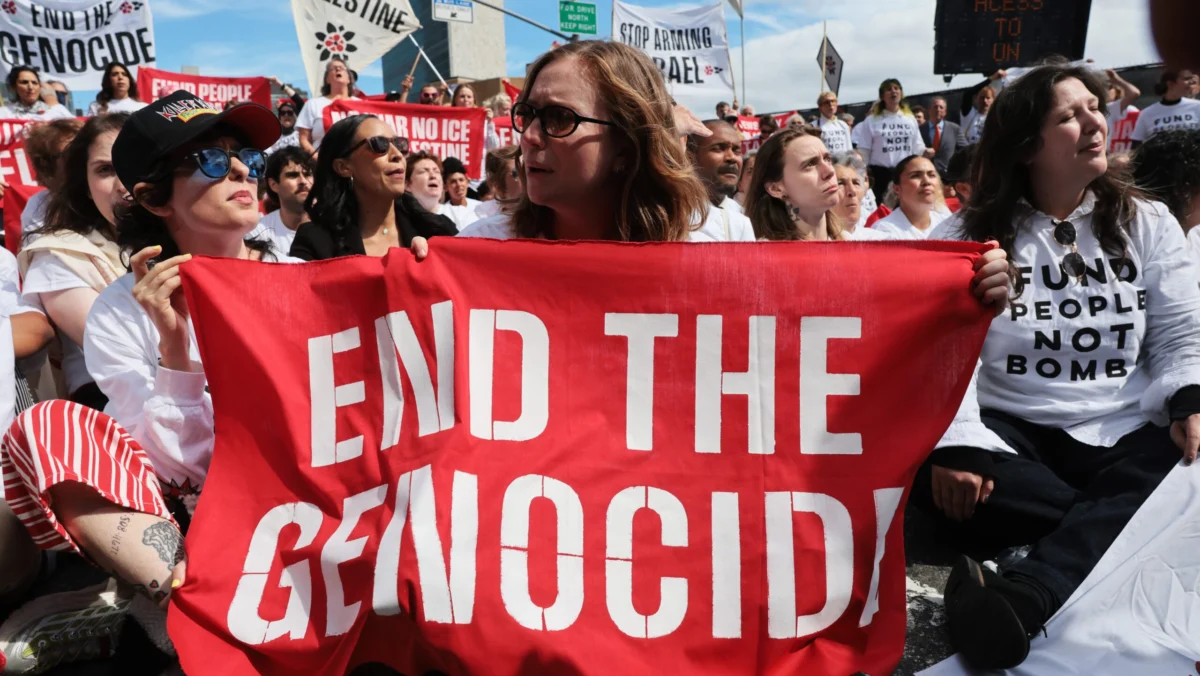
Actress and comedian Hannah Einbinder issued a strong statement following her arrest on Thursday during a protest in New York City, which preceded Israeli Prime Minister Benjamin Netanyahu’s address to the United Nations General Assembly. Einbinder, known for her role in HBO’s Hacks, was among approximately 100 individuals, including fellow actors Susan Sarandon and Caleb Hearon, who were taken into custody while demonstrating against what they described as Israel’s "genocidal war" against the Palestinian people and Southern Lebanon.
Actress Hannah Einbinder Arrested During Anti-Netanyahu Protest
The incident unfolded as protesters gathered to voice their opposition to Netanyahu’s presence in New York and his government’s policies regarding the Israeli-Palestinian conflict. Einbinder utilized her Instagram Story to convey her message, asserting that if the images of her and her peers being arrested drew any attention, it should be directed towards the "devastating genocidal war Israel is waging against people of Palestine and Southern Lebanon." She highlighted a litany of grievances, including "settler attacks, the home demolitions, the bombing of people as they sleep," lamenting what she characterized as daily crimes that receive insufficient international press coverage.
The protest occurred ahead of Netanyahu’s scheduled appearance at the United Nations General Assembly, an annual gathering of world leaders. Such visits often attract both supporters and detractors, with demonstrations serving as a significant platform for various political and social causes. For those opposing Israeli policies, Netanyahu’s visit presented a critical opportunity to amplify their concerns on a global stage.
The Protest: A Stand Against Netanyahu’s UN Address
The demonstration, which included other prominent figures like Cynthia Nixon and Sarah Sherman, reportedly escalated when protesters blocked an intersection. The New York City Police Department (NYPD) confirmed responding to what they termed an "unscheduled demonstration." According to an NYPD spokesperson, warnings were issued by the Community Affairs Bureau, advising participants to disperse. When individuals failed to comply and continued to obstruct the intersection, multiple arrests were made.
The act of civil disobedience, often involving the deliberate violation of specific laws (like blocking traffic) to draw attention to a perceived injustice, is a long-standing tactic in protest movements. Those arrested in such scenarios typically face misdemeanor charges, with outcomes varying from fines to brief detention. The objective is frequently less about avoiding legal repercussions and more about generating media coverage and public discourse around their cause.
Einbinder’s Forceful Statement: Accusations of Genocide
In her comprehensive Instagram statement, Einbinder did not mince words regarding the United States government’s role. She contended that the U.S. "has the power to bring an end to all of this killing, pillaging, and land theft, yet instead it chooses to welcome the butcher of Gaza with open arms." This accusation underscores a deeply divisive aspect of U.S. foreign policy, which has historically maintained strong diplomatic and military ties with Israel. Critics often argue that this support enables Israeli actions in the Palestinian territories, while proponents emphasize Israel’s right to self-defense and its status as a democratic ally.
Einbinder’s statement further expanded its critique to encompass both major American political parties. "The fact that the orchestrator of all this bloodshed is roaming freely in our cities is an indictment of BOTH REPUBLICANS AND DEMOCRATS who enable and protect architects of genocide like netanyahu [sic]," she wrote. This broad condemnation reflects a growing sentiment among some activists that both sides of the American political spectrum are complicit in perpetuating the conflict. She concluded her primary message by urging a focus on the core issue: "Let us not mistake the spectacle for the story: genocide is the headline, and it is time for it to end." In a subsequent post, Einbinder shared a link directing followers to donate to Pal Humanity, an organization supporting humanitarian efforts for Palestinians.
Context: The Israeli-Palestinian Conflict and US Policy
The term "genocide" used by Einbinder and other protesters is a highly charged and debated descriptor for the Israeli-Palestinian conflict. While international legal bodies and many governments have not formally recognized the situation as genocide, the term is frequently employed by critics of Israel’s policies to highlight the severe humanitarian impact on Palestinians, particularly in Gaza and the West Bank. These critics point to ongoing Israeli military operations, blockade of Gaza, expansion of settlements in the West Bank, and displacement of Palestinians as evidence of systematic oppression and collective punishment.
The conflict’s roots trace back over a century, involving competing claims to land, national identity, and self-determination. Recent years have seen periodic escalations of violence, particularly in Gaza, where a protracted blockade has led to dire living conditions for its two million inhabitants. The issue of Israeli settlements in the West Bank, considered illegal under international law by many nations, remains a significant point of contention, contributing to land dispossession and fragmentation of Palestinian territories. The U.S. has historically played a mediating role, often providing substantial aid to Israel while also advocating for a two-state solution. However, its policies have frequently drawn criticism from those who perceive a bias towards Israel.
Previous Activism: Einbinder’s Consistent Stance on Palestine
Einbinder’s recent arrest and statement are not isolated incidents but rather consistent with her established record as a vocal advocate for Palestinian rights. Her public support has been evident on previous high-profile occasions. Notably, at the 2025 Emmys (referencing a future hypothetical award year in the original text, which might be a typo for 2024 or 2023), during her acceptance speech for supporting comedy actress, she concluded with a declarative statement: "I just wanna say, finally, go birds, fuck ICE and free Palestine." This earlier remark garnered significant attention, cementing her position as an outspoken figure on these complex political and humanitarian issues.
Her willingness to use platforms typically reserved for entertainment to deliver pointed political messages distinguishes her among some celebrities. This approach reflects a broader trend in Hollywood and the entertainment industry, where artists increasingly leverage their public profiles to engage with social justice and political causes. Such interventions often ignite debate, with some praising the courage to speak out and others criticizing the perceived politicization of entertainment.
Law Enforcement’s Response and Procedures
The NYPD’s handling of the protest and subsequent arrests underscores the challenges law enforcement faces in balancing public order with freedom of assembly. Protests near critical infrastructure or major events, such as a United Nations General Assembly address, are typically met with heightened security measures. While the right to protest is constitutionally protected in the United States, that right is not absolute and is subject to reasonable restrictions on time, place, and manner. Blocking public thoroughfares, for instance, often crosses a line into unlawful assembly or disorderly conduct, leading to police intervention.
The standard procedure involves issuing warnings to protesters to disperse before making arrests. This process is designed to give individuals an opportunity to comply and avoid legal action. Those who choose to remain, understanding the potential consequences, often do so as a deliberate act of civil disobedience, aiming to elevate the visibility and urgency of their cause. The approximately 100 arrests made indicate a significant police response to the scale and perceived disruption of the demonstration.
Broader Implications and Public Discourse
The involvement of celebrities like Einbinder and Sarandon in such protests invariably amplifies their reach, drawing more media attention than similar demonstrations without high-profile participants. This celebrity engagement can galvanize public support, encourage donations to related causes, and push these often-marginalized narratives into mainstream discourse. However, it also opens them up to criticism, with detractors often accusing them of being ill-informed or using their fame for political grandstanding.
The ongoing debate surrounding the Israeli-Palestinian conflict in the United States is deeply polarized, reflecting diverse religious, political, and ethical viewpoints. Events like the protest outside the UN serve as flashpoints, igniting discussions across social media, news outlets, and political forums. The language used by protesters, particularly terms like "genocide," contributes to the intensity of these discussions, forcing a reckoning with the stark realities and differing interpretations of the conflict’s human cost.
Ongoing Debate and the Role of Celebrity Activism
Celebrity activism, while powerful, also navigates a complex landscape of public expectation and criticism. For some, a celebrity’s voice lends legitimacy and urgency to a cause. For others, it can be seen as detached or performative. Einbinder’s consistent and direct approach, however, suggests a deeply held conviction that transcends mere performative activism. Her willingness to risk arrest and use strong language indicates a profound commitment to the Palestinian cause.
The broader political environment in the U.S. also plays a role. As the Democratic Party grapples with internal divisions over foreign policy, particularly concerning Israel, the voices of progressive celebrities can influence the dialogue and push for shifts in party platforms. The protest, therefore, was not merely an isolated incident but a manifestation of ongoing internal and external pressures on U.S. policymakers regarding the Israeli-Palestinian conflict.
Looking Ahead: The Enduring Impact of Protest
While the immediate outcome of such protests might be a series of arrests and media headlines, their long-term impact lies in their ability to keep critical issues in the public consciousness. By directly confronting political leaders and challenging dominant narratives, activists like Einbinder aim to shift public opinion and ultimately influence policy. The images of celebrities being arrested for a cause resonate differently than those of ordinary citizens, potentially prompting a wider audience to engage with the underlying issues. The call to end the "genocide" and challenge U.S. foreign policy continues to echo in various forms of protest and advocacy, underscoring a persistent demand for change in how the international community addresses the Israeli-Palestinian conflict.