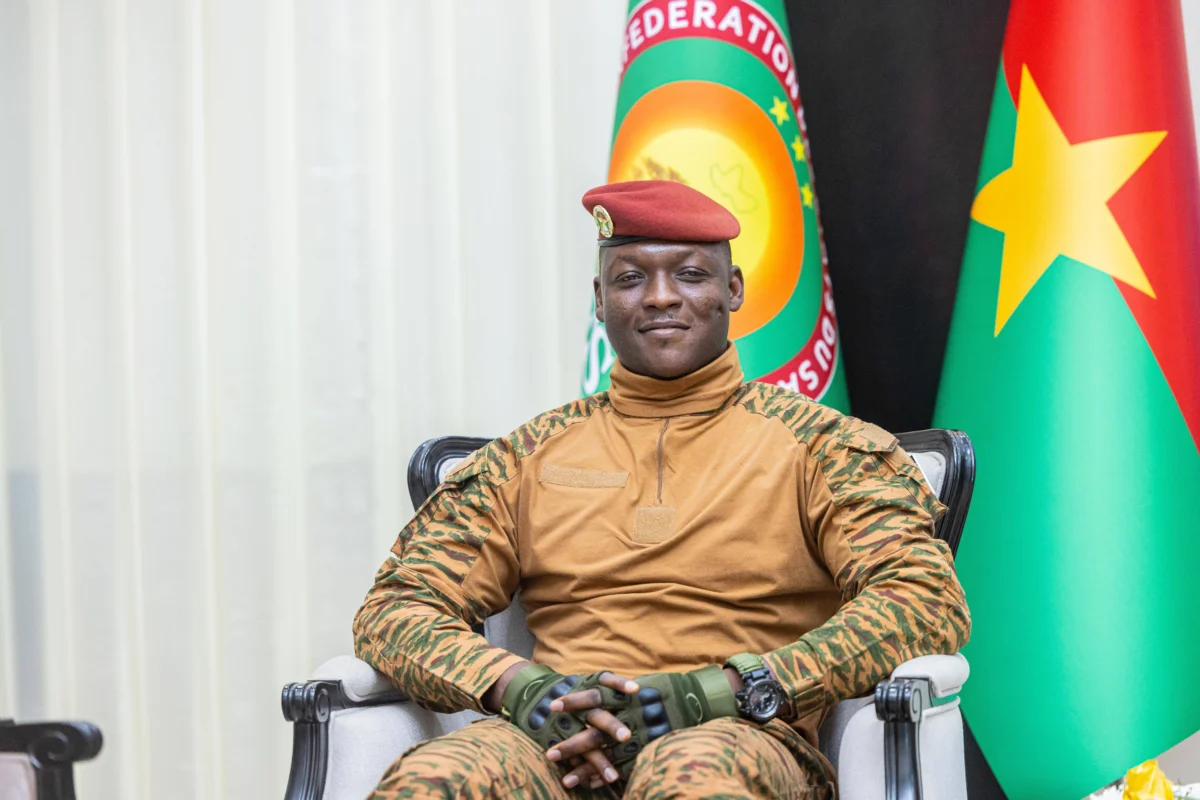
Captain Ibrahim Traore, a 38-year-old army officer who ascended to power in Burkina Faso through a 2022 coup, has rapidly become one of Africa’s most recognizable leaders. He is hailed by his supporters as a potent symbol of national sovereignty and a staunch resistor of foreign influence, a narrative that has resonated across the continent. However, as Traore’s international profile grows, his domestic rule is increasingly defined by a tightening grip on political freedoms, persistent insecurity, and pressing questions about whether his vision of national renewal can translate into tangible, lasting change for the West African nation.
Traore’s ascent to prominence has been swift and dramatic. In September 2022, he led a military takeover, ousting a transitional government that had been in place following an earlier coup. His administration quickly signaled a departure from conventional democratic timelines, with Traore himself publicly urging citizens in April to "forget about democracy" in favor of a revolutionary phase. This declaration followed the extension of the military-led transition and the dissolution of political parties, underscoring a strategic shift away from an immediate return to civilian rule. The stark contrast between Traore’s burgeoning continental image and the complex realities on the ground in Burkina Faso now forms a central paradox of his presidency.
For nearly a decade, Burkina Faso has been at the epicenter of a deepening security crisis in the Sahel region. Al-Qaeda and ISIL-linked armed groups have expanded their reach across vast swathes of the country, overwhelming successive governments and perpetuating a cycle of violence and instability. This precarious security situation has been a defining challenge for any leader in Ouagadougou, and Traore’s promise to restore order has been a cornerstone of his appeal.
The Roots of Ibrahim Traore’s Popularity
Captain Ibrahim Traore’s appeal extends far beyond Burkina Faso’s borders, tapping into a widespread sentiment of frustration across many parts of Africa. This frustration is directed at perceived foreign military interventions, economic dependencies, and political elites seen as detached from the concerns of ordinary citizens. Traore has skillfully leveraged these sentiments, positioning himself as a bulwark against what he terms neo-colonialism and a champion of self-determination.
Since seizing power, Traore has orchestrated a series of symbolic and substantive policy shifts. The expulsion of French troops, a former colonial power with a significant military presence, was a pivotal moment, widely celebrated by his supporters. Simultaneously, his administration has actively pursued closer ties with Russia, seeking new security and economic partnerships. This pivot aligns with a broader trend among military-led governments in the Sahel region, who are increasingly disengaging from traditional Western security alliances.
Traore’s rhetoric frequently invokes the legacy of Thomas Sankara, Burkina Faso’s charismatic revolutionary leader who ruled from 1983 until his assassination in 1987. Sankara remains an enduring symbol of anti-imperialism and self-reliance across Africa, and Traore’s embrace of his ideals has resonated deeply with a population yearning for national pride and a decisive break from past dependencies. His government’s focus on promoting local industry and agriculture, coupled with a strong emphasis on economic self-reliance, further cements this narrative of national renewal.
Security analysts suggest that Traore has effectively decoupled legitimacy from performance, prioritizing sovereignty over immediate efficacy in his security architecture. Measures such as the creation of the "Volunteers for the Defence of the Homeland" (VDP), a civilian auxiliary force, and Burkina Faso’s withdrawal from the Economic Community of West African States (ECOWAS) have found favor with a populace weary of foreign-backed military efforts that have consistently failed to quell the insurgency.
A Burkinabe diplomat, speaking on condition of anonymity, highlighted that Traore’s appeal stems from a desire for a leader perceived as less beholden to external powers. This sentiment is amplified by what some supporters view as Western criticism, which they interpret as evidence that Burkina Faso’s pursuit of an independent path challenges established international relationships.
Shifting the Paradigm: What Has Changed Under Traore’s Government?
Traore’s administration has actively sought to translate its sovereignty message into concrete policy initiatives. A primary focus has been on bolstering local production and asserting state control over strategic economic sectors, thereby reducing reliance on foreign partners. Government officials report increased investment in agriculture, with particular emphasis on staple crops like rice and maize, alongside efforts to stimulate domestic manufacturing and processing industries. Infrastructure development and greater national involvement in key economic sectors are also highlighted as priorities.
These initiatives are presented by supporters as laying the groundwork for enhanced economic independence, ensuring that national resources are channeled towards domestic development rather than external interests. The expansion of the VDP program, designed to support the military in areas where state security is tenuous, is another key initiative aimed at bolstering national defense capabilities.

The Unanswered Question: Has Security Improved?
The ultimate test of Captain Ibrahim Traore’s presidency remains the nation’s security situation. He assumed power with a clear mandate to reverse the decade-long deterioration in security that has plagued Burkina Faso. The relentless spread of armed groups, affiliated with al-Qaeda and ISIL, across the Sahel, exacerbated by instability in neighboring Mali, has created a pervasive sense of insecurity.
Since 2022, the Burkinabe military has intensified its operations, with government officials frequently announcing the recapture of towns and strategic positions. These claims suggest an improvement in security in certain areas and a regaining of territory previously controlled by insurgent groups.
However, the ground reality paints a more complex picture. Experts like Mustapha Bature Sallama, a security analyst based near the Ghana-Burkina Faso border, emphasize that Traore’s leadership will ultimately be judged on tangible security gains. Despite government assertions, Burkina Faso continues to grapple with significant threats from groups like Jama’at Nusrat al-Islam wal-Muslimin (JNIM) and ISIL’s West Africa Province (ISWAP). The humanitarian toll remains immense, with millions requiring assistance and over two million people displaced internally. Independent verification of official security claims is increasingly challenging due to restricted access for journalists and humanitarian organizations.
Intelligence cooperation between Burkina Faso and neighboring Ghana aims to monitor cross-border threats and prevent the spillover of armed group violence. Nevertheless, Burkina Faso remains one of the countries most severely affected by armed group violence, with ongoing attacks across multiple regions and regular civilian casualties. The limited access to many affected areas further complicates assessments of the security situation and humanitarian needs.
The Erosion of Political Freedoms
Beyond the security challenges, Traore’s government has also been characterized by a move towards consolidating power, extending beyond the initial military transition. In January, authorities dissolved political parties and suspended political activities, citing the need to prevent divisions during a period of national crisis. This move, coupled with the earlier extension of the military transition, has effectively deferred any immediate prospects for a return to electoral democracy.
The tightening of state control has also impacted religious affairs. Traore recently announced the commencement of a "battle" against Muslim scholars accused of promoting religious extremism. This declaration followed the adoption of a new Religious Freedoms Law and the arrest of several prominent Sunni clerics. This confrontation is particularly significant as many Muslim leaders had previously been considered part of Traore’s support base. Critics warn that such measures risk undermining religious independence and freedom of expression, while authorities maintain that these extraordinary steps are necessary in the face of a national security emergency.
Human rights organizations have also voiced concerns regarding restrictions imposed on political parties, journalists, and civil society organizations, highlighting a growing trend of curtailed freedoms under the current administration.
The Verdict: Symbolism vs. Substance
Captain Ibrahim Traore’s rise has been fueled by a powerful and resonant message: that Burkina Faso must assert greater control over its security, resources, and political destiny. For a significant segment of the population, he embodies a new generation of African leaders willing to challenge the legacy of former colonial powers, reject established Western security frameworks, and demand genuine control over national assets. In a region increasingly marked by frustration with foreign intervention, this message has found fertile ground.
However, the potent symbolism of Traore’s leadership has created a formidable challenge: the imperative to translate symbolic victories into tangible improvements in the lives of Burkinabe citizens. If the metric of success is measured by sovereignty, compelling political messaging, and the ability to inspire a loyal following, Traore has undeniably achieved remarkable influence in a compressed timeframe, cementing his status as one of Africa’s most recognizable political figures.
Conversely, if the assessment focuses on concrete improvements in security, humanitarian conditions, and political freedoms within Burkina Faso, the picture becomes considerably more complex. Armed violence persists, displacement remains a widespread crisis, and fundamental questions linger about the capacity of military rule to deliver lasting stability. Traore has proven exceptionally adept at transforming the concept of sovereignty into a powerful political narrative. The critical question now is whether this narrative can deliver the security and justice that a significant portion of the Burkinabe population urgently seeks.
A youth leader in Ouagadougou, speaking anonymously due to safety concerns, articulated this sentiment: "We are proud to see a leader who stands up to the West and wears our traditional clothes. That pride is real. But pride doesn’t feed a family, and it doesn’t protect a village. We want Captain Traore to be a symbol of strength, but we also need him to be a symbol of safety and justice here at home."