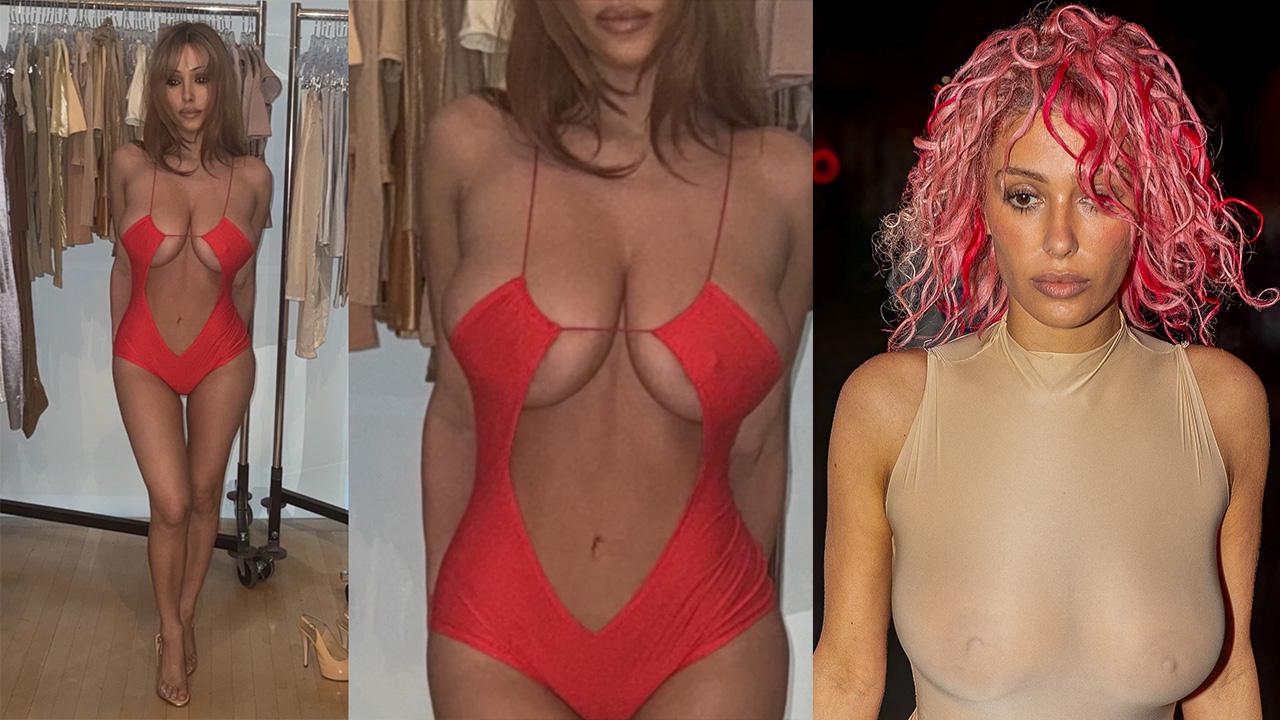
Bianca Censori, the wife of multifaceted artist Kanye West, recently captured widespread attention following the release of a series of provocative social media images depicting a notable wardrobe malfunction, which she artfully concealed with an emoji. The photos, shared across various platforms, showcased Censori in a minimalist red bodysuit, prompting renewed discussion about her distinctive fashion choices and her public persona. These images surfaced amidst ongoing scrutiny of Censori’s often daring attire, a topic she has addressed directly in recent interviews, asserting her autonomy and artistic intent behind her controversial sartorial selections.
The Genesis of Bianca Censori’s Public Persona
Bianca Censori first garnered significant public interest following her private marriage to Kanye West in December 2022, shortly after his divorce from Kim Kardashian. An Australian architect and designer, Censori was previously known for her work with West’s Yeezy brand, holding a background that suggested a creative sensibility. Her emergence into the spotlight as West’s wife quickly shifted public discourse from her professional background to her increasingly unconventional and revealing fashion. This transition marked the beginning of a period characterized by a stream of viral outfits that consistently pushed boundaries, establishing Censori as a figure synonymous with avant-garde and often scandalous public appearances.

West, a figure long recognized for his profound impact on fashion, music, and culture, has a history of influencing the style of those around him, particularly his romantic partners. His collaborations with past muses often resulted in dramatic transformations in their public image, aligning them with his evolving artistic vision. In Censori, observers noted a continuation of this pattern, with her personal style appearing to merge with West’s experimental aesthetic. This partnership has fueled speculation and fascination, positioning Censori as a canvas for a collaborative artistic expression that challenges conventional norms of celebrity dressing.
Bianca Censori’s Latest Bold Fashion Statement
The recent images that sparked renewed conversation depict Bianca Censori in what appeared to be a dressing room setting, showcasing a form-fitting, barely-there red bodysuit. The daring garment, characterized by its minimal coverage, highlighted Censori’s figure, leading to an undeniable "nip slip" that was subsequently obscured by a strategically placed red star emoji in one of the close-up shots. She completed the look with simple heels and eschewed any additional accessories, maintaining a focus on the garment itself.
In the sultry photographs, Censori opted for a striking beauty aesthetic, featuring a smoky eye and a natural lip, with her hair styled loosely down. Her gaze was directed away from the camera in several of the snapshots, contributing to an artistic, somewhat detached mood. The photos were originally posted on the Instagram account of CATTURA, a creative production studio, before being reposted by Censori, amplifying their reach and the subsequent public reaction. This method of dissemination highlights the calculated nature of such celebrity disclosures, often involving collaborations with creative entities to craft a specific public image.

Wardrobe Malfunction and Social Media Response: Bianca Censori
The images, particularly the one featuring the digital cover-up of the wardrobe malfunction, quickly became a focal point for online discussion. The accompanying caption, attributed to Censori, read: "sorry for being too much, hope you find less." This cryptic message was widely interpreted as a direct, albeit veiled, response to the ongoing criticism and public commentary surrounding her controversial fashion choices. It suggested a defiant stance, framing her attire not as an accident or a misstep, but as an intentional expression that some might find overwhelming or "too much."
The phrase ignited further debate, with some commending her unapologetic attitude towards self-expression, while others viewed it as an provocative retort to legitimate concerns about modesty or public decorum. The use of an emoji to censor the "nip slip" itself became a subject of analysis, seen by some as a playful nod to social media guidelines and by others as a further act of artistic commentary, drawing attention to the very act of censorship in the digital age. This layered interaction with her audience through imagery and text is characteristic of how modern celebrities navigate and control their narratives.
Bianca Censori Addresses Public Scrutiny

For months following her public debut with Kanye West, Bianca Censori remained largely silent regarding the intense scrutiny her fashion garnered. Her silence, coupled with the escalating extremity of her outfits, only amplified public curiosity and speculation. However, in a candid interview with Vanity Fair in February, Censori finally broke her silence, offering a window into her perspective on her often-criticized attire. This interview served as a pivotal moment, shifting her public discourse from passive display to active articulation of her choices.
During the interview, Censori articulated her philosophy, stating, "I was naked everywhere. I didn’t detach with it at any point. I consistently showed the same imagery over and over and over again. I live my artwork." This statement reframes her fashion as a form of performance art, an extension of her creative identity rather than merely provocative dressing. She dismissed the weight of public opinion, asserting, "I don’t really care. I always just think, ‘They’ll get it someday.’ And if they don’t, they don’t." This unwavering stance suggests a deep-seated conviction in her artistic expression, irrespective of external validation or criticism.
The Collaborative Vision: Bianca Censori and Kanye West
A significant aspect of Bianca Censori’s Vanity Fair interview was her clarification regarding the collaborative nature of her fashion choices with Kanye West. Addressing widespread speculation that she was merely a puppet for West’s artistic whims, Censori firmly stated, "I wouldn’t be doing something I didn’t want to do," emphasizing her personal agency in the styling process. This assertion directly countered narratives suggesting a lack of autonomy in her highly scrutinized public appearances.

She further elaborated on their creative partnership, revealing, "Me and my husband would work on my outfits together. So it was like a collaboration, it was never ‘I was being told to do something…’" This insight positions their approach to fashion as a joint artistic endeavor, akin to a designer dressing a muse. Censori drew an analogy, asking, "If you were married to Gianni Versace, wouldn’t he give you a dress or something?" This comparison underscores her view of West not just as a husband, but as a creative force with whom she shares a symbiotic relationship, particularly in the realm of design and aesthetics.
Censori also took the opportunity to address the underlying motivations behind her marriage to West. Dispelling notions that she sought fame or a "platform" through their union, she declared, "I didn’t marry my husband because I wanted some sort of platform. I married him because I love him. Is that like the corniest thing ever?" This personal revelation aimed to anchor her relationship in genuine affection rather than transactional benefits, offering a more intimate perspective amidst the spectacle of their public life. The couple reportedly tied the knot in December 2022, marking a new chapter in both their personal and public narratives.
Broader Implications and Cultural Impact
The ongoing saga surrounding Bianca Censori’s fashion choices and her recent social media post transcends mere celebrity gossip; it taps into broader cultural discussions about artistic freedom, personal autonomy, and the objectification of women in the public eye. Her willingness to push boundaries, often resulting in "scandalous photos," challenges traditional perceptions of celebrity modesty and decorum. This deliberate defiance forces a re-evaluation of what is considered acceptable or transgressive in an era dominated by instantaneous digital sharing and constant public judgment.
Censori’s narrative, intertwined with Kanye West’s influence, highlights the complex dynamics within celebrity relationships where personal identity can become a subject of public consumption and artistic collaboration. Her insistence on viewing her attire as "artwork" positions her within a lineage of performance artists who use their bodies and clothing to provoke thought and reaction. Whether the public fully embraces this interpretation or continues to critique her choices, Censori’s presence ensures a sustained dialogue on fashion as a form of expression, the boundaries of taste, and the evolving landscape of celebrity image management.
The constant stream of commentary, both positive and negative, surrounding Bianca Censori underscores the powerful role of social media in shaping and amplifying public discourse. Each new outfit or post acts as a catalyst for renewed debate, reflecting diverse societal views on female empowerment, artistic license, and the responsibilities of public figures. As Censori and West continue to navigate their highly visible partnership, their collaborative approach to fashion will likely remain a significant cultural touchstone, prompting ongoing discussion about identity, art, and celebrity in the 21st century.