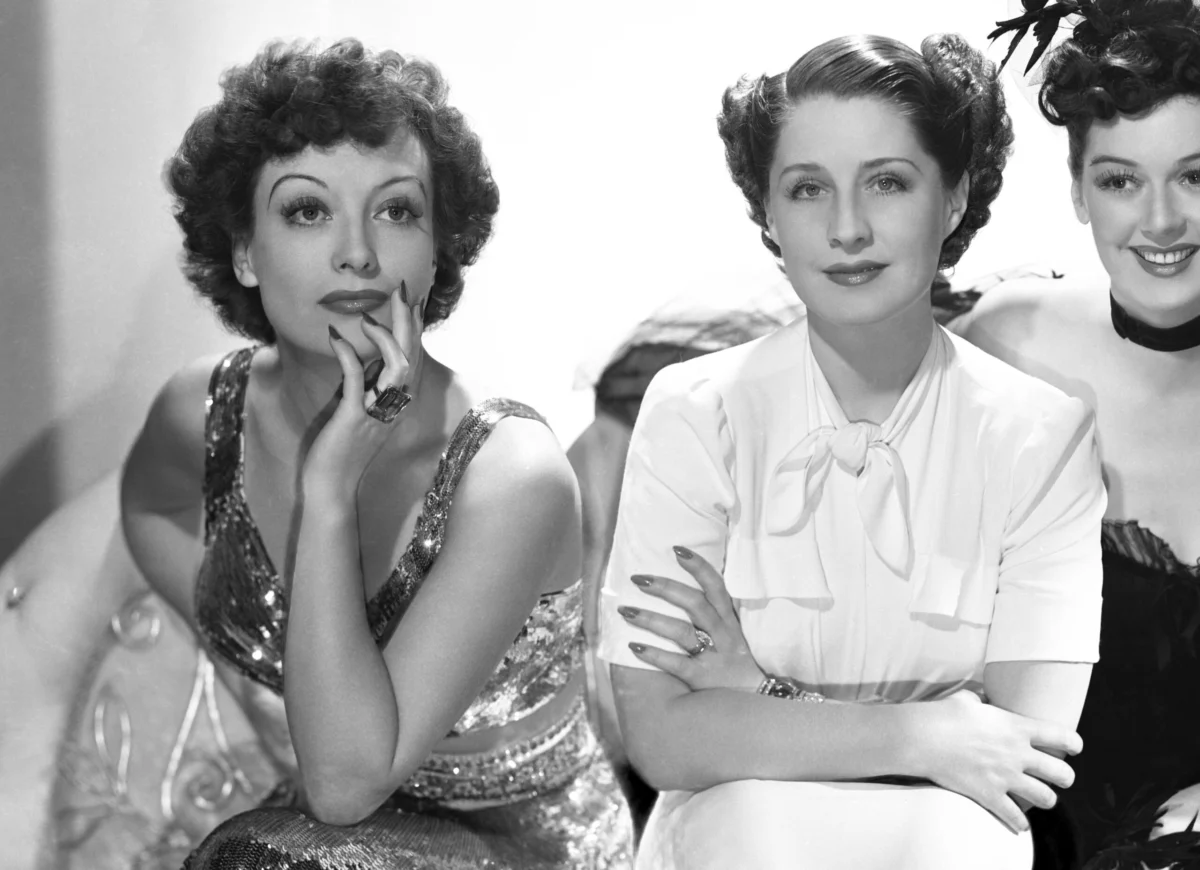
A new book by Illeana Douglas, Jungle Red! The Making of MGM’s The Women, published September 15 by Lyons Press, argues that the most intense and enduring rivalry in Hollywood history was not between Joan Crawford and Bette Davis, nor between sisters Olivia de Havilland and Joan Fontaine, but rather the deeply personal and professional Joan Crawford and Norma Shearer’s feud. The book, which delves into the behind-the-scenes drama of MGM’s 1939 all-female classic, provides an exclusive excerpt highlighting the profound animosity that defined the collaboration between these two legendary actresses, an enmity that profoundly shaped the film’s production and cultural impact.
The Genesis of a Legendary Rivalry
Illeana Douglas’s Jungle Red! positions the 1939 film The Women as a groundbreaking cinematic achievement, not only for its all-star female cast — including Rosalind Russell, Paulette Goddard, and Joan Fontaine alongside Crawford and Shearer — but also as a template for modern female-driven narratives. However, at its core, the production became a battleground for two of Hollywood’s most formidable stars. The book makes a compelling case that the Joan Crawford and Norma Shearer’s feud was more than mere publicity; it was a deeply ingrained antagonism fueled by years of professional jealousy, social disparity, and a fierce struggle for dominance within the rigid studio system of Metro-Goldwyn-Mayer.
The roots of their conflict stretched back to the mid-1920s when Crawford, then still an ambitious newcomer, served as Shearer’s body double in Lady of the Night (1925). Shearer, already a rising star, solidified her position as "the First Lady of MGM" through her marriage to studio production head Irving Thalberg. This union granted her unparalleled influence, allowing her to secure the most coveted roles and artistic control. Crawford, who achieved breakout stardom with Our Dancing Daughters (1928), resented Shearer’s privileged status, viewing her as an "ambitious upstart" who gained roles through marital connections rather than raw talent. Shearer, in turn, dismissed Crawford as "common" and "crude," highlighting their differing social backgrounds—Shearer from a more genteel upbringing, Crawford from poverty and burlesque.
A Battle for Roles and Recognition
Crawford’s frustration mounted as she was relegated to a string of dancing films and musicals, such as Hollywood Revue of 1929 and Untamed (1929), while Shearer consistently received critical acclaim and prestigious projects. Crawford directly confronted Thalberg, questioning why all the "good roles" were reserved for his wife. Her defiance resulted in punishment, leading to a low-grade musical Western, Montana Moon (1930). This era solidified Crawford’s belief that her career was being actively suppressed to elevate Shearer.
The professional tension escalated significantly in 1938. Branded "box office poison" alongside other major stars, Crawford desperately needed a hit. She vigorously pursued the lead role in Idiot’s Delight, a part she believed was tailor-made for her as a former showgirl masquerading as a Russian countess opposite Clark Gable, with whom she had a rumored on-again, off-again romance. However, Thalberg’s widow, Norma Shearer, intervened, securing the role for herself. This perceived slight became one of the biggest grudges Crawford carried into The Women, stating, "I cried buckets over Idiot’s Delight." Crawford also envied Shearer’s five Oscar nominations, including a win for The Divorcee (1930) and a recent nod for Marie Antoinette, while Crawford, despite acclaimed performances in films like Paid (1930) and Grand Hotel (1932), had never been nominated.
Casting The Women: A Calculated Move
When The Women went into production, Norma Shearer was initially attached to play the leading role of Mary Haines. She had seen the Broadway play in 1936 and considered it an inevitable vehicle. However, after Thalberg’s death, Shearer was in the process of reinventing her public image as a grieving widow, and a comedy about "bitter, funny wives complaining about men" did not align with this carefully crafted persona. Despite her reservations, studio pressure and her late husband’s teachings about prioritizing "what is good for the picture as a whole" eventually swayed her.

Meanwhile, the film was evolving from a "Norma Shearer vehicle" into "George Cukor’s The Women," with a vast talent pool being considered for its 135 roles. Initially, Crawford was reportedly turned down for the role of Crystal Allen, the opportunistic gold-digger who steals Mary Haines’ husband. Eighteen-year-old Lana Turner was announced for the part. However, Crawford was determined not to let The Women slip through her fingers. She viewed the role of Crystal as an opportunity to secure a much-needed hit and challenge Shearer directly, especially without Thalberg’s protective shadow. She famously told Louis B. Mayer, "The woman who steals Norma Shearer’s husband can’t be a nobody." Crawford even took the unprecedented step for an actress of her stature of testing for the role, ultimately winning over director Cukor and convincing producer Hunt Stromberg of her necessity for the picture. The studio, recognizing the immense publicity potential of a genuine on-screen rivalry, saw the value in fueling the Joan Crawford and Norma Shearer’s feud.
On-Set Antics and Public Spectacle
The moment Crawford was cast, MGM’s publicity machine capitalized on the pre-existing animosity. Before filming even began in March 1939, a Look magazine cover promoted The Women with a stark image of Shearer and Crawford glaring at each other under the headline, "They Don’t Like Each Other… Inside Stories of 31 Hollywood Feuds." Director George Cukor, despite his optimism that the seasoned actresses were "too smart for those antics," soon found himself managing a constant battle of wills.
From the first day of shooting on April 25, 1939, the set became a hotbed of petty grievances and calculated provocations. The feud manifested in various ways, from disputes over billing and dresses to trailers and even Crawford’s knitting needles. Screenwriter Anita Loos observed that while Shearer and Crawford "could never have been personal friends," they both understood the "feud was good copy, and so they helped it along." Stories of their squabbles were regularly reported by gossip columnists like Hedda Hopper, who was also cast in the film, suggesting that "someone was spilling the tea."
One notable incident involved their dressing rooms. Shearer, as the top-billed star, had been assigned the largest, air-conditioned trailer, decorated in her preferred coral, pink, and cream. Upon her arrival, she discovered Crawford’s trailer (dressing room three) was positioned one foot further out than the others, giving it a subtle advantage. Shearer immediately demanded it be moved back in line. Crawford’s arrival on set was equally theatrical, complete with her maid, uniformed chauffeur, record player, opera records, and her beloved dachshund, Pupchen, whose presence was stipulated in her contract. Crawford’s loud opera music during Shearer’s rehearsals and their limousine-arrival competition further underscored the on-set tension. Hairstylist Sydney Guilaroff recalled Cukor’s greatest challenge was not directing, but constantly separating the two, sending one to a fitting while the other rehearsed.
The Climax and Enduring Echoes
The tension reached its peak during the filming of their sole face-to-face scene, a confrontational exchange in Crystal Allen’s dressing room. Crawford, seizing an opportunity to settle years of perceived slights, allegedly called in sick, delaying production and leading to a sensationalized report in the Los Angeles Daily News about her suffering from "intestinal flu and arsenic poisoning." Despite the dramatic reports, Crawford made a "remarkable recovery" to film the scene, delivering a performance that many believed was fueled by genuine resentment. Bystanders recalled the scene as a moment where Crawford, free from Thalberg’s protection, could finally "get even."
The animosity continued off-screen and into the film’s release. Crawford notably skipped Shearer’s wrap party, telling Hedda Hopper, "So many people say Norma and I don’t like each other. Who are we to disagree with the majority opinion?" Shearer, in turn, refused to attend the premiere and penned an open letter to the trades, downplaying her role and subtly casting shade on Crawford. Crawford’s retort was sharp: she praised Rosalind Russell for "walking away with the film" and remarked that Shearer "as usual, played the perpetual virgin, the wronged wife." With a biting compliment, Crawford added, "I love playing bitches, and Norma helped me tremendously with this part."
The Women became a resounding success, a testament to the power of its all-female ensemble and the compelling drama both on and off screen. The opening credits, which cheekily depicted each actress as an animal, featured Crawford as a leopard and Shearer as a young deer. Illeana Douglas’s book argues that a more fitting representation for Shearer, a tenacious survivor in the "jungles of Hollywood" who amassed six Oscar nominations and became "the first lady of MGM," would have been a lioness. The film’s enduring legacy is intrinsically linked to the legendary Joan Crawford and Norma Shearer’s feud, an antagonism that transcended mere publicity to become a defining chapter in Hollywood’s Golden Age. Douglas’s work offers a fresh perspective, illuminating the depth of this rivalry and its profound impact on one of cinema’s most iconic productions.