Paramount Global, through its Paramount Television Studios and CBS Studios divisions, has secured over $37.3 million in California tax credits for two major productions, Ascent and a Clueless sequel series, a significant award that underscores the state’s commitment to retaining film and television production despite an ongoing legal dispute between the studio and California’s Attorney General over a proposed $111 billion acquisition of Warner Bros. Discovery. This substantial allocation positions Paramount among the leading recipients in the latest round of incentives granted by the California Film Commission, reinforcing its investment in local production infrastructure and talent even as it navigates a high-stakes corporate challenge within the state.
California’s Bid to Retain Hollywood Production
California’s Film & Television Tax Credit Program, specifically its expanded iteration, serves as a crucial economic engine designed to counteract the exodus of productions to states offering more aggressive financial incentives. The program aims to ensure that the entertainment industry, historically synonymous with the Golden State, continues to generate substantial economic activity, create jobs, and foster a robust creative ecosystem within its borders. Governor Gavin Newsom has been a vocal proponent of these initiatives, emphasizing their role in shining a spotlight on local talent, generating fair wages, and driving billions in economic impact. This latest round of tax credit allocations is seen as a testament to the program’s effectiveness in solidifying California’s competitive edge in the global entertainment landscape.
The state’s proactive stance comes at a critical juncture for the entertainment industry, where production levels in Los Angeles have seen fluctuations, at times nearing historic lows. The competition among states to host Hollywood productions is fierce, with jurisdictions like Tennessee actively courting major studios with promises of more fiscally conservative environments, lower taxes, and predictable governance. Deputy Governor Stuart McWhorter of Tennessee, in a direct appeal to Paramount CEO David Ellison, highlighted his state’s commitment to being a partner in private-sector growth, underscoring the aggressive "tit-for-tat battle" for studio investment. Such overtures present a constant challenge for California, which relies on these tax credits to ensure that studios like Paramount continue to anchor their multi-billion dollar spending within the state rather than reallocating it to competing regions.
Paramount’s Strategic Investment Amidst Legal Tussle
The announcement of these significant California tax credits arrives while Paramount is engaged in a contentious legal battle with California prosecutors regarding its ambitious bid to acquire Warner Bros. Discovery. The state’s Attorney General has expressed concerns over the proposed merger, primarily focusing on potential antitrust implications and market consolidation within the media landscape. This dual narrative — California’ simultaneously offering substantial financial incentives for production while also scrutinizing Paramount’s expansion through regulatory channels — highlights the complex relationship between government oversight and economic development.
Despite the legal friction, Paramount’s continued investment in California-based productions demonstrates a strategic commitment to the state. David Stapf, President of CBS Studios, affirmed this dedication, stating that Southern California has "long been home" to the Paramount-owned company. He expressed pride in the ongoing investment in the local creative community and production talent, specifically acknowledging the California Film Commission for making it possible to produce returning seasons of shows like Matlock and NCIS: Origins, and now the highly anticipated Clueless sequel, in Los Angeles. This commitment is vital, given that a reallocation of Paramount’s estimated $30 billion in spending could deliver a significant blow to the state’s economy and its entertainment workforce.
The Latest Round of California Tax Credits
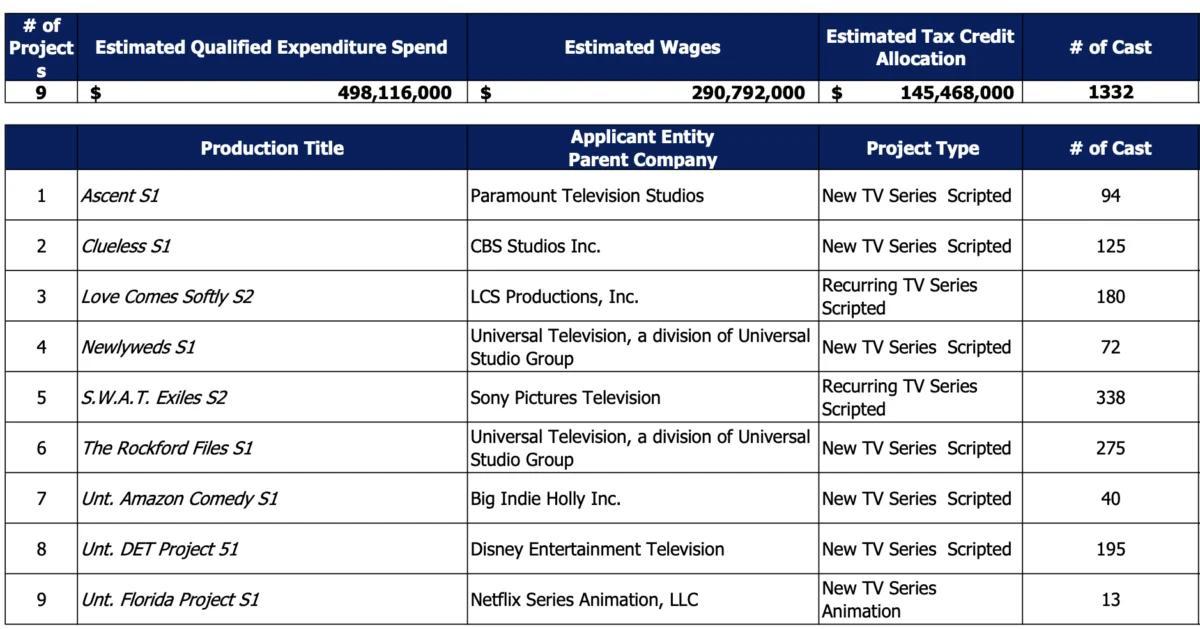
In the most recent allotment of California tax credits, Paramount Television Studios and CBS Studios secured $37.3 million for two high-profile projects. The first is Ascent, a thriller slated to star Viola Davis, and the second is a sequel series to the beloved 1995 cult classic film Clueless. These projects represent a substantial investment in California’s production sector, promising hundreds of jobs and millions in local spending.
While Paramount was a major beneficiary, Disney led this particular round, securing approximately $45 million for a massive, as-yet-untitled detective series. Combined, this latest wave of incentives distributed $145.5 million across nine shows, which are projected to spend over $498 million within the state across more than 1,032 shoot days. Seven of these productions are entirely new series, a welcome boost for a production landscape that has seen a reduction in new series filming in the region in recent times.

Other notable recipients of these California tax credits include:
- Universal Television: Awarded $26.8 million for two projects, The Rockford Files ($21 million) and Newlyweds ($5.8 million).
- Sony Pictures: Received $16.2 million for the second season of S.W.A.T. Exiles.
- Amazon: Secured $11.6 million for an untitled production.
- Netflix: Awarded $1.2 million for an untitled project.
The diversity of studios and projects underscores the broad impact of the tax credit program across the industry, from established networks to major streaming platforms.
Economic and Industry Impact
The economic ramifications of these California tax credits are far-reaching. The total spend of nearly half a billion dollars from this single round of projects alone translates directly into job creation for thousands of crew members, actors, and support staff, many of whom are unionized and based in Los Angeles. This influx of production also stimulates local businesses, including catering services, equipment rental companies, transportation providers, and hospitality sectors, all of which benefit from the increased activity.
Jamie Lee Curtis, executive producer of Newlyweds, highlighted this direct benefit, expressing her appreciation for the California tax credit. As a born-and-raised Los Angelina who started her career at Universal in 1977, Curtis emphasized how the incentive allows her production to continue hiring and employing hundreds of highly skilled, LA-based union crew members, thereby helping to keep productions rooted in the state. This sentiment resonates across the industry, affirming the program’s crucial role in sustaining the local workforce and preventing a further brain drain of talent to other production hubs.
The Film Commission reports that since its newest iteration, the film and TV tax credit program has tapped 170 productions, collectively spending upward of $6.6 billion. The sheer volume of applications has surged by an impressive 82 percent compared to the previous year, indicating strong demand and confidence in California’s incentives. This success is tangible: FilmLA reported an over 34 percent increase in TV shoot days in Los Angeles during the three-month period from April to June, a direct positive outcome attributed to the expanded tax credit program.
Broader Implications and Future Outlook
The strategic awarding of these California tax credits to major players like Paramount, Disney, and Universal serves a dual purpose: it directly injects capital into the state’s economy and sends a clear message about California’s unwavering commitment to its status as the global epicenter of entertainment production. This commitment persists even as the state’s regulatory bodies simultaneously engage with these same studios on matters of market competition and corporate acquisitions. The ongoing legal battle with Paramount over the Warner Bros. Discovery deal, while distinct from the tax credit program, highlights the complex and sometimes contradictory nature of state governance in a dynamic economic sector.
The state government’s ability to balance robust economic incentives with vigilant regulatory oversight will continue to shape the future landscape of Hollywood. By providing significant financial motivation for studios to film within its borders, California aims to protect its long-standing infrastructure, skilled workforce, and cultural legacy in the entertainment industry. The continued success of the expanded Film & Television Tax Credit Program suggests that, despite competitive pressures from other states and internal regulatory challenges, California remains a formidable force in retaining and attracting high-value film and television production. The substantial investment by Paramount and other major studios underscores a collective belief in the enduring value of producing content in the Golden State, reinforcing its unparalleled position in the global entertainment market.