Defense attorneys for James “Fergie” Chambers have submitted a final legal brief to the Spanish government, marking a critical turning point in a case that has sparked a diplomatic and political firestorm. Chambers, a 41-year-old U.S. citizen and prominent benefactor of various global humanitarian projects, remains in a Madrid prison as the Spanish Council of Ministers prepares to weigh an extradition request from the United States. The case has evolved into a significant test of Spanish sovereignty and the legal definitions of political protest versus criminal activity.
The legal team representing Chambers argues that the U.S. government’s request is politically motivated and lacks the specific evidentiary foundations required under international law. In a recently filed brief, attorneys asserted that the Trump administration has failed to identify individual acts of violence or property damage that can be personally attributed to Chambers. Instead, the defense maintains that the U.S. Department of Justice is attempting to criminalize financial contributions and activities fundamentally linked to protected political expression.
At the heart of the legal dispute is the principle of dual criminality, which requires that the alleged offense be a crime in both the requesting and the receiving country. Chambers’ attorneys point out that the U.S. charge of “conspiracy to commit riot” has no direct equivalent in the Spanish penal code. Under Spanish law, such a discrepancy can be grounds for the summary denial of an extradition request, as the government cannot legally extradite an individual for conduct that is not considered a crime within its own borders.
Escalating Pressure to Deny US Extradition Request for Leftwing Donor
The political stakes of the case have intensified as the Spanish Council of Ministers approaches a decisive meeting scheduled for September 22. This 22-member body, led by Prime Minister Pedro Sánchez, holds the administrative power to halt the extradition process before it ever reaches the judicial stage. The council is currently reviewing supplemental materials provided by the U.S. government on August 26, which seek to justify the detention and transfer of the American activist.
Chambers’ partner, actor and activist Stella Schnabel, has taken a central role in the public campaign to secure his release. Last week, Schnabel held high-level meetings with several members of the Spanish parliament, urging them to intervene. She has also authored a direct appeal to Prime Minister Sánchez, describing the denial of the extradition as the “only morally acceptable decision” for a government that prides itself on human rights advocacy.
The case represents a historic milestone in transatlantic legal relations. It is the first documented instance of the United States seeking the extradition of one of its own citizens based on allegations of providing support to Hamas. While the U.S. government’s case centers on a $7.5 million wire transfer from a U.S. bank to Tunisia several years ago, the specific details of the indictment remain under seal, further complicating the defense’s ability to respond to the allegations.
Legal Challenges to the Extradition Request for Leftwing Donor
The defense team, which includes the renowned human rights lawyer Baltasar Garzón, argues that the financial transactions in question were entirely transparent and intended for humanitarian purposes. Garzón, who gained international fame for his pursuit of former Chilean dictator Augusto Pinochet, has been vocal about the dangerous precedent this case could set. He argues that if Spain complies with the request, it would essentially allow a foreign power to criminalize the act of providing aid to the Palestinian people.
“That’s what Fergie has financed: humanitarian aid and support for people in a situation of great need,” Garzón said in a statement. He emphasized that under Spanish and European legal standards, providing food, medical supplies, and basic infrastructure to a besieged population does not constitute terrorism. The defense also contends that the charge of “international money laundering” is logically flawed, given that Chambers’ wealth is the result of a legal settlement with his family, the owners of the multi-billion-dollar media conglomerate Cox Enterprises.
In mid-2023, Chambers reached a settlement with his family in which he sold back his shares in the Atlanta-based company for approximately $250 million. This legal acquisition of wealth, the defense argues, precludes the possibility of money laundering, which typically involves the concealment of the origins of illegally obtained funds. Since receiving the settlement, Chambers has reportedly funded nearly 100 projects in 20 countries, including the Sameer Project, an initiative providing vital aid within the Gaza Strip.

Political Fractures Within the Spanish Coalition
The extradition request has created significant friction within Spain’s ruling coalition. The government of Prime Minister Sánchez relies on the support of progressive movements such as Sumar and Podemos, both of which have come out strongly in defense of Chambers. These parties view the U.S. request as an overreach of imperial power and an attempt to silence a vocal critic of U.S. and Israeli foreign policy.
Ione Belarra, the leader of Podemos, recently opened her party’s quarterly meeting with a staunch defense of the American donor. Belarra told supporters that Chambers is “on the right side of history” for his financial commitments to Palestinians in Gaza. Similarly, the Sumar coalition filed an official statement in the Spanish Congress, urging the executive branch to reject the petition. They argued that the true goal of the U.S. government is to punish Chambers for his political opinions and his participation in international movements for justice.
Irene Montero, a member of the European Parliament and a leading figure in Podemos, echoed these sentiments. She told reporters that Spain must assert its independence from the United States and refuse to become a “subject” of American judicial whims. Montero noted that the actions Chambers is accused of do not align with Spanish legal definitions of criminal conduct, making the extradition a violation of domestic legal principles.
Humanitarian Aid Versus Allegations of Terrorism
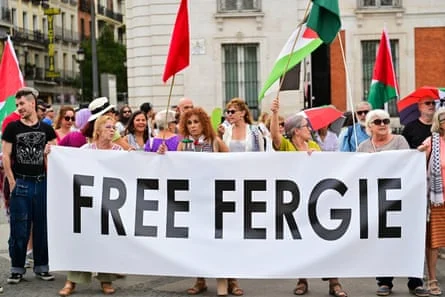
The U.S. government’s focus on the $7.5 million transfer to Tunisia has been met with specific counter-explanations from Chambers’ associates. Stella Schnabel clarified that the funds were largely directed toward Club Africain, a popular Tunisian football club known for its political activism and pro-Palestinian stance. Supporters of the club have since organized “Free Fergie” demonstrations, asserting a “synchronicity” between Chambers’ philanthropic goals and the club’s community-focused mission.
Beyond the sports world, the case has galvanized a broad spectrum of civil society. A petition delivered to the Spanish government features signatures from high-profile figures including actor Richard Gere, climate activist Greta Thunberg, and civil rights icon Angela Davis. These advocates argue that the prosecution of Chambers is part of a broader trend of using anti-terrorism legislation to target activists who support Palestinian rights.
The controversy is further fueled by Chambers’ own public history of radical dissent. A self-described anti-imperialist, he has been a vocal critic of the U.S. government, once stating in an interview that he believed the destruction of the U.S. was necessary for the prosperity of humanity. He also drew criticism for social media posts following the October 7 attacks, in which he defended the actions of Palestinian resistance factions. While these statements are controversial, his legal team argues they are protected speech and should not be used as a pretext for criminal extradition.
The Impact of International Advocacy and Public Protests
Public demonstrations have erupted in at least six Spanish cities, including Madrid and Barcelona, as the Council of Ministers’ deadline approaches. Organizers of these rallies, such as Irene Zugasti, view the case as a litmus test for European independence. Zugasti noted that the pressure on the Spanish government is immense, as the outcome will signal whether European nations are willing to stand up to the United States when political freedoms are at stake.
The international reach of the support for Chambers has been notable. At the Festa do Avante in Portugal, one of the region’s largest cultural and political festivals, attendees displayed banners declaring that “supporting Palestine isn’t a crime.” In Tunisia, fans of Club Africain have continued to wear “Free Fergie” T-shirts at matches, turning the legal battle into a symbol of international solidarity.
As the September 22 meeting nears, the Spanish government finds itself caught between its diplomatic obligations to a major ally and the demands of its domestic political partners. The decision by the Council of Ministers will not only determine the future of James Chambers but will also serve as a landmark ruling on the limits of extradition in cases involving political activism and humanitarian aid. The legal brief submitted this week remains the final word from the defense before the government decides whether to allow the U.S. request to move into the Spanish judicial system.