At 71, acclaimed character actor and Tony Award winner Reed Birney has ignited a firestorm of critical discussion and public debate with his leading performance in Elliot Tuttle’s debut feature, Blue Film. This unexpected, controversial role marks a significant, albeit divisive, turning point in Birney’s illustrious career, catapulting him from a respected supporting player to the epicenter of a challenging cinematic conversation that explores the darkest corners of human experience. The film, produced on a shoestring budget, has garnered both fervent praise for its fearless artistry and strong condemnation for its subject matter, positioning Birney’s portrayal at the heart of this polarized reception.
A Veteran Actor’s Unprecedented Challenge
The role of Hank Grant in Blue Film is a departure for Reed Birney, an actor largely recognized for his nuanced, often understated contributions to hit television series such as House of Cards, The Blacklist, and Gossip Girl. For an actor of his age, securing a role of such magnitude and notoriety is rare. Yet, Birney’s turn as Hank Grant has become the most talked-about performance of his career, stunning audiences and critics alike with its raw intensity and disquieting authenticity. The film’s independent spirit, helmed by newcomer Elliot Tuttle with a budget under $100,000, underscores the artistic risks taken by all involved.
Unpacking the Narrative of "Blue Film"
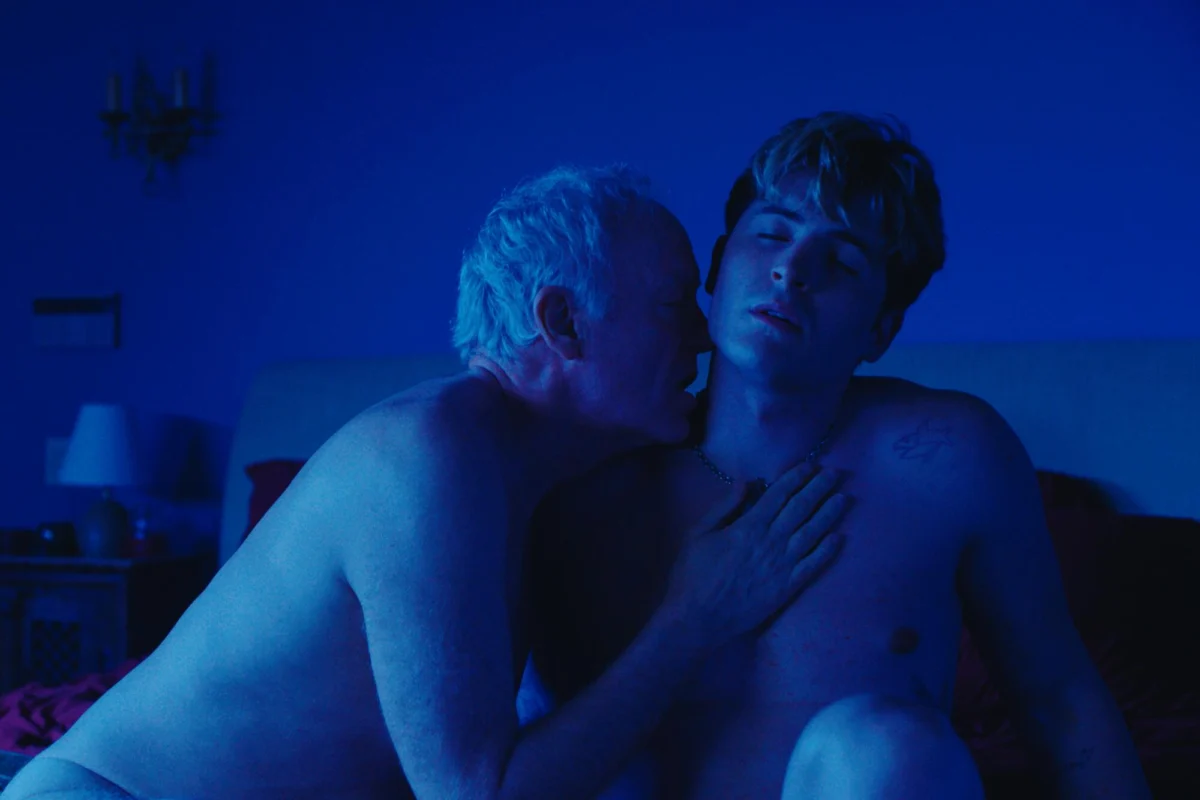
Blue Film introduces viewers to Hank Grant, a former middle-school English teacher who served seven years in prison for attempting to sexually assault one of his students. The narrative unfolds as Hank hires an adult sex worker, Aaron Eagle (portrayed by Kieron Moore), who is revealed to be Alex, another of Hank’s former students from over a decade prior. Hank orchestrates this fraught encounter with a singular, disturbing purpose: to confess his past love for Alex, to offer an explanation for his actions, and to observe the man his former pupil has become. What ensues is a profoundly unsettling and emotionally charged exploration of intimacy, inextricably bound by the traumatic and deeply troubled origins of their student-teacher relationship.
Birney’s portrayal of Hank Grant is lauded for its unflinching honesty, presenting a stark and arguably unprecedented cinematic portrait of a pedophile in American cinema. His performance is a tour de force, fearlessly committed to uncovering the warped and mangled fragments of humanity within a character many viewers would instinctively deem irredeemably monstrous. Birney imbues Hank with an overwhelming sense of shame and regret, anchored by an uneasy, almost genuine vulnerability. It is the kind of work that, under different circumstances, would undoubtedly place an actor of Birney’s caliber firmly in the awards conversation, were the film not so intentionally disturbing in its final form. Beyond his acting, Birney also served as an executive producer on Blue Film and collaborated with Tuttle for several months on the script, indicating a deep personal and creative investment in the project.
Navigating Controversy and Critical Acclaim
The journey of Blue Film from production to public viewing has been as challenging as its subject matter. Filmed in 2023, the movie faced numerous rejections from film festivals during its post-production phase. It garnered a reputation for being divisive, even "radioactive," long before its first public screening. Reed Birney himself admits he was unprepared for the intensity of the backlash. "I never for a second thought it would be controversial," Birney stated, expressing his initial perception of Hank as merely "a sad and broken man," rather than a monster, manipulator, or groomer. This personal interpretation highlights the complex moral landscape the film attempts to navigate.

Despite initial hurdles, Blue Film eventually premiered to critical acclaim at the Edinburgh Film Festival in the summer of 2023. However, securing a distributor proved to be another significant challenge, reflecting the film’s polarizing nature. The Hollywood Reporter‘s review in October described the film as one that "crawls directly under the skin, burrowing deep and drawing blood," yet noted its continued struggle for distribution months after its premiere. Eventually, nascent distributor Obscured Releasing acquired the film earlier this year, releasing it in select theaters in May before making it available for rental or purchase on digital platforms. This limited release strategy underscores the difficulties faced by radical independent cinema in reaching a broader audience.
The Perilous Line Between Actor and Character
The immediate aftermath of Blue Film‘s release saw Reed Birney closely tracking audience reactions online and attending several screenings. He observed a stark division: some viewers praised the film for its bold provocations and felt seen by its willingness to explore difficult themes, while others condemned it as "irresponsible" and argued it "should never have been made." Birney acknowledged the intensely personal nature of these reactions, noting that individuals with personal experiences of trauma or sexual abuse might find it impossible to extend any generosity towards Hank, given the loaded nature of the subject.
A unique challenge emerged for Birney due to his status as a well-regarded but not widely famous actor. Many viewers encountering Blue Film represent their first exposure to his work, making it difficult for them to separate the performance from the character. "Which in a weird way is a compliment, I guess, that I was able to accomplish something in that I am in fact acting," Birney mused, expressing gratitude for those who are able to make that crucial distinction. This phenomenon highlights the double-edged sword of a deeply committed performance in a highly controversial role, particularly for actors whose public persona isn’t yet fully established.
Reed Birney’s Enduring Career in the Spotlight
Reed Birney‘s path to this career-defining role has been anything but conventional. His stage career in New York commenced in the 1970s, building a reputation as a formidable presence in the theater world. His early forays into film, however, were marked by a series of unfortunate turns. His cinematic breakout was anticipated with Arthur Penn’s 1981 dramedy Four Friends, where he played a pivotal "fifth friend." Despite initial Oscar buzz and critical admiration for his portrayal of a disabled college student, the film ultimately flopped.
His next significant feature role arrived four years later in 1985’s Crimewave, Sam Raimi’s follow-up to The Evil Dead, co-written by the Coen Brothers. Birney even secured the lead role. However, a challenging shoot led production company Embassy Pictures to wrest control from Raimi, who subsequently disavowed the film, which also failed commercially. Birney candidly described this period as his film career entering a "weird non-existence," leading to a 13-year hiatus from the big screen. His return, as "Merchant Prince #1" in 1998’s A Perfect Murder alongside Michael Douglas and Gwyneth Paltrow, famously saw him reduced to a fleeting shot of "the back of my head at a poker table." These early setbacks led Birney to ruefully acknowledge, "As I’m telling you this story, it seems like I have really had a cursed film career."
A Legacy Forged in Challenging Roles
Birney’s fortunes began to shift in his mid-50s with the 2008 off-Broadway revival of Sarah Kane’s audacious Blasted. In this production, he took on the role of a bigoted and predatory tabloid writer, a character so far removed from his affable, mild-mannered public persona that Birney initially believed a mistake had been made in his casting. "It was as if someone had asked me to play Stanley Kowalski. It was all wrong," he recalled. Yet, his performance garnered rave reviews, solidifying his stature within the New York theater community after decades of consistent, strong work.

A string of Broadway roles followed, culminating in his Tony Award-winning performance in The Humans. This stage success gradually paved the way for a resurgence in his film career, albeit with notable exceptions; his role in the 2021 screen adaptation of The Humans was recast with film star Richard Jenkins. However, Birney continued to demonstrate his affinity for challenging material, earning a Gotham Award nomination for his searing work in 2021’s Mass, another uncompromising drama that explored the aftermath of a deadly school shooting from the perspective of two sets of grieving parents.
Examining Reed Birney‘s extensive credits reveals a consistent thread: a resilience in the face of setbacks, a patient wait for substantial roles, and a distinct willingness to embrace polarizing material. Far from shying away from controversial subjects, Birney has often found his most significant career breakthroughs by confronting them head-on. His career trajectory also defies the conventional wisdom that older actors are relegated to increasingly smaller roles, instead demonstrating an artistic vitality that deepens with age.
The Broader Implications of "Blue Film"
Birney expresses a desire to play "rich, complicated people who are maybe at a crossroads," acknowledging the inherent challenges for actors his age. While his film career has historically comprised numerous supporting roles – "the best friend or the awful senator or whatever" – Blue Film has offered undeniable proof that he "can play a big part. You can carry a movie." He hopes this will open doors, though he remains pragmatic about the scarcity of such opportunities for a 71-year-old actor. His ambition, he clarifies, is to be "in the middle of the story instead of on the side of the story."
Blue Film‘s nature as an arthouse "hot-potato," neither universally embraced nor widely seen, complicates this aspiration. Birney beams with pride when discussing the project, yet acknowledges its complex standing as a starring vehicle. He views it as "the biggest thing that’s ever happened to me professionally," but concedes it "may be just a blip somewhere." He draws a sharp contrast with Call Me by Your Name, a film he notes also dealt with pedophilia but was celebrated for its aesthetic beauty and setting. "That movie is also about a pedophile, which nobody seemed to care about at the time. I sat there thinking, ‘This is so wrong,’ but everybody’s like, ‘It’s so beautiful!’” Birney observed, highlighting the selective reception of controversial themes in cinema.
A Defining Moment for Reed Birney?
Blue Film offers no easy entry point for its audience. It is a messy, claustrophobic experience that unflinchingly confronts the darker facets of humanity. For Reed Birney, the mere fact that the film continues to be discussed months after its digital release represents a substantial victory for radical cinema—a genre increasingly difficult to produce and distribute. He champions the film’s unique qualities, describing it as "so one of a kind and so beautifully made and so smart," expressing confidence that it will ultimately "find its way."
Birney’s perspective on Blue Film‘s improbable journey is one of profound satisfaction. "It’s already done so much more than it ever should have — look, a $50,000 movie about a pedophile should never have been seen by anybody, honestly," he stated. He finds contentment in its unexpected reach and impact. For Reed Birney, an actor who has spent decades honing his craft and embracing complex characters, the possibility that Blue Film might be his most significant, or even his final, leading role is not a source of regret, but rather a profound source of pride. "And if it’s the biggest part I ever play, and it’s the last big part I ever play — that’s not so bad, either," he concluded, encapsulating a career defined by artistic courage and an unwavering commitment to exploring the full spectrum of human experience.