Hollywood’s film industry recently announced significant revisions to the eligibility criteria for the Academy Award for Best International Feature Film, allowing films to qualify not just through national submission but also via wins at prestigious international festivals. This modern evolution in Oscar rules highlights a long, complex history of how foreign cinema has been recognized, a journey that saw its most curious and groundbreaking moment in 1938 with the Best Picture nomination of Jean Renoir’s French anti-war classic, La Grande Illusion—the first foreign feature to break out in Hollywood’s top tier without an official "foreign language" category.
A Shifting Landscape for Global Cinema at the Oscars
For decades, the Academy of Motion Picture Arts and Sciences has grappled with how to acknowledge the best of global filmmaking. Before 1957, when a dedicated Best Foreign Language Film category (now Best International Feature Film) was established, international cinematic excellence was sporadically honored with Special or Honorary Awards. Landmark films like Vittorio De Sica’s The Bicycle Thief (Italy, 1949) and Akira Kurosawa’s Rashomon (Japan, 1952) received such accolades, decided by the Board of Governors rather than the full Academy membership, reportedly to spare voters the need for subtitles. While films like Costa-Gavras’ Z (1969) achieved dual nominations (Best Picture and Best Foreign Language Film), and Bong Joon Ho’s Parasite (2019) famously shattered the "one-inch barrier of subtitles" to win Best Picture, La Grande Illusion achieved its Best Picture nomination decades earlier, navigating a far more insular and less globally-minded Hollywood.
An Unprecedented Hollywood Breakthrough

In 1938, when the nominations for "Outstanding Production" (the precursor to Best Picture) were announced, La Grande Illusion stood out dramatically among ten nominees. Unlike British films, which were in English and occasionally broke into the main categories (like Laurence Olivier’s Hamlet, which won Best Picture in 1949), Renoir’s French-language, subtitled film was an exotic entry. It lacked major studio backing and arrived from a director virtually unknown in the United States. Jean Renoir, the son of the famous Impressionist painter Auguste Renoir, had seen his earlier masterpieces like Boudu Saved from Drowning (1932) and The Crime of Monsieur Lange (1936) largely ignored by American distributors, only to be released in the US decades later. His 1936 films, The Lower Depths and The People of France, had received only modest arthouse attention, with critics primarily identifying him by his father’s renown. La Grande Illusion would change that, establishing Renoir as a cinematic master in his own right.
The Film’s Poignant Anti-War Narrative
Produced in Paris by Les Réalisations d’Art Cinématographique, La Grande Illusion found its American distributor in World Pictures Corp., spearheaded by Irvin Shapiro, a pioneering figure in foreign film distribution. The film, released in the aftermath of World War I and on the precipice of World War II, adopted a somber, pacifist tone, deliberately avoiding heroic battle scenes. Its advertising even warned: "A War Story without War Scenes!" Renoir, a veteran of the Great War who served as both a cavalry officer and pilot and was wounded twice, infused the narrative with a profound understanding of conflict’s human cost.
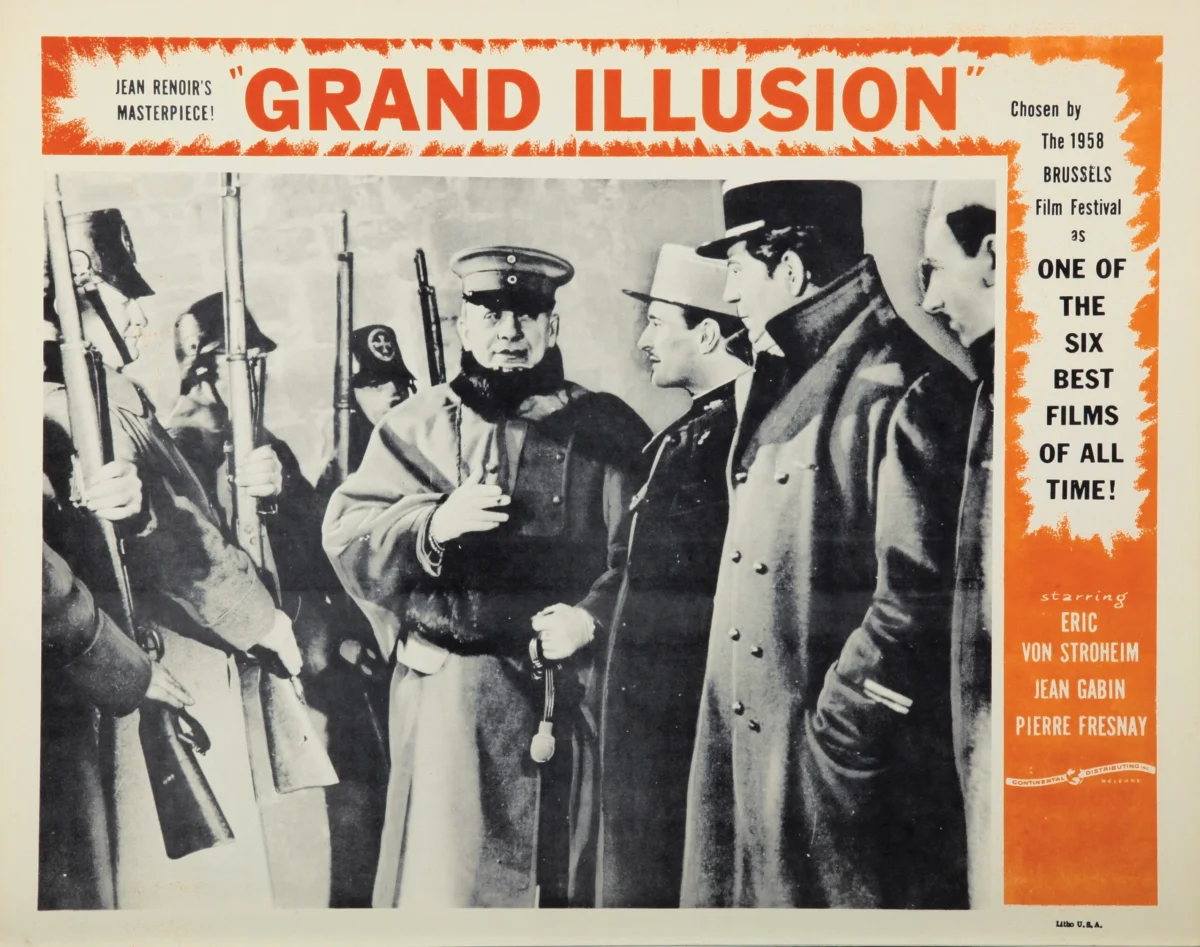
The plot centers on two French pilots, the aristocratic Captain de Boeldieu (Pierre Fresnay) and the working-class Lieutenant Maréchal (Jean Gabin), shot down and captured by the chivalrous German aviator Captain von Rauffenstein (Erich von Stroheim). Their journey through various German prisoner-of-war camps brings them into contact with a diverse group of French countrymen, including the generous Lieutenant Rosenthal (Marcel Dalio), a Jewish soldier whose compassionate portrayal served as a subtle commentary on the historical injustices like the Dreyfus Affair. The film explores themes of class solidarity transcending national divides, with de Boeldieu and von Rauffenstein finding common ground as European aristocrats whose era is fading. A pivotal scene sees de Boeldieu sacrifice himself to allow Maréchal and Rosenthal to escape, forcing a reluctant von Rauffenstein to shoot his class comrade. The film concludes with Maréchal and Rosenthal finding temporary solace with a German war widow before making their final perilous journey to freedom in Switzerland, a quiet, bittersweet triumph in the shadow of war.
From Parisian Praise to American Acclaim

La Grande Illusion premiered on June 8, 1937, in Paris to widespread critical and public acclaim. French critics hailed it as "a masterpiece of cinema" and "a beautiful human work." American correspondents, including Pierre Autre of Motion Picture Herald, echoed this sentiment, calling it "by far, the best French film of the year." The Hollywood Reporter predicted it would be a "smash hit" in the States.
Its American debut on September 12, 1938, at the refurbished Filmarte Theater in New York, drew a sophisticated crowd including columnists, novelists, and actors. The Filmarte, run by importer Jean H. Lenauer, was a quintessential "sure seater" arthouse catering to a devoted clientele. Grand Illusion ran for an unprecedented 27 weeks there, its lobby famously adorned with reproductions of Auguste Renoir’s Impressionist paintings. The film’s reputation soon spread beyond the arthouse circuit. Industry luminaries like Samuel Goldwyn called it "the most brilliantly directed film I have seen in years—a challenge to Hollywood." Producer Walter Wanger, director Mervyn LeRoy, and actresses Lillian Gish and Helen Hayes publicly endorsed it. The New York Film Critics named it the year’s best foreign film, and the National Board of Review went further, declaring it "the best film of the year from any country." Special praise was reserved for Erich von Stroheim, whose compelling performance resonated deeply, prompting The New York Times‘ Frank Nugent to lament Hollywood’s "folly in permitting so fine an actor to remain idle and unwanted."
Navigating Hollywood’s Censorship and Mainstream Distribution
To truly break out of the arthouse "ghetto" and into mainstream American cinemas, La Grande Illusion needed a Production Code Administration (PCA) seal. On July 29, 1938, distributor Irvin Shapiro submitted the film for review. The PCA, Hollywood’s self-censorship body, requested "slight deletions," including a shot of a prisoner rubbing silk underwear, the use of the word "damn," and a humorous reference to a prisoner attempting escape in drag. More notably, the PCA flagged "the racial angle in reference to Rosenthal"—specifically, two instances of antisemitic insults directed at him by Maréchal. Shapiro chose to retain these lines, and after the other requested cuts were made, the PCA issued its seal on November 23, 1938. The Roman Catholic Legion of Decency also deemed it "AI: unobjectionable for adults."
With the Code imprimatur, Grand Illusion gained access to major cinema chains like RKO, Warner, and Publix. Advertisements explicitly informed first-time foreign filmgoers that "English titles translate the dialogue." Word-of-mouth, repeat viewings, and even French teachers bringing their classes contributed to its box office success.

A Film for its Time: Political Resonance and Nazi Suppression
The film’s release coincided with a palpable anti-war sentiment as another global conflict loomed. In 1938, Nazi Germany annexed Austria, invaded the Sudetenland, and launched Kristallnacht. For many Americans, La Grande Illusion‘s portrayal of "the futility of mankind’s armed conflict" (as Variety put it) held ominous relevance.
Its anti-war message, however, was not universally embraced. Although it won "the most artistic ensemble" award at the Venice Film Festival in 1937, it was subsequently banned by Italy under pressure from Nazi Germany, which deemed it "anti-German" and an affront to "Germany’s honor." The sympathetic portrayal of Rosenthal was a particular point of contention. The Nazis took active measures to suppress the film; historian Herman G. Weinberg reported that on the day the Nazis moved into Vienna in March 1938, Grand Illusion was forcibly removed from screens mid-showing. Renoir viewed such suppression as "a signal honor—and a decoration."
In America, the film became a powerful vehicle for differing political agendas. Isolationists like Congressman Hamilton Fish (R-NY) lauded it as "an antidote to war hysteria." Conversely, anti-Nazis interpreted its tolerant and pacifist spirit as a powerful rebuke to Nazi eugenics and militarism. Mike Gold of the Daily Worker declared it would "give you hope for humanity and patience and inspiration in the fight against the Nazi syphilis." The Hollywood Anti-Nazi League sponsored screenings, amplifying its message. On January 12, 1939, a special "Congressional Night" screening was arranged in Washington, D.C., for senators and congressmen, underscoring its perceived importance in legislative circles.
Academy Recognition and Enduring Legacy

The widespread critical buzz and profound cultural impact of La Grande Illusion ultimately reached the Academy’s voting pool. A newly adopted protocol on December 20, 1937, had opened "Outstanding Production" nominations to all eligible Academy members, rather than just specific branches. By the time nomination ballots were sent out on January 23, 1939, the film had been widely seen across New York and Los Angeles. Its resonant timeliness and undeniable excellence propelled it into the top ten nominees. For Renoir and Shapiro, the nomination itself was a monumental achievement.
The Academy’s recognition ensured La Grande Illusion‘s continued circulation, moving from the Filmarte to other landmark arthouses. In September 1939, with the outbreak of war in Europe, World Pictures Corp. re-released the film with a new, urgent publicity campaign: "Never so timely!" and "They said the Europe of 1914-1918 would never happen again—but!" Renoir’s response was laconic, "In 1936, I made a picture in which I tried to express all my deep feelings for the cause of peace. It was very successful. Three years later the war broke out."
The careers of the film’s key figures continued to evolve. Von Stroheim returned to Hollywood, often playing sinister Nazis. Renoir himself came to Hollywood in 1941, working with Darryl F. Zanuck at 20th Century-Fox before moving to RKO and United Artists, directing films like This Land Is Mine (1943) and the hit social realist drama The Southerner (1945). He later returned to Europe for a vibrant Technicolor period before settling in Los Angeles, where he died in 1979.
A Coda of Cinematic Devotion: Preserving the First Foreign Feature to Break Out
The story of La Grande Illusion culminates in an extraordinary act of film preservation. In June 1940, as Nazis occupied Paris, Henri Langlois, the visionary archivist of the Cinémathèque Française, desperately sought to protect his collection, including the original 35mm negative of La Grande Illusion, which Nazi Propaganda Minister Joseph Goebbels specifically ordered seized and destroyed. Remarkably, Langlois found an unlikely ally in Franz Hensel, head archivist for the Reichsfilmkammer and now a Nazi major stationed in Paris. Hensel, described by The Hollywood Reporter as "a Nazi who apparently cared more for cinema than party allegiance," collaborated with Langlois to safeguard the Cinémathèque’s treasures. Defying Goebbels’ designation of Grand Illusion as "cinematic public enemy No. 1," Hensel secured the negative and, when it was confiscated and shipped to Berlin, ensured its protection within the Reichsfilmarchiv vaults until the Allied victory.

After the war, the negative, located in the Soviet sector of Berlin, was transported to Moscow and deposited at Gosfilmofund, the Soviet film archive, its true value initially unrecognized. Years later, Soviet and French film archivists identified the treasure. In 1999, a pristine print of Grand Illusion was struck from this original negative and re-released by Rialto Pictures, becoming the definitive version circulated today. This remarkable tale of its rescue and restoration underscores the film’s enduring power and the profound dedication of those who believed in its importance, ensuring that this groundbreaking foreign feature continues to captivate audiences and inspire reflection on the human condition amidst conflict.