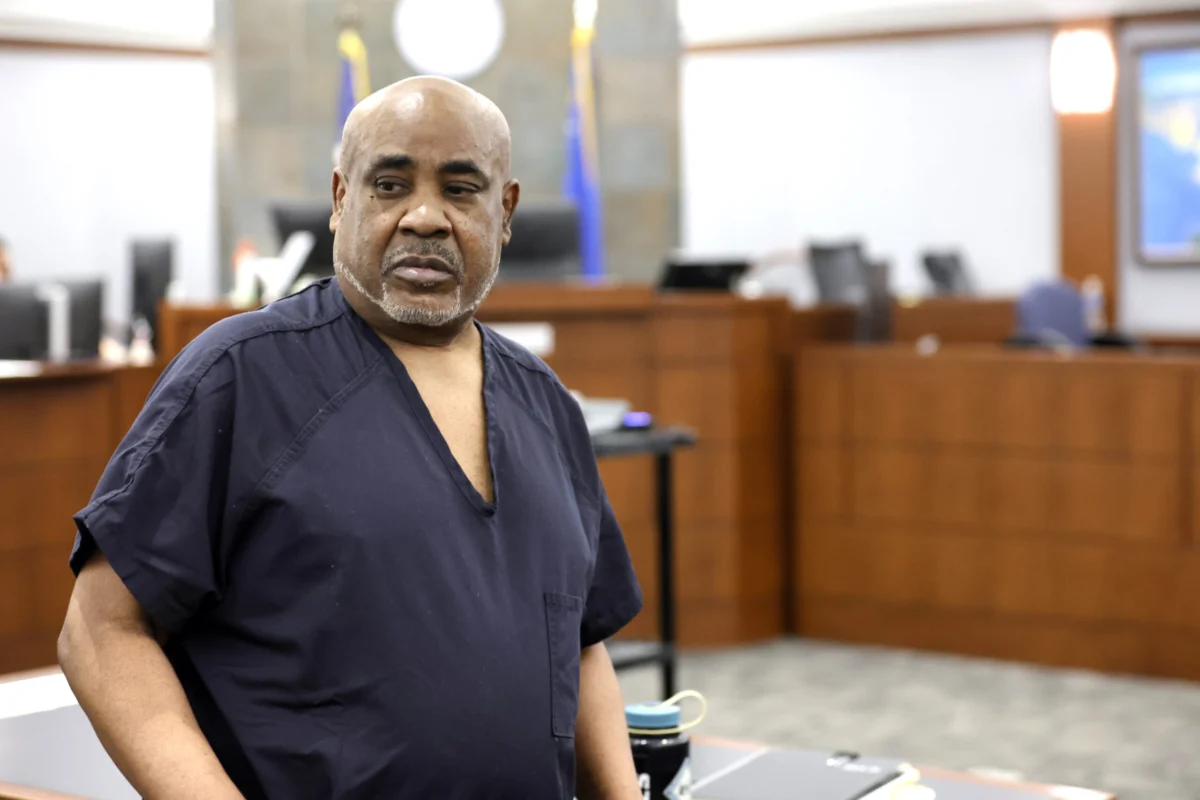
The long-awaited Tupac Murder Trial officially commenced this week in Las Vegas, bringing decades of speculation and legal limbo to a pivotal courtroom showdown. Nearly three decades after the drive-by shooting that claimed the life of hip-hop legend Tupac Shakur, Duane “Keffe D” Davis, 60, stands accused of orchestrating the killing, marking a significant development in one of modern music’s most enduring unsolved mysteries.
A Decades-Old Mystery Unravels in Court
On Monday morning, both the prosecution and Davis’s defense presented their opening statements, setting the stage for a trial that promises to revisit the raw tensions of 1990s West Coast hip-hop. Chief Deputy District Attorney Binu Palal told jurors that Davis arranged the murder in a calculated “act of revenge.” This retaliatory motive, Palal asserted, stemmed from Shakur’s alleged attack on Davis’s nephew, Orlando “Baby Lane” Anderson, earlier that fateful night. The prosecution’s narrative aims to connect the dots between the street-level violence and the tragic end of a global superstar.
Davis, a self-proclaimed former gang leader, was arrested and charged with murder with a deadly weapon in September 2023, making him the only individual ever formally charged in connection with Shakur’s death. His arrest sent shockwaves through the entertainment world and the criminal justice system, reigniting public interest in a case that many had believed would forever remain cold. The central piece of evidence for the prosecution is Davis’s own 2019 memoir, Compton Street Legend, in which he candidly discussed his involvement in the events surrounding Shakur’s murder, including allegedly providing the firearm used in the crime.
Prosecutor Palal emphasized the weight of Davis’s own words, telling the jury, “Let’s be clear, Duane Davis did not pull the trigger. But he did plan the shooting in retaliation of the beating of his nephew. Remarkably, you will learn that from Duane Davis himself.” This strategy highlights the prosecution’s reliance on Davis’s past admissions to establish his culpability in the conspiracy to commit murder.
Defense Challenges Credibility of Accused’s Own Words
In a sharp contrast, Davis’s defense attorney, Michael Sanft, urged the jury to view the memoir as a work of fiction rather than a confession. During his opening statement, Sanft reportedly dismissed the book as “bullshit,” arguing that Davis “was never charged for any of what he said during that time period, and it’s because they knew he was full of crap.” The defense intends to challenge the reliability of Davis’s self-published accounts, suggesting they were embellished for notoriety or financial gain and should not be taken as factual evidence in a court of law. This contention sets up a battle over the credibility of the defendant’s own narrative, a unique challenge in criminal jurisprudence.
The conflicting portrayals of Davis’s memoir underscore the complexities of a case built heavily on decades-old testimony and the defendant’s self-incriminating statements. The defense will likely argue that law enforcement had ample opportunity to charge Davis earlier if his claims were truly credible, implying a desperate attempt by authorities to finally close a high-profile case.
Tupac Shakur: A Legacy Forged in Music and Conflict
Tupac Amaru Shakur remains one of the most influential and enigmatic figures in music history. Born in New York City in 1971, his career spanned just five years, yet his impact on hip-hop and popular culture is immeasurable. Known for his raw lyricism, poetic depth, and unflinching social commentary, Shakur’s music explored themes of poverty, racism, police brutality, and inner-city struggles, resonating deeply with millions. Albums like All Eyez on Me and Me Against the World cemented his status as a voice for the marginalized and a prophet of his generation. His artistry was often intertwined with a tumultuous personal life, marked by legal troubles, rivalries, and a constant struggle for authenticity in the face of immense fame.
The night of September 7, 1996, saw Shakur attend a Mike Tyson fight at the MGM Grand in Las Vegas. Afterward, he was riding as a passenger in a black BMW driven by Marion “Suge” Knight, then the notorious CEO of Death Row Records, Shakur’s label. At approximately 11:15 p.m., as their entourage stopped at a red light on Flamingo Road, a white Cadillac pulled alongside, and occupants fired multiple shots into Knight’s vehicle. Shakur was hit four times, critically wounded. Despite emergency surgery, he succumbed to his injuries six days later, on September 13, at the age of 25. His untimely death plunged the music world into mourning and ignited a frenzy of conspiracy theories that have persisted for nearly three decades.
The Infamous East Coast-West Coast Rivalry
Shakur’s murder occurred at the height of the infamous East Coast-West Coast hip-hop rivalry, a period of intense artistic competition that tragically escalated into real-world violence. This feud pitted artists and labels from the West Coast, primarily Death Row Records (associated with the Bloods gang), against those from the East Coast, notably Sean “Diddy” Combs’ Bad Boy Records (associated with the Crips gang). The rivalry was fueled by diss tracks, public confrontations, and a media narrative that often sensationalized the escalating tensions. Duane Davis himself was a known leader of the South Side Compton Crips, adding another layer to the complex web of gang affiliations and personal vendettas that characterized the era.
Davis had previously claimed that Combs had offered a bounty for Shakur’s death, an allegation Combs has vehemently and consistently denied. While Combs has faced recent legal challenges unrelated to this case, these allegations highlight the deep-seated animosities and theories that have surrounded Shakur’s death. The trial is expected to delve into these historical connections, shedding light on how gang affiliations and music industry power struggles converged to create a volatile environment.
Day One Witness Testimony
The first day of the Tupac Murder Trial saw several key witnesses take the stand, providing crucial insights into the immediate aftermath of the shooting and the initial, often frustrated, investigative efforts. Among those who testified were:
- Las Vegas police officer Garry Dale: Dale was one of the first responders to the chaotic scene. He recalled encountering a gravely wounded Shakur, who, despite his injuries, famously refused to identify his assailants. According to Dale, Shakur told him, “No, we’ll take care of it,” a statement that has long been interpreted as a reflection of street code and a desire for personal retribution rather than reliance on law enforcement. This refusal to cooperate has been a persistent hurdle in the investigation.
- Ingrid Stokes: A civilian who was in a nearby car when the shooting occurred, Stokes offered a chilling eyewitness account of the gunfire and the ensuing panic. Her testimony aims to corroborate the details of the drive-by, providing a civilian perspective on the sudden violence that unfolded on a Las Vegas street.
- Former homicide detective Brent Becker: Becker, who was involved in the initial investigation, testified about the challenges faced by law enforcement. He specifically recalled Suge Knight’s testimony, describing him as “timid” and expressing his belief that Knight “lied to us. He just didn’t know anything.” This testimony underscores the difficulties investigators faced in securing reliable information from individuals who were present or closely connected to the events.
- Former LAPD police officer Fred Miller: The inclusion of Miller as a witness is particularly significant. As one of the detectives who investigated the murder of The Notorious B.I.G. (Christopher Wallace), Shakur’s East Coast rival who was killed just six months after Tupac, Miller’s presence highlights the perceived interconnectedness of these two iconic, unsolved hip-hop murders. His testimony could potentially draw parallels between the investigative challenges or illuminate the broader context of gang-related violence affecting the music industry during that period.
The day concluded with the jury reviewing an extensive audio interview with Duane Davis, a critical piece of evidence that the prosecution believes will directly implicate him in the conspiracy to murder Tupac Shakur. This audio, likely containing Davis’s own statements about the events, will be central to the jury’s deliberations.
Seeking Closure: Implications for Justice and Culture
The initiation of the Tupac Murder Trial represents a monumental effort to bring resolution to a case that has haunted the realms of music, culture, and criminal justice for nearly three decades. For Shakur’s family, particularly his mother Afeni Shakur (who passed away in 2016, having spent years advocating for justice), and his countless fans, this trial offers the first tangible hope of accountability. The delay in prosecution raises complex questions about justice delayed and the evolving nature of evidence, particularly when relying on the defendant’s own admissions made years after the fact.
The outcome of this trial will have far-reaching implications. A conviction could set a precedent for cold cases where self-incriminating memoirs play a crucial role, potentially encouraging others with knowledge of past crimes to come forward. Conversely, an acquittal could reinforce existing doubts about the justice system’s ability to solve such high-profile, decades-old crimes, especially those deeply embedded in complex gang and music industry rivalries.
Beyond the legal ramifications, the trial has reignited a cultural conversation about Tupac’s enduring legacy, the dark side of hip-hop’s golden era, and the pervasive impact of gang violence. It forces a new generation to confront the tragic consequences of the East Coast-West Coast rivalry, reminding many that the glamorized conflicts of the past had very real, devastating outcomes. As the trial proceeds, the world watches, hoping that after nearly 30 years, the truth behind the murder of one of music’s most revered icons will finally emerge from the shadows. The proceedings are set to resume on Tuesday, with further witness testimony and evidence expected to unfold.