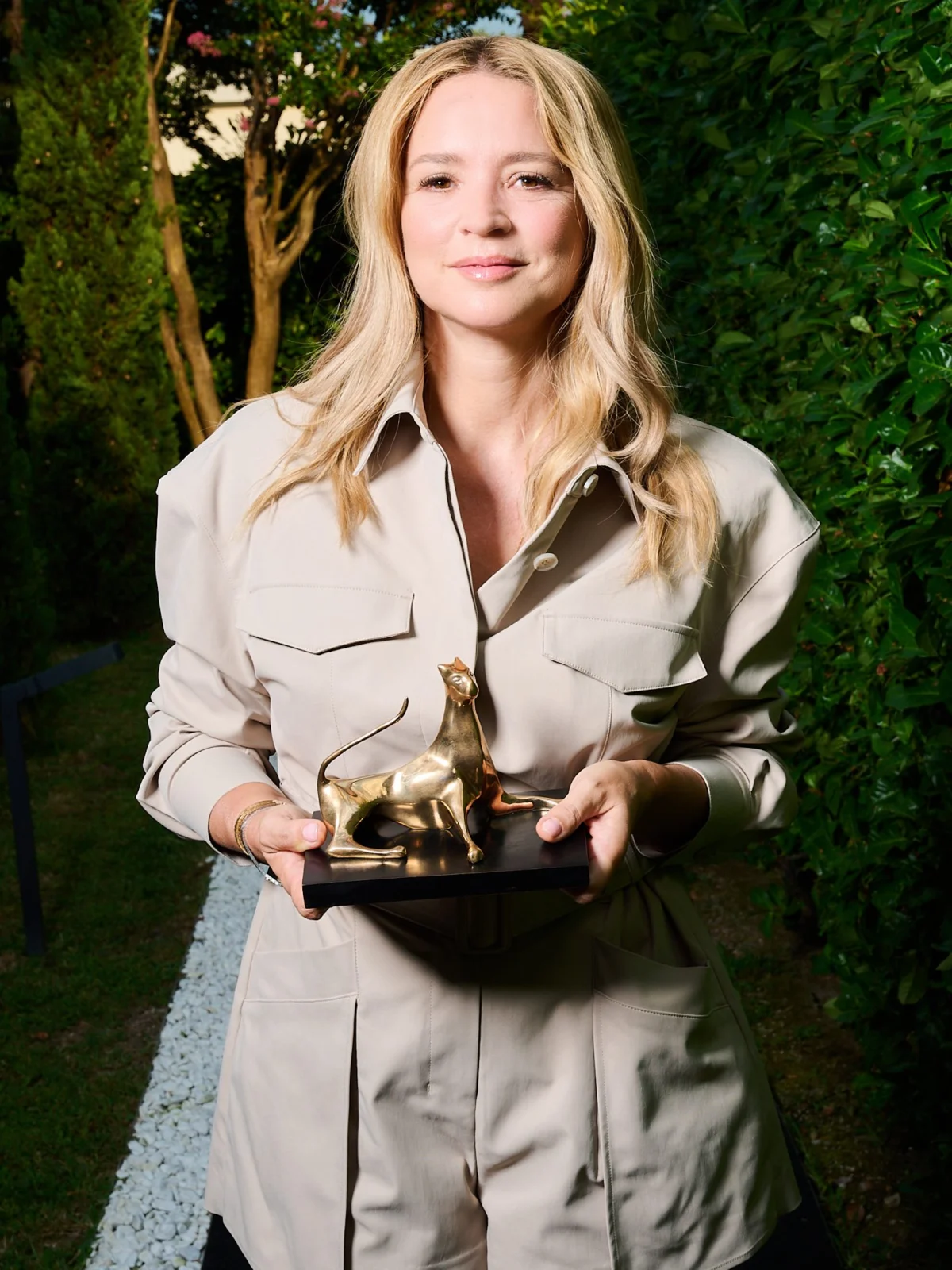
Belgian-born actress Virginie Efira, a prominent figure in contemporary European cinema, was honored with the prestigious Leopard Club Award at the 79th Locarno Film Festival on Friday evening, a recognition that underscored her significant contributions to the art form and her profound appreciation for the festival’s unique ethos. The ceremony, held in the iconic Piazza Grande, saw Efira deliver an emotional and heartfelt speech, emphasizing the collective spirit of filmmaking and the essential role of an engaged audience.
The Leopard Club Award, presented annually by the Locarno Film Festival, celebrates personalities who have left an indelible mark on the international film industry through their artistic excellence and dedication. Previous recipients include acclaimed actors and directors, making Efira’s inclusion a testament to her diverse and impactful career, spanning critically praised roles in films such as Benedetta, Paris Memories, and All of a Sudden. Her selection for this honor highlighted her versatility and consistent ability to captivate audiences and critics alike across various genres and directorial visions.
A Career Defined by Depth and Collaboration
Virginie Efira’s journey in cinema began after a successful career in television, a transition she navigated with remarkable grace and strategic choices. Born in Schaerbeek, Belgium, her early career as a presenter and journalist in French and Belgian television provided her with a public profile, but her true passion lay in acting. Her cinematic breakthrough arrived with roles that showcased her dramatic range, quickly establishing her as a formidable talent in French and international productions. She has become known for her fearless approach to complex characters, often collaborating with visionary directors who push the boundaries of storytelling.
Her filmography reflects a discerning eye for projects that challenge both herself and the audience. From the provocative intensity of Paul Verhoeven’s Benedetta, where she portrayed a 17th-century lesbian nun, to the poignant exploration of memory and trauma in Mia Hansen-Løve’s One Fine Morning and Alice Winocour’s Paris Memories, Efira consistently chooses roles that resonate with profound human experiences. These performances have garnered her numerous accolades, including a César Award for Best Actress for Revoir Paris (English Paris Memories).
Locarno’s Unique Embrace of Cinema
The Locarno Film Festival, established in 1946, holds a distinctive position among major international film festivals. Renowned for its commitment to discovering new talent, showcasing avant-garde cinema, and fostering a deep appreciation for diverse cinematic expressions, Locarno prides itself on its adventurous programming. Unlike some larger, more commercially focused festivals, Locarno is celebrated for its dedication to film as an art form, often premiering works that challenge conventions and spark critical dialogue. The festival’s central venue, the Piazza Grande, an open-air screening space capable of seating up to 8,000 people, symbolizes its philosophy of making cinema accessible and a communal experience.
This setting perfectly complemented Efira’s acceptance speech. Addressing the vast crowd, she articulated her immense joy and honor at receiving the Leopard Club Award. Speaking primarily in French, she humorously acknowledged the linguistic barrier in the Italian-speaking canton of Ticino, asking, "Do most people understand?" The resounding "yes" from the enthusiastic audience affirmed the shared connection that transcends language, a testament to cinema’s universal appeal.
An Ode to the Audience and Collective Art
Efira’s speech quickly pivoted to a heartfelt tribute to the Locarno Film Festival itself, praising its "greatest faith in the audience." She passionately expressed her belief that viewers are "hungry for films that resonate with us, that move us, that innovate, that offer us something greater." This sentiment struck a chord with the festival’s ethos, which champions films that challenge predictable desires and genuinely surprise. Her words underscored Locarno’s role in fostering a sophisticated and curious viewership, a characteristic that Efira clearly deeply admires.

She further lauded Locarno as "truly avant-garde," highlighting its pivotal role in "discover[ing] artists" and looking at "a cinema that is being invented." This perspective aligns with the festival’s mission to be a launching pad for emerging voices and a platform for cinematic experimentation, distinguishing it from festivals that might lean more heavily on established industry names. Efira’s recognition of this unique quality resonated deeply with festival organizers and attendees alike, reinforcing the mutual respect between artist and institution.
Emotional Recognition and the Collective Burden
The award held particular significance for Efira, who shared an emotional reflection on her career. "I think it’s the first time I’ve received an award like this," she confessed, distinguishing it from past accolades, such as those at Cannes. She clarified that while individual film awards are gratifying, this particular honor represented a broader recognition of her entire body of work and sustained career, a distinction that "touches me deeply." This profound appreciation highlighted the weight of a career-spanning award, acknowledging years of dedication and artistic evolution.
However, Efira was quick to contextualize her achievement within the collaborative framework of filmmaking. She asserted that the award, while personally significant, was a "very heavy burden" for an actor alone. "An actor on their own isn’t much. It’s truly a collective profession," she stated, underscoring her humility and profound understanding of the cinematic process. She emphasized that "to achieve something that might have some merit, you need a vision," directly attributing success to the directors and creative teams with whom she has worked.
Directors and the Unamplified Voice
In a powerful display of gratitude, Efira named several directors who have been instrumental in her career, including Ryusuke Hamaguchi, Justine Triet, Rebecca Zlotowski, and Valérie Donzelli. Her acknowledgment of these diverse talents highlighted the collaborative alchemy required to bring compelling stories to the screen. "On your own, you’re not much," she reiterated, concluding with a direct address to the audience: "And without the audience, you’re nothing at all. So, thank you for your curiosity." This final sentiment reinforced her earlier praise for Locarno’s audience and their vital role in the cinematic ecosystem.
A moment of unexpected drama unfolded when, as Efira mentioned the Saturday screening of Ryusuke Hamaguchi’s All of a Sudden—a film for which she learned some Japanese and shared a Best Actress Palme at Cannes with co-star Tao Okamoto—her microphone momentarily failed. Without missing a beat, the seasoned performer continued speaking, projecting her voice more loudly across the vast Piazza Grande. When the microphone abruptly came back to life moments later, she reacted with a charming "Oh, it works, great!" to appreciative laughter, further endearing herself to the audience and demonstrating her unwavering commitment to communication, amplified or not.
A Festival of Stars and Storytelling
Giona A. Nazzaro, the artistic director of the Locarno Film Festival, introduced Efira with immense pride, also speaking in French. He lauded her as "an incomparable artist," praising her for "always remaining true to herself" and ultimately proclaiming that "Virginie Efira embodies the modernity of cinema." His words served as a powerful endorsement of her artistic integrity and her significant influence on contemporary film.
Following Efira’s moving acceptance, the festival continued its dynamic program with the world premiere of I Is Another (Ich Ist ein Anderer), directed by Felix Randau. The film, starring Claes Bang (The Square) and Valerie Pachner, delves into the intriguing story of Nazi Heinrich Himmler’s former massage therapist. The creative team shared their excitement about presenting their work in front of Locarno’s passionate audience. Claes Bang expressed his awe, remarking, "This looks much better than in photos. People, you are amazing! Thank you for coming! This is so pretty and beautiful and wonderful."
The evening at the Locarno Film Festival thus encapsulated the essence of a major cinematic event: the celebration of a celebrated artist, the communal experience of film, and the anticipation of new stories. Virginie Efira’s powerful message about collaboration and the audience’s vital role resonated deeply, cementing her status not just as an acclaimed actress, but as a thoughtful advocate for the enduring power and collective spirit of cinema.