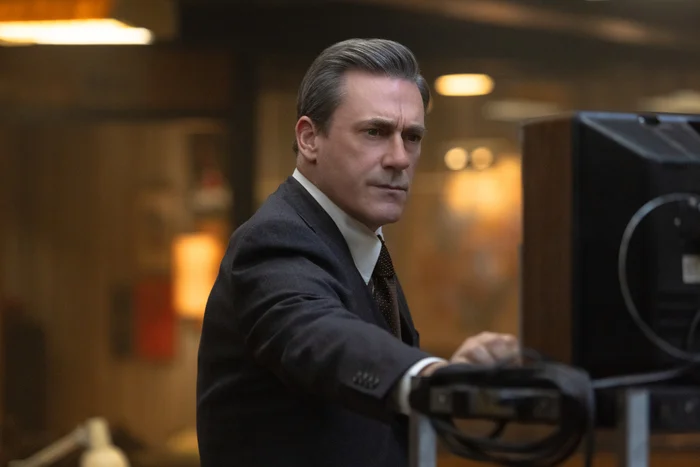
Jon Hamm’s new MGM+ series, American Hostage, delves into a harrowing 1977 true crime story that the acclaimed actor asserts holds striking relevance to the contemporary political and social landscape. Scheduled to premiere on September 20, the psychological thriller casts Hamm as Fred Heckman, a beloved Indianapolis radio reporter unexpectedly thrust into a life-or-death hostage crisis. The series explores not only the mechanics of the crime but also the deeper societal frustrations and media ethics that continue to echo decades later.
Unpacking the Premise of American Hostage
In American Hostage, Hamm portrays Fred Heckman, a prominent local news broadcaster whose professional integrity and personal resolve are tested when a disgruntled borrower takes a mortgage broker hostage. The captor’s demand is singular and audacious: he insists on being interviewed live on Heckman’s popular radio news program. This desperate plea for airtime transforms a local financial dispute into a high-stakes media spectacle, forcing Heckman into an unprecedented role that blurs the lines between journalist and crisis negotiator.
The narrative is a direct adaptation of a true crime event from 1977, a story previously chronicled in a narrative podcast of the same name, also featuring Hamm. The series is co-created by Shawn Ryan, known for his work on gritty dramas like The Shield, and Eileen Myers, a seasoned writer and producer. Together, they aim to bring a nuanced and tense portrayal of a historical incident that captivated a nation.
The Historical Echoes: The Tony Kiritsis Hostage Crisis of 1977
The factual basis for American Hostage centers on the infamous Tony Kiritsis hostage crisis, an event that unfolded over 63 agonizing hours in Indianapolis, Indiana. On February 8, 1977, Kiritsis, a 44-year-old unemployed man, kidnapped Richard Hall, a 49-year-old mortgage broker he accused of defrauding him in a land deal. Kiritsis then wired a sawed-off shotgun to Hall’s neck, threatening to kill him if his demands were not met.
Kiritsis’s primary demand was to broadcast his grievances live on radio, specifically through Fred Heckman, a trusted voice on Indianapolis’s WIBC. He believed that only by telling his story publicly could he expose what he perceived as systemic injustice and financial corruption. This unusual demand placed Heckman, a veteran journalist revered for his objective reporting, in an unimaginable ethical quandary. He was faced with the responsibility of reporting the news while simultaneously being an active participant, potentially influencing the outcome of a volatile situation.
A Nation Under Strain: The 1970s Context
The Kiritsis crisis did not occur in a vacuum; it resonated deeply with the socio-economic anxieties of 1970s America. The decade was marked by persistent inflation, economic stagnation, and a lingering sense of national disillusionment following the Vietnam War and the Watergate scandal. Trust in government and established institutions was at a low ebb, and many Americans felt a growing sense of disenfranchisement.
Kiritsis, a man pushed to the brink by financial despair, symbolized a segment of the population feeling overlooked and unheard. His desperate act, however extreme, tapped into a broader public sentiment of frustration with economic inequalities and a perceived lack of recourse for ordinary citizens against powerful financial entities. This backdrop is crucial to understanding why Hamm and the creators of American Hostage find the story so compellingly relevant today.
The Enduring Relevance of American Hostage to Today’s Political Climate
Jon Hamm articulated the series’ contemporary resonance, telling The Hollywood Reporter that “there’s some thematic devices that resonate in the culture politically now.” He specifically pointed to “the idea of a certain segment of the population being overlooked, or feeling overlooked or feeling under-addressed, in their wants and needs and desires.” This sentiment, he argues, transcends the decades, drawing a direct line from the economic anxieties of 1977 to the political polarization and socio-economic divides prevalent in the United States today.
The title itself, American Hostage, was deliberately chosen for its multi-layered meaning. While it literally refers to the act of one person taking another captive, Hamm explains its deeper implication: "This man obviously takes a person hostage, but is he in fact hostage to his American Dream?" This question probes the aspirational yet often elusive nature of the American Dream, particularly for those grappling with financial insecurity, mounting debt, and the perception of a rigged system. The series challenges viewers to consider whether systemic issues can hold individuals captive, even without physical chains.
This metaphorical interpretation of being "hostage to the American Dream" resonates powerfully with current economic conditions. Debates around housing affordability, student loan debt, and income inequality dominate national conversations. Many Americans today feel a similar sense of being trapped by economic circumstances, mirroring the despair that drove Kiritsis to his extreme actions. American Hostage thus serves as a potent commentary on the persistent struggles for economic justice and recognition within American society.
Media Transformation: From Local Event to National Spectacle
The Kiritsis case also represents a pivotal moment in the evolution of American news media. Hamm highlighted it as one of the first instances where a local story exploded onto the national stage, foreshadowing the 24/7 news cycle and the blurring of local and national narratives. Before this, local incidents rarely garnered such widespread, real-time national attention.
Hamm drew parallels to later events, such as O.J. Simpson’s infamous police chase in 1994, which he cited as many people’s first experience with a live, nationally televised local event. He also referenced the Patty Hearst kidnapping and subsequent events, another case where local developments captured national headlines. These incidents marked a shift in how news was consumed, moving towards a more immediate, sensationalized, and continuously unfolding narrative.
This shift, Hamm suggested, has culminated in today’s media landscape, where "everything is maximized for the salaciousness of its content." The series implicitly critiques how the drive for viewership and engagement can sometimes overshadow journalistic ethics and the nuanced reporting of complex issues. The Kiritsis incident, born out of genuine desperation, inadvertently became a spectacle, illustrating the early stages of this transformation.
The Crisis of Media Trust: Then and Now
Shawn Ryan, one of the series’ co-creators, emphasized the "journalistic aspect to the show" as "very pertinent today." He lamented the current "fractured journalist world" where individuals "can kind of choose your news more than the news really informing you these days." This stands in stark contrast to the era depicted in American Hostage, when, as Ryan noted, "journalists to be trusted and for the news to be something that was sacred."
This observation aligns with contemporary data on public trust in media, which, according to Gallup, remains at record lows. The series offers a poignant reminder of a time when news organizations held a more universally accepted position of authority and credibility. Today, the proliferation of partisan news outlets, social media echo chambers, and the spread of misinformation have severely eroded that trust, leading to a deeply polarized information environment.
Fred Heckman’s character embodies the ethical tightrope walked by journalists in crisis situations. He is a reporter who has "invested decades into building his reputation as telling the truth," suddenly expected to act as a hostage negotiator and to save lives. This impossible position highlights the profound responsibilities and inherent conflicts faced by those tasked with informing the public, especially when public safety and human lives hang in the balance. The series prompts reflection on the immense pressure placed on journalists and the ethical boundaries that are constantly tested in the pursuit of a story.
Crafting American Hostage: Vision and Expectations
The decision to adapt the Kiritsis story into a series underscores its enduring dramatic potential and its relevance as a social commentary. Shawn Ryan and Eileen Myers, with their proven track records in creating compelling television, are poised to deliver a psychological thriller that is both historically accurate and emotionally resonant. Ryan’s background in crafting character-driven dramas with complex moral ambiguities makes him a fitting choice to explore the ethical dilemmas inherent in Heckman’s story.
Jon Hamm, known for his ability to portray characters of gravitas and hidden depths, from Don Draper in Mad Men to his recent film roles, brings a commanding presence to the role of Fred Heckman. His portrayal is expected to capture the reporter’s integrity, his internal conflict, and the immense burden of responsibility he carried. The transition from a narrative podcast, where Hamm already lent his voice, to a full-fledged television series allows for a richer visual and dramatic exploration of the tense stand-off and its broader implications.
The premiere of American Hostage on MGM+ on September 20 is anticipated to draw significant attention, particularly among fans of true crime narratives and sophisticated dramas. It offers MGM+ an opportunity to showcase a prestige project that combines historical intrigue with contemporary social commentary. The series is expected to generate discussion not only about the Kiritsis case itself but also about the enduring challenges of economic disparity, media ethics, and the complex nature of the "American Dream" in a fractured society.
A Timely Reflection on American Society
American Hostage stands as more than just a retelling of a historical true crime. It is a meticulously crafted psychological thriller that uses a 1977 event to hold a mirror to America’s present. Through Jon Hamm’s portrayal of Fred Heckman and the vivid recreation of the Tony Kiritsis crisis, the series explores the intricate connections between individual desperation, societal grievances, and the evolving role of media. Its timely commentary on economic anxieties, political disillusionment, and the critical issue of media trust ensures that American Hostage will resonate deeply with contemporary audiences, offering a poignant reflection on both the past and the continuing struggles within American society.