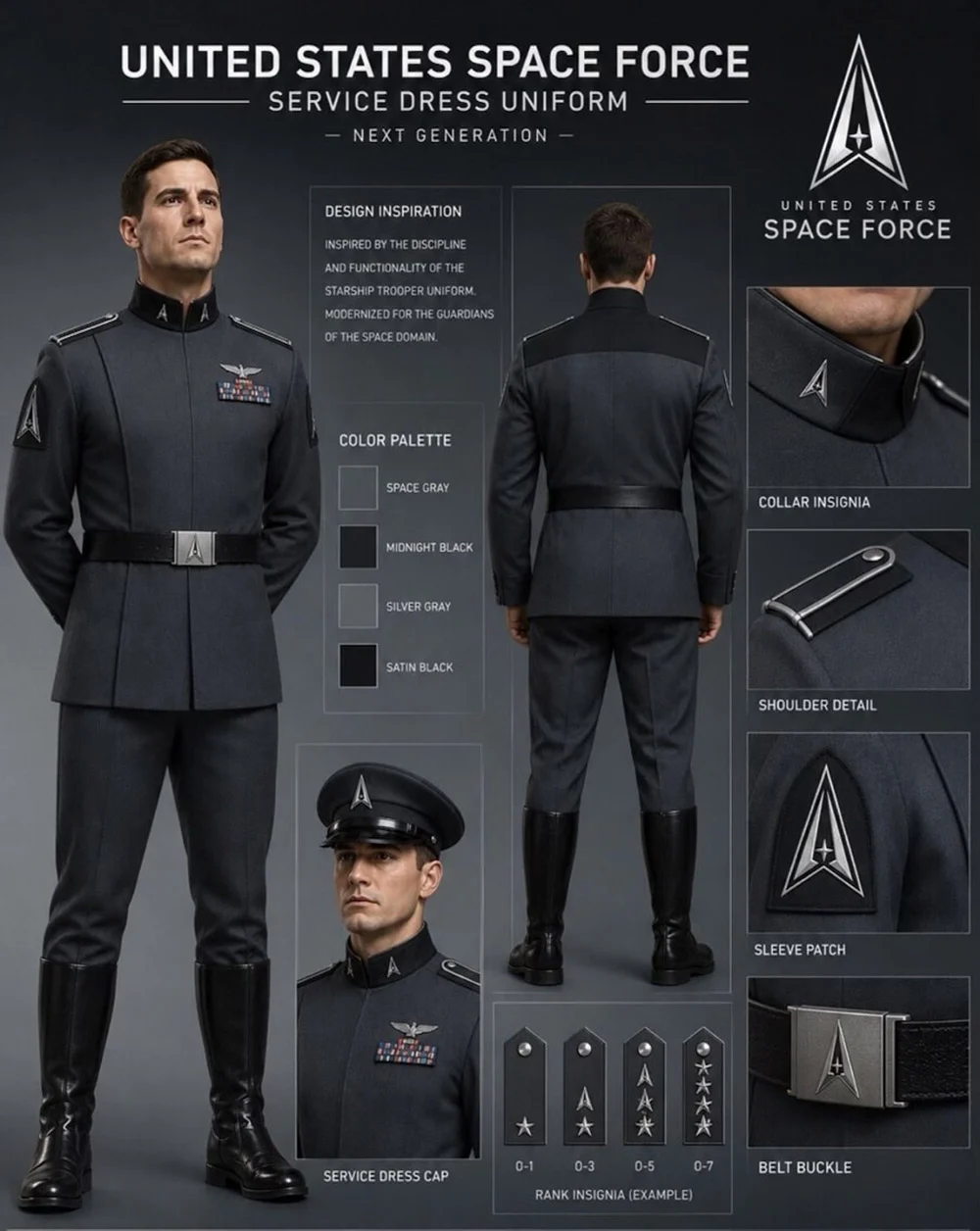
Filmmaker Paul Verhoeven recently offered a stark critique of the U.S. Space Force’s proposed "next generation" service dress uniforms, which former President Donald Trump unveiled on social media on September 6. While Trump’s post explicitly cited Verhoeven’s 1997 sci-fi action film Starship Troopers as inspiration for the severe black-and-gray design, Verhoeven countered that the film’s aesthetic roots lie with Leni Riefenstahl, the notorious German filmmaker who glorified the Nazi regime through propaganda. His comments underscore a fundamental misinterpretation of his satirical work, a point Verhoeven has frequently emphasized regarding the film’s cautionary tale about unchecked militarism and nascent fascism.
The Unveiling of the Space Force Uniforms
The controversy began when former President Donald Trump, a vocal proponent of the U.S. Space Force, shared design mockups for new military service dress uniforms on Truth Social. The accompanying text described the proposed attire as "inspired by the discipline and functionality of the Starship Trooper uniform," aiming for a modern yet formidable appearance for the newest branch of the U.S. Armed Forces. The designs featured a sleek, dark aesthetic, evoking a sense of future-forward combat readiness. This reveal quickly ignited a debate, not only about the uniforms’ practicality and aesthetic appeal but also about the underlying cultural and historical references they might inadvertently invoke.
The U.S. Space Force itself, established in 2019 under the Trump administration, has been a subject of continuous discussion regarding its identity and visual representation. As the first new military service in over 70 years, it has faced the unique challenge of forging a distinct image that balances traditional military gravitas with its futuristic mission. Previous uniform iterations, including its initial camouflage patterns and service dress, have also drawn scrutiny and public comment, highlighting the significant role that visual branding plays in military branches.
Verhoeven’s Sharp Rebuke: A Nod to Riefenstahl
Paul Verhoeven, the Dutch director behind Starship Troopers, responded to the news with a mix of amusement and pointed clarification. "It’s an honor, isn’t it?" he initially quipped, laughing, when asked by The Hollywood Reporter about the inspiration. However, his tone quickly shifted to a serious elucidation of his film’s visual genealogy. He stressed that when the Trump administration references Starship Troopers, they should be fully aware that its stylistic foundation is "based on the style of Leni Riefenstahl."
Riefenstahl, a filmmaker infamous for her powerful propaganda films for the Nazi Party, most notably 1935’s Triumph of the Will, perfected a cinematic language that aestheticized power, conformity, and mass spectacle. Her work employed dramatic camera angles, sweeping orchestral scores, and meticulous choreography to create an idealized, heroic vision of the Nazi movement and its leaders. Verhoeven’s deliberate invocation of Riefenstahl is not merely an artistic detail but a critical commentary on the potential for aesthetics to mask or glorify dangerous ideologies. He further articulated his concern: "I don’t know if this president is aware that the movie says these [characters] are fascists without knowing that they’re fascists. That’s the point."

Starship Troopers: Misunderstood Satire and Its Cult Status
Released in 1997, Starship Troopers was initially met with a lukewarm critical reception and modest box office performance. Many contemporary viewers and critics struggled with its overt violence, hyper-stylized militarism, and seemingly earnest portrayal of a dystopian, insect-battling future. However, over the decades, the film has undergone a significant critical re-evaluation, solidifying its status as a cult classic. Publications like The Atlantic have reappraised it as "One of the Most Misunderstood Movies Ever," while The Ringer highlighted its prescient "cautionary tale about reckless militarism and the dangers of fascism."
Verhoeven’s film, loosely adapted from Robert A. Heinlein’s 1959 novel, depicts a future society where citizenship is earned through military service, and a global government wages an interstellar war against an alien insect species. The narrative follows a group of fresh-faced recruits, including Johnny Rico (Casper Van Dien), Carmen Ibanez (Denise Richards), and Carl Jenkins (Neil Patrick Harris), as they are swept into this brutal conflict. While the surface narrative presents them as heroic figures, Verhoeven meticulously embedded layers of irony and satire, portraying the characters and their society with an unsettling blend of enthusiasm and chilling authoritarian undertones. The film’s pervasive propaganda newsreels, the uniforms, and the unquestioning patriotism all serve to illustrate how easily a society can slide into fascism, even while believing itself to be righteous.
Verhoeven has often expressed frustration at the initial misinterpretation of his work. "Many of the people who were working on the movie were disappointed when they saw the result," he recalled, noting that while he understood his satirical intent, "I don’t know if many of the actors and actresses realized." He added that the film has been challenging for audiences "because its heroes are, without knowing, Nazis. That’s been a problem. I thought people would understand and laugh about it. But that was not the case."
Leni Riefenstahl’s Enduring, Controversial Legacy
Leni Riefenstahl remains one of the most controversial figures in cinematic history. Her films, particularly Triumph of the Will (1935) and Olympia (1938), are lauded for their technical innovation and visual grandeur, yet inextricably linked to their role in disseminating Nazi ideology. Triumph of the Will, a documentary chronicling the 1934 Nazi Party Congress in Nuremberg, masterfully employed techniques like dynamic editing, soaring aerial shots, and intimate close-ups of Adolf Hitler to craft a mythic, almost divine image of the Nazi leadership and its mass appeal.
Riefenstahl’s artistry presented Nazism not as a political movement but as an aesthetic spectacle of power, unity, and strength. Her work, commissioned and overseen by Hitler himself, profoundly influenced subsequent propaganda and political filmmaking, demonstrating the dangerous effectiveness of visual rhetoric in shaping public perception. While she consistently denied being a Nazi sympathizer and claimed her work was purely artistic, her complicity in the regime’s propaganda machine has cemented her problematic legacy. Verhoeven’s deliberate channeling of Riefenstahl’s style in Starship Troopers was a calculated move to expose the seductive nature of fascism’s aesthetic, a point evidently missed by those who sought inspiration from the film’s uniforms.
The Role of Costume Design and Military Aesthetics
The uniforms in Starship Troopers were the vision of Oscar-nominated costume designer Ellen Mirojnick, whose extensive credits include collaborations with Verhoeven on Basic Instinct and Showgirls, as well as films like Wall Street, Speed, Twister, and Fatal Attraction. More recently, she has worked with Steven Soderbergh on projects like Kimi and Black Bag, and Christopher Nolan on Oppenheimer. Mirojnick’s design for the Mobile Infantry in Starship Troopers combined elements of traditional military attire with a futuristic, almost utilitarian sleekness, emphasizing conformity and a stark, imposing presence.

Military uniform design is inherently fraught with symbolism. Beyond practicality, uniforms convey identity, authority, and often, national values. Historically, nations have carefully crafted their military attire to project specific images, from the elaborate ceremonial dress of European monarchies to the functional simplicity of modern combat fatigues. The choice of black-and-gray for the Space Force, and its supposed connection to Starship Troopers, highlights a desire to project an image of advanced, disciplined power. However, as Verhoeven points out, when the inspiration itself is a satirical critique of fascism, the aesthetic choice carries unintended, and potentially disturbing, implications.
Broader Implications and Public Discourse
The Space Force uniform controversy, fueled by Verhoeven’s comments, extends beyond mere aesthetic preference. It taps into a deeper public discourse about the interpretation of historical symbols, the power of satire, and the potential for political leaders to misappropriate cultural artifacts. The misreading of Starship Troopers as a straightforward celebration of militarism, rather than a critical deconstruction, underscores a recurring challenge in popular culture: the difficulty of conveying nuanced irony, especially when dealing with potent political themes.
Verhoeven, as a Dutch citizen who has resided in the U.S. for decades, often reflects on the political culture of America. "I’m a Dutch citizen, and I cannot vote. I’ve been here in this country for 40 years and it’s still difficult for me to understand the political culture here in America," he noted, hinting at the complexity of how satire, history, and political messaging intersect in the American context. The incident serves as a reminder that visual choices, especially in official capacities, carry significant weight and can inadvertently evoke powerful, and sometimes uncomfortable, historical parallels.
The public reaction to the proposed Space Force uniforms and Verhoeven’s commentary reflects a broader sensitivity to military symbolism, particularly in a post-9/11 world where questions of national identity, global power, and the nature of warfare are continually debated. Whether the Space Force will proceed with designs so closely linked to a film intended to critique fascism, and to an aesthetic rooted in Nazi propaganda, remains to be seen. The incident, however, has undeniably sparked a vital conversation about artistic intent, political interpretation, and the enduring power of historical memory in contemporary design choices.