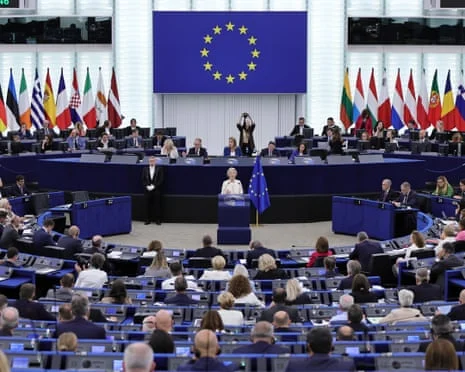
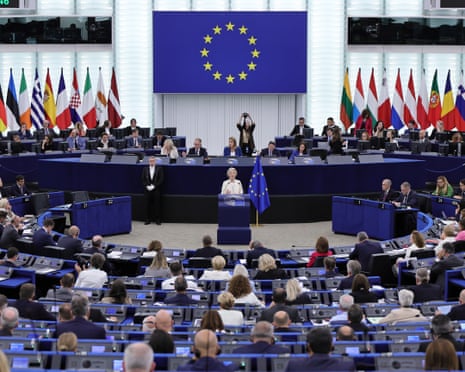
European Commission President Ursula von der Leyen issued a historic proposal during her annual State of the Union address on Wednesday, suggesting that Canada could become the first "associate member" of the European Union. Speaking before the European Parliament in Strasbourg, von der Leyen framed the potential partnership as a strategic necessity to secure the bloc’s supply chains and bolster democratic resilience in an increasingly hostile global landscape. The invitation marks a paradigm shift in European foreign policy, signaling a move toward a "coalition of the willing" among middle powers that share the EU’s commitment to the rules-based international order.
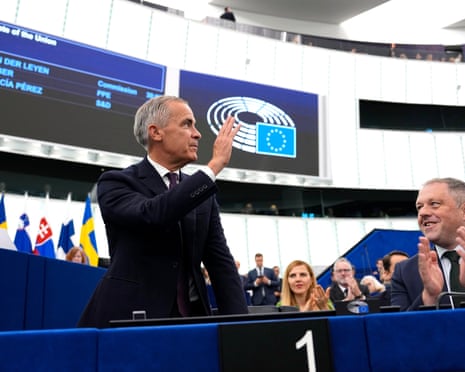
The proposal comes at a moment of profound geopolitical tension, as the European Union seeks to navigate a world fractured by trade wars, territorial aggression, and the rapid ascent of disruptive technologies. By offering Canada a unique status within the European framework, von der Leyen aims to create a high-speed trade and security corridor that would grant the EU access to critical raw materials while providing Canada with a stable alternative to an increasingly protectionist United States. Canadian Prime Minister Mark Carney, who was present in the Strasbourg chamber for the announcement, is expected to provide a formal response during his own address to the European Parliament scheduled for Thursday.
The Strategic Rationale Behind Canada as an Associate Member of the EU
The move to integrate Canada more closely into the European project is driven by the immediate economic needs of both parties. For the European Union, Canada represents a vital source of critical raw materials and rare earths, which are essential for the green energy transition and the production of high-tech defense systems. Currently, China maintains a near-monopoly on these resources, a "stranglehold" that von der Leyen described as unsustainable. By bringing Canada in as an associate member of the EU, Brussels hopes to diversify its supply lines and reduce its vulnerability to economic coercion from Beijing.

Canada’s motivation is
equally urgent. Facing a potential trade war with a Donald Trump-led administration in the United States, Ottawa is seeking to insulate its economy from American tariffs and volatility. The European market, with its hundreds of millions of high-spending consumers, offers a logical destination for Canadian exports that may no longer find a welcome home south of the border. This alignment of interests suggests that the "long winding road" typical of third-country relationships with the EU could be replaced by a streamlined, high-speed integration process.
Geopolitical Implications and the Concept of Middle Powers
The proposal also carries significant weight for the United Kingdom, which has struggled to define its relationship with the European Union following Brexit. Analysts suggest that the offer to Canada sets it apart from the UK, which had the opportunity for similar associate status but opted for a "clean break." As the EU focuses its political energy on the Canadian partnership, London may find itself sidelined in a "two-speed race" for influence and resources. Prime Minister Keir Starmer has previously discussed a deal for critical raw materials with Canada, but those negotiations have yet to yield a concrete agreement, potentially leaving Britain scrambling to catch up.
Beyond trade, the "associate member" designation would signify a deeper political alignment. Mark Carney has frequently spoken about the need for "middle powers"—nations that are not superpowers but possess significant economic and moral influence—to unite in defense of democratic values. Von der Leyen echoed this sentiment, stating that the partnership is not a move against any specific nation but a choice for "common strength." She emphasized that in a world where power often belongs to the "strongest, richest, and loudest," the EU and Canada are choosing to work together voluntarily to preserve the freedom of democracies.

Security Challenges and the Proposed European Security Council
While trade dominated the headlines, the State of the Union address also focused heavily on the mounting security threats on European soil. Von der Leyen warned that Russia’s war of aggression in Ukraine continues to escalate, accompanied by a rise in hybrid threats, including cyber sabotage, arson, and drone incursions across Lithuania, Denmark, and Poland. To counter these developments, the Commission President called for the establishment of a "European Security Council" and the creation of an emergency security protocol, modeled after NATO’s Article 4.
This new security framework would allow any member state to trigger a coordinated European response to incidents that fall just below the threshold of open military aggression. Von der Leyen argued that existing security systems were "made for a different world" and that the EU must now develop its own "counter-hybrid playbook." She reaffirmed that the bloc would defend "each and every single square meter" of its territory, emphasizing that the fate of Europe must remain firmly in the hands of Europeans.
Support for Ukraine and Sanctions Enforcement
The address included a pledge of the "strongest ever support" for Ukraine as the country prepares for what is expected to be the toughest winter of the war. The EU is currently redirecting funds to help Kyiv purchase advanced air defense systems and is working to develop an "affordable modular missile defense system" manufactured within Europe. Von der Leyen highlighted the story of Sasha, a young Ukrainian gymnast who returned to competition after losing a leg in a Russian strike, as a symbol of the "Ukrainian spirit of resistance." Sasha, who was present in the gallery, received a standing ovation from the members of Parliament.
Regarding Russia, von der Leyen shifted the focus from creating new sanctions to the rigorous enforcement of existing ones. She acknowledged that Moscow is doing everything possible to bypass current restrictions and stated that the EU’s primary task is to "close the loopholes." By tightening the enforcement of trade and financial bans, Brussels intends to maintain maximum pressure on the Russian economy and its ability to fund its military operations.
Rebalancing the Trade Relationship with China
The Commission President was notably blunt regarding the EU’s trade deficit with China, which she revealed has reached €1 billion per day. Labeling this imbalance "unsustainable," she warned of a "second China shock" that is already causing deindustrialization in Europe’s industrial heartlands. The EU plans to use all available tools to rebalance the relationship, focusing on protecting European factories and communities from what it views as unfair trade practices and state-subsidized competition.
This economic pivot away from China further underscores the importance of the proposal to make Canada an associate member of the EU. By securing a reliable partner for critical raw materials in the West, the EU can afford to take a firmer stance against Beijing without risking its technological and environmental goals. The move signals a broader trend toward "friend-shoring," where nations prioritize trade with allies over low-cost but politically risky partners.
Digital Regulation and the Introduction of the Kids’ Act
In the realm of digital policy, von der Leyen announced a sweeping new initiative called the "Kids’ Act," aimed at protecting children from the addictive and harmful features of social media. Citing the "great capture" of children’s attention by big tech platforms, she proposed a total ban on social media for children under the age of 13 and strict parental supervision for those under 15. The legislation would also mandate "safe design" for platforms used by those aged 15 to 18.
The Commission President emphasized that the "burden of proof" would be reversed, requiring tech companies to prove their platforms are safe for minors before they can be accessed. "It is us who decide the rules, not big tech," she declared, framing the initiative as a defense of childhood itself. This focus on digital sovereignty extended to artificial intelligence, where von der Leyen advocated for "AI with human agency," emphasizing that technology should empower professionals like doctors rather than replace them.
Climate Resilience and Migration Policy
Following a summer of record-breaking heat and devastating wildfires, von der Leyen called for urgent action on climate preparedness. She warned that while the past few months were the hottest on record, they would likely be the "coolest of the years to come." The EU will propose a new package on climate resilience and heatwave preparedness next month, focusing on urban adaptation and cooling infrastructure. She paid tribute to Rune Kyndal, a Danish pilot who died fighting wildfires in Greece, urging the Parliament to "think bigger and learn faster" in the face of escalating environmental disasters.
On the issue of migration, von der Leyen addressed the recent crisis in Ceuta, declaring that the Spanish border is a European border. She proposed a new "European Emergency Response" instrument to handle scenarios where mass movements of people are "engineered and weaponized" by adversaries. While pledging to uphold fundamental human rights, she stated firmly that "it is us Europeans who decide who comes to our union and under what circumstances," calling for a strengthening of the Frontex border agency.
A New Generation for the European Ideal
Concluding her address, von der Leyen reflected on the "powerful promise" of the European Union’s founding fathers. She announced the creation of a "Congress for Europe" intended to bring together the union’s most brilliant minds to inspire a new generation to "think European." Despite the "precarious" state of the world, she argued that the union remains the strongest it has ever been, provided it can maintain its unity against anti-European forces and disinformation.
The proposal to invite Canada to become the first associate member of the EU serves as the centerpiece of this vision for a proactive, sovereign Europe. By reaching across the Atlantic to forge a new kind of institutional bond, the EU is attempting to redefine its role as a global power capable of securing its own destiny. As Mark Carney prepares to speak on Thursday, the international community will be watching closely to see if this "dramatic offer" marks the beginning of a new era in transatlantic cooperation.