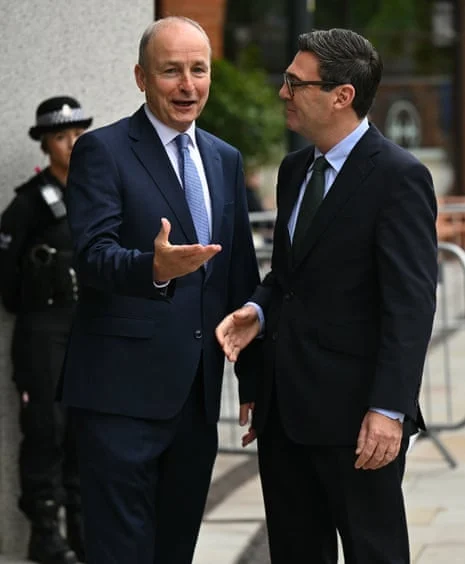
Prime Minister Andy Burnham met with Irish Taoiseach Micheál Martin at the government’s northern headquarters on Friday, signaling a significant diplomatic effort to secure critical trade concessions within the European Union’s emerging "Made in Europe" framework. The high-level talks, held at No. 10 North in Manchester, represent a pivotal moment for the Burnham administration as it attempts to recalibrate the United Kingdom’s relationship with Brussels while maintaining a distinct domestic identity. The meeting occurred as London intensifies its lobbying efforts to protect British industries from being sidelined by new EU procurement laws that favor member-state production.
The visit marks the first time Prime Minister Burnham has utilized the Manchester-based No. 10 North to host an overseas head of government. This move is widely viewed as a strategic attempt to decentralize British political power and demonstrate that major international diplomacy can be conducted outside the traditional confines of London. According to Downing Street officials, the meeting focused on a range of shared objectives, including the ongoing support for Ukraine, trade stabilization, and the UK’s desire for a formal reset with the European Union.
Seeking Exemptions from the EU’s ‘Made in Europe’ Plan
As Burnham hosts Ireland’s taoiseach as he bids for UK exemptions from EU’s ‘Made in Europe’ plan, the economic stakes for British manufacturing and technology sectors have reached a critical threshold. The "Made in Europe" initiative, a cornerstone of the EU’s current industrial strategy, aims to prioritize internal supply chains and reduce reliance on external partners. For the United Kingdom, these procurement laws pose a direct threat to cross-border trade, potentially locking British firms out of lucrative European contracts.

Simultaneously, Chancellor of the Exchequer John Healey traveled to Dublin to attend an informal meeting of Ecofin, the gathering of EU finance ministers. Healey’s presence at the summit is part of a coordinated "charm offensive" designed to convince European counterparts that the UK should be granted specific exemptions from the protectionist measures. Treasury sources indicate that Healey is arguing for a implementation of the rules that "lands a good deal for all" rather than "erecting new barriers" that could stifle regional economic growth.
The British government is particularly concerned that without these exemptions, the UK-EU trade reset promised by the Labour government will be dead on arrival. With Ireland currently holding the presidency of the European Union, the Taoiseach’s visit to Manchester is seen as a vital opportunity for Burnham to leverage Ireland’s influence within the bloc. Martin, for his part, expressed a desire for "even stronger and closer relationships" between the EU and the UK, noting that such a development would be of significant benefit to the Irish economy.
Diplomatic Alignment on Middle East Policy
Beyond trade, the meeting highlighted a growing alignment between London and Dublin on international humanitarian issues. Micheál Martin used the occasion to praise Prime Minister Burnham for "standing up for justice," specifically referencing the UK’s recent imposition of sanctions against illegal Israeli settlements in the West Bank. This stance has resonated strongly in Ireland, where historical experiences of colonialism have fostered deep-seated public support for the Palestinian cause.
During a joint press appearance, Martin stated that the UK’s leadership on this issue is essential for "fulfilling the rights of all in the Middle East to security, to peace, and to some decent future." The Taoiseach’s remarks underscore a shift in the UK’s foreign policy tone under Burnham, moving toward a more assertive role in international law and humanitarian advocacy. This diplomatic synchronization is expected to strengthen the UK’s hand during upcoming international summits, including a proposed UK-EU summit scheduled for later this year.
However, the path to a broader European reset remains fraught with delays. Although Burnham expressed optimism regarding the upcoming summit, a firm date has yet to be finalized. Critics have pointed out that the meeting has been repeatedly postponed, raising questions about the EU’s willingness to grant the specific trade exemptions the UK is currently seeking.
Domestic Policy Friction and the Wandsworth Legal Challenge
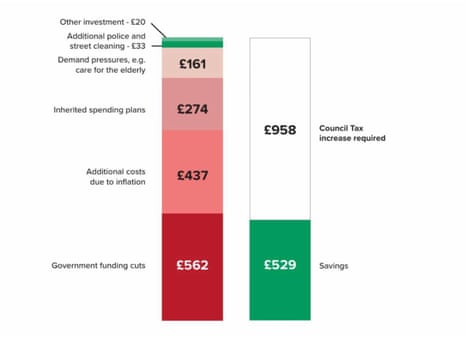
While the Prime Minister focused on international diplomacy, a domestic firestorm erupted over local government funding. Conservative leader Kemi Badenoch announced on Friday that the Tory party has "instructed lawyers" to challenge government-imposed funding cuts to Wandsworth Council in London. Badenoch alleged that the Labour government is deliberately penalizing areas that do not vote for them, leading to a projected 94% increase in council tax for Wandsworth residents.
The funding crisis stems from the "Fair Funding Review 2.0," a policy enacted last year that updated the formulas used to assess local authority needs. The new system adjusts funding based on socio-economic indicators such as deprivation and population density. Crucially, the "resource adjustment" mechanism penalizes councils that historically maintained low council tax rates, under the theory that they have the capacity to raise local taxes to compensate for reduced central government grants.
Wandsworth, which was Tory-controlled for over 40 years and famous for having the lowest council tax in England, now finds itself at the center of a legal and political battle. Badenoch described the 40% cut in funding as "outrageous," while the government argued that the previous system was "arbitrary and hard to defend." Institute for Fiscal Studies analyst Kate Ogden noted that residents in traditionally low-tax areas may have to accept that those rates came with "consequences for public services."
Border Security and the Reform UK Immigration Proposals
The political landscape was further complicated by announcements from the Reform UK party during the Democratic Unionist Party (DUP) annual conference in Belfast. Danny Kruger, the Reform UK MP overseeing the party’s plans for government, unveiled a proposal to intensify immigration checks on coaches, buses, and trains traveling from the Republic of Ireland into Northern Ireland.
Kruger alleged that "illegal and unvetted dangerous criminals" are utilizing the "soft" Irish border as a "backdoor route into the UK." The proposal includes a civil penalty of £10,000 per passenger for any bus or rail operator found to be transporting individuals without a legal right to enter. While Reform UK insists these are not "border checks"—as they would be conducted at terminals rather than the crossing point—the move has sparked concerns regarding the stability of the Common Travel Area and the delicate post-Brexit arrangements in Northern Ireland.
The proposal serves as a direct challenge to the Burnham administration’s handling of migration and border security. It also highlights the persistent tensions within the UK’s internal market and its relationship with its closest neighbor, issues that the Prime Minister had hoped to smooth over during his meeting with Taoiseach Martin.
The Revolving Door: Tom Watson and the Palantir Controversy
Adding to the government’s headaches, the Green Party issued a scathing condemnation of former Labour deputy leader Tom Watson following his decision to join the American AI firm Palantir. Watson, who is currently on a leave of absence from the House of Lords, stated he was "terrifically excited" to help transform public services through Palantir’s software, citing potential benefits for the NHS, the military, and the police.
However, Green MP Siân Berry characterized the move as an example of the "corrosive revolving door" between high-level politics and corporate lobbying. Palantir has long been a controversial figure in UK politics due to its contracts with the US Immigration and Customs Enforcement (ICE) and the Israeli Defense Forces (IDF). Berry argued that the company has "no business at all" in the UK’s public services and accused Watson of being hired specifically to "lobby his friends in the Labour government."
Palantir confirmed that Watson has surrendered his parliamentary pass and access privileges while working for the firm. Nevertheless, the optics of a former high-ranking Labour official joining a major tech contractor while the government seeks to modernize the NHS via AI and data platforms have provided ample ammunition for political opponents.
Economic Outlook and the Future of Public Institutions
Amid the political maneuvering, the British economy showed unexpected signs of resilience. Retail sales across Great Britain rose last month, defying gloomy forecasts and providing a boost for Chancellor Healey as he prepares to deliver next month’s budget. The bounce-back suggests that consumer confidence may be stabilizing, despite the ongoing debates over tax hikes and public service funding.
However, the future of several public institutions remains uncertain. The UK Youth Parliament, a democratic body formed in 1999 to represent children aged 11 to 18, is reportedly at risk of being scrapped. Government funding for the program has not been confirmed beyond March 2027, and a recent review found that only a quarter of young people were aware of the parliament’s existence.
Similarly, the BBC faces potential "mission drift" as the government considers a new charter obligation for the broadcaster to "drive economic growth." The House of Lords Communications and Digital Committee has urged the government to drop the proposal, warning that it could skew commissioning toward "generic, exportable content" at the expense of its public service mandate.
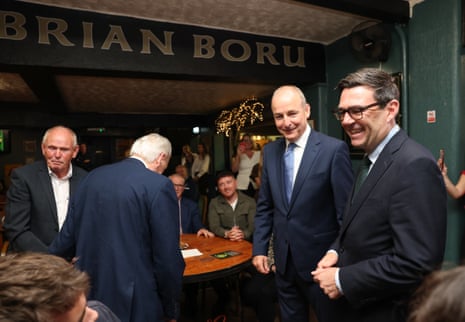
As the diplomatic session in Manchester concluded, Prime Minister Burnham and Taoiseach Martin visited a local Irish community center, emphasizing the deep cultural and ancestral ties between the North West of England and Ireland. While the "cordial" atmosphere of the visit provided a temporary reprieve from domestic conflicts, the underlying pressure to secure a "Made in Europe" exemption remains the defining challenge for the UK’s immediate economic future. The Burnham administration now faces the difficult task of turning these friendly discussions into concrete legislative victories in Brussels.