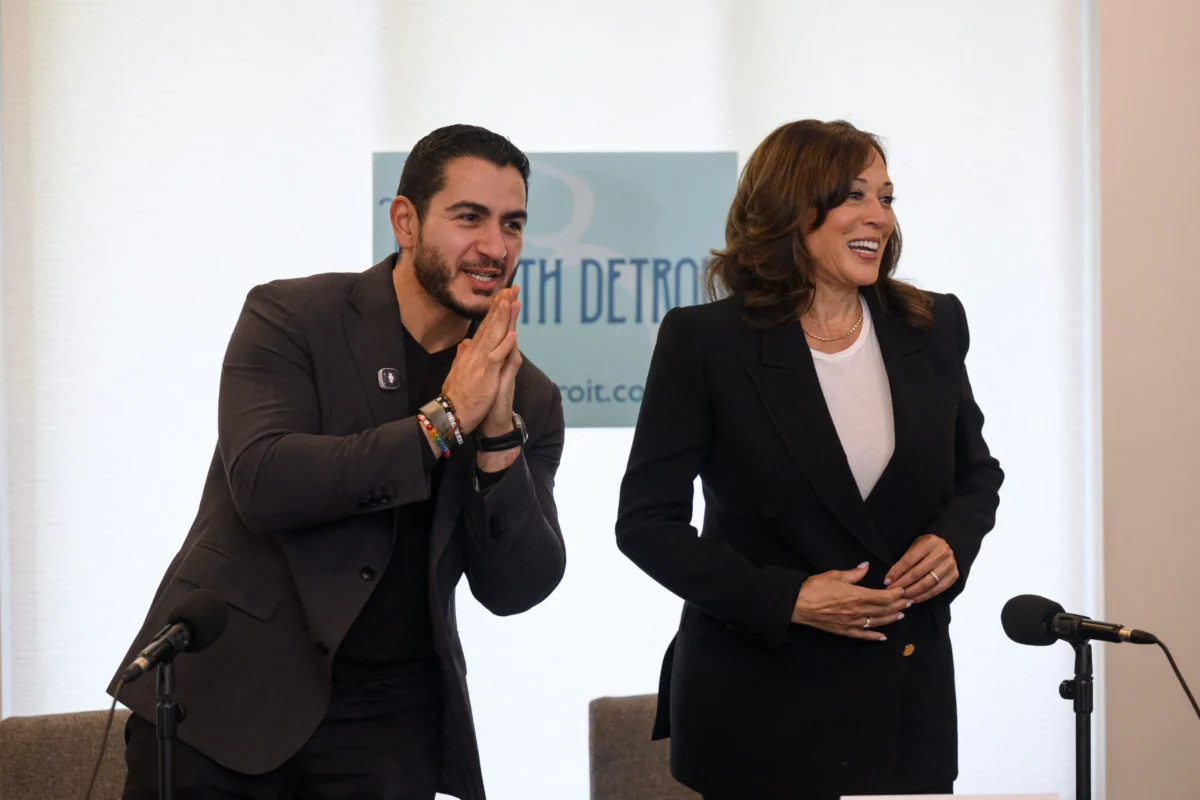
Vice President Kamala Harris joined Michigan Democratic Senate candidate Abdul El-Sayed on the campaign trail in Detroit, a strategic move aimed at bolstering Democratic unity in a critical swing state as the party eyes the final sprint toward the November midterm elections. The joint appearance underscored the Biden-Harris administration’s efforts to consolidate support among diverse Democratic factions, particularly in a state that proved pivotal in the 2020 and 2024 presidential contests.
The visit arrives at a crucial juncture for the Democratic Party, which has been grappling with internal divisions that surfaced prominently during El-Sayed’s hard-fought primary battle. The Democratic Senate nominee faced a formidable challenge from four-term Democratic Congresswoman Haley Stevens, who garnered significant backing from the Democratic establishment and pro-Israel political action committees. El-Sayed’s campaign has emphasized building a broad electoral coalition, a strategy that necessitates bridging these ideological and demographic divides.
"We’re building an electoral coalition here," El-Sayed stated on Tuesday, addressing economic concerns that resonate deeply with Michigan voters. He articulated his belief that Harris’s presence in Detroit, a city where her political career has inspired many, would serve to further unify and strengthen the Democratic Party’s base. This outreach is particularly significant given the demographic landscape of Wayne County, the state’s largest Democratic stronghold and home to Detroit’s predominantly Black electorate.
Bridging Factions and Targeting Key Demographics
The joint campaign stop in Detroit, Wayne County’s core, highlights a calculated effort to energize and mobilize key segments of the Democratic electorate. El-Sayed’s campaign recognizes the paramount importance of Black voters in securing a victory in November, especially as he navigates potential pressure points among some white Jewish voters who traditionally lean Democratic. The choice of Wayne County, a consistent Democratic stronghold, signals an intent to shore up support in areas critical for statewide success.
This strategic alliance comes at a time when the Democratic Party is acutely aware of the shifting allegiances within its traditional voter base. The 2024 presidential election saw President Donald Trump narrowly win Michigan, a state heavily influenced by its substantial Arab-American voting bloc. Harris’s previous stance on pro-Israel policies led to a significant number of Arab Americans in Michigan, who had previously been reliable Democratic voters, abstaining from supporting her presidential bid, a trend El-Sayed’s campaign seeks to reverse.
El-Sayed has been vocal about the need for solidarity ahead of the midterms, reflecting on the factors that contributed to the outcome of the 2024 presidential election. He noted that the election’s result stemmed from an inability to find common ground and unite people to move forward effectively. His message to voters, echoed by Harris’s presence, is one of shared economic concerns and the collective effort required to address the challenges faced by working families.
The Shadow of Past Policy Decisions
The political landscape in Michigan, particularly concerning Arab and Muslim voters, has been significantly shaped by past policy decisions and endorsements. Advocates have previously argued that as long as Harris maintained her commitment to supplying arms to Israel and did not distance herself from President Joe Biden’s unwavering support for the U.S. ally, her standing with Arab and Muslim voters would remain precarious. This backdrop adds a layer of complexity to the current campaign, underscoring the delicate balance El-Sayed and Harris must strike.
The upcoming midterm elections are poised to be a consequential contest for the Senate seat. El-Sayed is set to face off against former Representative Mike Rogers, the Trump-backed Republican nominee, who ran unopposed in the Republican primary. Rogers’ campaign has sought to frame Harris’s visit as an indication of weakness within the Democratic Party, suggesting it reflects a need for external validation.
Navigating Criticism and Building Unity
El-Sayed has directly addressed such criticisms, asserting that building a winning coalition necessitates a willingness to confront past differences rather than circumvent them. At the Detroit event, he emphasized that while complete agreement on all issues may not be possible, understanding the stakes involved is crucial. He urged voters to rally around shared economic priorities, articulating a vision for progress that hinges on collaboration.
"We don’t have to agree on everything to understand what is at stake," El-Sayed stated, underscoring his commitment to inclusive political engagement. He reiterated that the path forward involves the difficult but necessary work of bringing diverse groups together and fostering collective action. This approach seeks to bridge ideological divides by focusing on tangible economic benefits and shared aspirations for the state.
The Broader Implications for the Democratic Party
The joint campaign appearance between Harris and El-Sayed carries broader implications for the Democratic Party’s strategy in pivotal swing states. Michigan, with its diverse electorate and history of close elections, represents a microcosm of the challenges and opportunities facing Democrats nationwide. The effort to unify different factions – from progressive activists to moderate voters and key demographic groups – is essential for electoral success.
The campaign’s focus on economic issues aims to resonate with a wide spectrum of voters who are concerned about inflation, job security, and the overall cost of living. By highlighting shared economic anxieties and proposing solutions, the Democrats hope to cut through partisan divisions and appeal to voters’ immediate concerns. This strategy is particularly relevant in Michigan, where economic shifts have significantly impacted communities across the state.
Looking Ahead to the General Election
As the general election draws nearer, the dynamics of the Senate race in Michigan will continue to evolve. The engagement of high-profile figures like Vice President Harris signals the national importance of this contest. The Republican Party, under Donald Trump’s influence, is also mobilizing its base, setting the stage for a closely watched electoral battle.
The ability of El-Sayed and the Democratic Party to effectively bridge internal divides and mobilize a broad coalition of voters will be a determining factor in the outcome. The campaign’s focus on unity, economic prosperity, and direct engagement with communities reflects a strategy designed to navigate the complex political landscape of Michigan and secure a victory in November. The ongoing efforts to connect with voters across different backgrounds and ideologies underscore the high stakes of this midterm election for both the state and the nation.