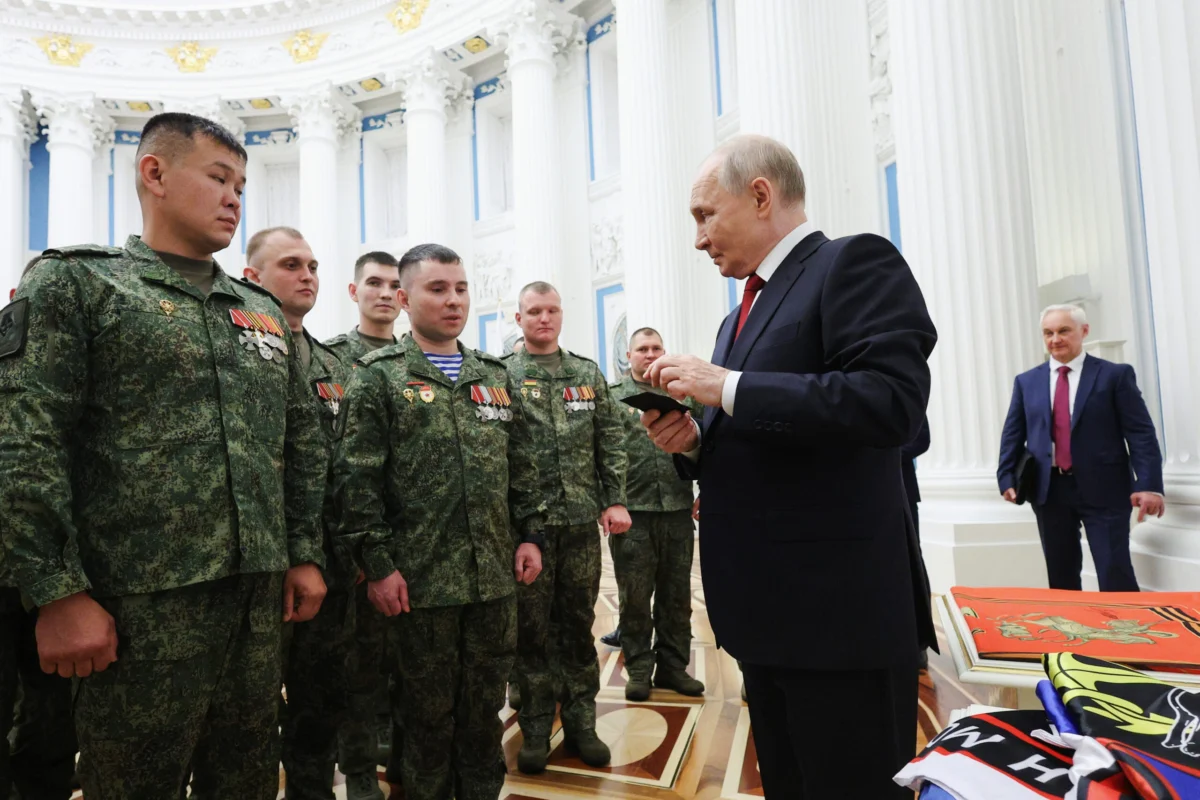
Russian President Vladimir Putin has ordered a significant expansion of the nation’s armed forces, authorizing the addition of 15,500 military personnel. This move comes as Russia’s battlefield advances in Ukraine have largely stalled after more than four and a half years of intense fighting, raising questions about Moscow’s strategic objectives and the future trajectory of the conflict. The decree, signed on Sunday, marks the fourth time this year that Putin has increased the authorized size of the Russian military, bringing the total personnel additions since March to 47,860.
The Kremlin has offered no explicit public justification for this latest military buildup. However, the decision coincides with mounting human and material losses for Russia, coupled with limited territorial gains on the Ukrainian front lines. Experts suggest that this expansion is a response to the grinding nature of the conflict and Russia’s ongoing efforts to sustain a protracted war.
Escalating Military Footprint: A Pattern of Expansion
President Putin’s latest decree establishes the authorized strength of the Russian armed forces at 2,441,630 units, with 1,550,500 designated as military personnel. This latest increment follows similar orders issued in March, June, and July of this year, signaling a consistent trend toward augmenting Russia’s military manpower. While the decree does not detail the recruitment methods for these new personnel, the repeated expansions underscore a commitment to bolstering the ranks of the Russian military.
Andrei Kortunov, Director General of the Russian International Affairs Council, characterized the expansion as largely "technical." He posited that the addition of 15,000 personnel is unlikely to fundamentally alter the dynamics of the conflict in Ukraine, suggesting that a diplomatic resolution remains a distant prospect. This perspective highlights the potential disconnect between Russia’s stated military objectives and the practical impact of such incremental personnel increases.
Strategic Imperatives Behind Putin’s Military Expansion
Ukraine expert Olena Halushka asserts that Russia’s war effort in Ukraine is not proceeding as planned. She points to Putin’s demands at a summit in Alaska last year, where he reportedly insisted on Ukraine’s withdrawal from parts of the Donetsk region that Russia had failed to capture. A year later, the battlefield situation contradicts such optimistic projections for Moscow, with Ukraine demonstrating resilience and continued resistance.

Halushka believes that Putin’s latest decree is indicative of Russia’s persistent strategy to secure sufficient manpower for a prolonged military engagement. This approach is further complicated by the widespread deployment of drones, which has made large troop concentrations and rapid military movements increasingly perilous for all sides. Russian military claims earlier this month indicated that its losses had surpassed 300,000, with over 20,000 casualties reported in the first half of September alone, though these figures remain unverified by independent sources.
Beyond Ukraine: Broader Geopolitical Considerations
While the conflict in Ukraine is the most immediate context, some analysts suggest that Putin’s decision to expand the army extends beyond the immediate needs of the Ukrainian theater. Alexey D. Muraviev, a professor and senior research fellow in Defense and Strategic Studies at Edith Cowan University, argues that the current increase is unlikely to be directly tied to Russia’s immediate operational requirements in Ukraine. He suggests that the planning, recruitment, and formation of new units would take considerable time and would not address pressing battlefield needs.
Instead, Muraviev proposes that Putin’s move is driven by "longer-term strategic considerations." These include escalating tensions with NATO and the perceived "increased possibility of a major open conflict between Russia and NATO in the foreseeable future." This perspective frames the military expansion as part of a broader geopolitical realignment, with Russia actively reorganizing its military, expanding its standing forces, and forming new divisions, including army and marine units. Furthermore, Muraviev notes Russia’s concern over the growing military power of Japan and the United States in the Pacific, suggesting a need to counter these perceived security threats.
The Shifting Landscape of the Ukraine War
The conflict in Ukraine continues to be characterized by intense aerial exchanges, even as ground operations progress at a slow pace. On Monday, Russian attacks across Ukraine resulted in at least 10 fatalities and over 80 injuries. Drones targeted critical infrastructure, including the National Academy of Sciences in Kyiv, with further attacks reported in Dnipro, Kharkiv, and Zaporizhia.
The escalating aerial assaults on Kyiv have forced prominent educational institutions, such as Taras Shevchenko National University, to transition to remote learning due to the deteriorating security situation. The university announced it would operate in a remote format until at least October 16, highlighting the direct impact of the conflict on civilian life and infrastructure.
Meanwhile, on the eastern front, Ukrainian forces have reportedly made gains in northern Donetsk. According to Reuters, a senior Ukrainian commander stated that Kyiv’s forces had recaptured approximately 51 square kilometers (19.7 square miles) in a recent operation, bringing the total recovered area to 176 square kilometers (68 square miles). Donetsk remains a crucial battleground and a significant point of contention, with Ukraine currently controlling about 20 percent of the region. Russia’s annexation of four occupied Ukrainian regions, including Donetsk and Luhansk, in 2022 has not been recognized by the international community.

Diplomatic Stalemate and the Prospect of Protracted Conflict
Despite the resumption of diplomatic efforts, significant breakthroughs remain elusive. Russia continues to demand territorial concessions from Ukraine, specifically the cession of eastern regions it has annexed, and insists on Kyiv renouncing its NATO aspirations. Ukraine, however, has firmly rejected territorial concessions and is seeking security guarantees from its European allies.
Recent diplomatic overtures included visits by U.S. envoys Steve Witkoff and Jared Kushner to Moscow and Kyiv, where they met with both President Putin and President Zelenskyy. While Zelenskyy described the proposals as "decent ideas," fundamental disagreements, particularly concerning territory, persist. Washington is reportedly exploring technical-level trilateral talks involving Russia, Ukraine, and the United States, with the United Arab Emirates suggested as a potential venue.
President Putin has indicated that proposals for resuming negotiations are "on the table," but Russia is still assessing its interests. Ukraine expert Halushka remains skeptical about the prospects for a diplomatic resolution as long as Moscow believes that "continuing the war will cost it less than ending it." She points to Russia’s actions as evidence that the Kremlin still hopes to achieve its objectives through military force, the targeting of civilians, and the erosion of Western support for Ukraine.
The Escalating Nature of the Conflict
Academic Muraviev views the war in Ukraine as having entered "a new escalation phase," with Moscow intensifying its aerial campaign and striving for "air dominance" through drone and missile attacks. He interprets this escalation as a direct response to Ukraine’s declared "40-day special operation" in June, which aimed to disrupt Russia’s war effort and undermine public morale.
In response, Muraviev suggests, the Kremlin seeks to "demonstrate its capacity to bring Ukraine down to its knees" by systematically targeting key sectors of Ukraine’s economy, including its steel industry and agricultural exports, while imposing a de facto naval blockade without direct engagement of its Black Sea Fleet. Russia’s current targeting of data and communication centers, refineries, bridges, and locomotives is seen as an effort to make the war "simply unaffordable to its Western allies." A proposed "energy truce" by U.S. President Donald Trump has thus far failed to halt the retaliatory attacks between the warring nations.