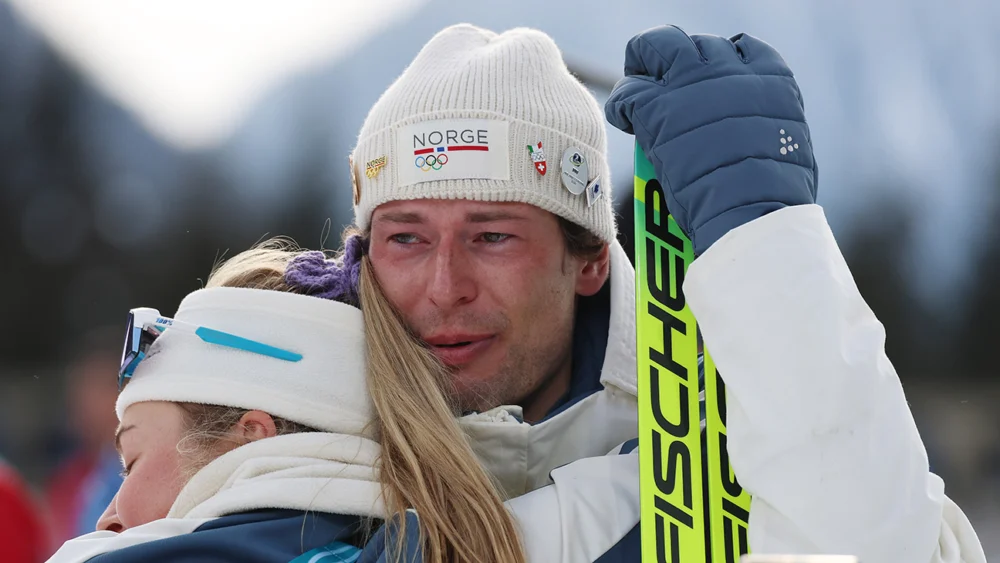
Norwegian biathlon athlete Sturla Holm Lægreid made global headlines following his bronze medal win at the 2026 Milan Cortina Games, not for his athletic achievement, but for a highly unusual and emotional post-competition interview where he tearfully admitted to cheating on his girlfriend. The raw, public confession, broadcast by the Norwegian Broadcasting Corporation, quickly went viral, igniting widespread discussion about personal responsibility, public apologies, and the intense scrutiny faced by elite athletes.
The Unprecedented Confession on a Global Stage
The incident unfolded after Lægreid, a decorated biathlete and six-time Biathlon World Champion, completed the demanding men’s 20 km biathlon event. While typically such interviews focus on performance, strategy, and future aspirations, Lægreid veered sharply into his personal life, using the international platform to address a profound private failing. His tearful admission of infidelity to his girlfriend of six months, whom he described as "the love of my life, the most beautiful and kindest person," captivated and stunned viewers worldwide.
Lægreid elaborated on the immense emotional toll the past week had taken, revealing he had confessed to her seven days prior. "It’s been the worst week of my life," he stated, his voice thick with emotion. He reflected on the perceived loss of his "gold medal in life" and the disappointment he believed many would now feel towards him. He emphasized his singular focus on his girlfriend, noting that sports had "taken a bit of a back seat these past couple of days." His desire to share his Olympic moment with her, despite the chasm his actions had created, was palpable.
A Public Plea for Forgiveness and Redemption
The Norwegian athlete’s candor extended to a desperate plea for reconciliation. "I’m not ready to give up," Lægreid asserted, suggesting that his public confession was a drastic measure to demonstrate the depth of his remorse. He expressed a hope that "committing social suicide [like this] might show her how much I love her." This statement highlighted the immense personal stakes he felt, framing his confession not just as an admission, but as a public act of contrition aimed at salvaging his relationship.
Lægreid acknowledged the gravity of his actions and expressed profound regret. "I accept the consequences of what I’ve done. I regret it with all my heart," he declared. In a moment of self-deprecating honesty, he mused, "Maybe I’m dumb as a rock. I’m a member of Mensa, but I still do stupid stuff." This attempt to humanize his mistake, contrasting his intellectual capability with his emotional lapse, resonated with some viewers while drawing skepticism from others.
He further explained his rationale for the public disclosure, stating he had "realized that this is the woman of my life, and I can’t live my whole life keeping that from her." For Lægreid, the path to potential redemption lay in complete transparency. "My only path to the finish line is to tell her everything and put it all on the table, and hope that she’ll still love me. I’ve done that for her, and now for the entire world. I’ve nothing to lose." This sentiment underscored the extremity of his situation, suggesting a man at rock bottom, willing to risk everything for a chance at forgiveness.
The Unique Pressures of Elite Athletics and Personal Life
Sturla Holm Lægreid’s confession sheds light on the often-hidden struggles of elite athletes. While the public typically sees their triumphs and tribulations on the field of play, their personal lives are usually shielded from the intense media glare. Biathlon, a sport combining the physical endurance of cross-country skiing with the precision of rifle shooting, demands extraordinary discipline and focus. Athletes like Lægreid dedicate years to training, often sacrificing personal relationships and a conventional lifestyle in pursuit of Olympic glory.
The pressure to perform, coupled with prolonged periods away from home, can strain personal bonds. When these pressures intersect with personal failings, the consequences can be magnified under the public microscope. Lægreid’s decision to weaponize his own vulnerability on such a grand stage raises questions about the psychological toll of elite sports and the boundaries between an athlete’s public persona and private identity.
Broader Implications of a Public Confession
The incident at the Milan Cortina Games represents a rare intersection of personal drama and professional achievement in the high-stakes world of international sports. Historically, athletes facing personal scandals often issue carefully worded statements or retreat from the public eye. Lægreid’s approach, however, was a raw, unscripted outpouring of emotion, delivered moments after winning an Olympic medal. This deviation from traditional crisis management strategies has sparked extensive debate among sports psychologists, media strategists, and the public alike.
Some view his actions as a desperate, albeit misguided, attempt at genuine accountability, believing that his willingness to "commit social suicide" might indeed convey the depth of his regret. Others perceive it as a calculated, manipulative tactic, an attempt to leverage public sympathy to pressure his girlfriend into forgiveness. The very public nature of the apology, critics argue, shifted the burden of decision-making onto his girlfriend in a highly visible and potentially uncomfortable way.
The Immediate Aftermath and Public Reaction
Journalistic reactions to Lægreid’s interview were swift and varied. One journalist described it as "the strangest medal interview I’ve seen," while a Norwegian podcaster labeled it "the most absurd medal interview of all time." These comments underscore the unprecedented nature of the event, which defied all conventional expectations for post-competition press conferences.
The incident quickly became a trending topic across social media platforms, eliciting a torrent of diverse opinions. Some viewers expressed empathy for Lægreid, acknowledging the immense courage it must have taken to be so vulnerable. They saw his actions as a desperate cry for help and a genuine expression of love. Conversely, a significant portion of the public reacted with skepticism and even outrage. One comment, widely shared, quipped, "If my ex, who just cheated on me, did this on a worldwide broadcast, I would order a drone strike on him." Another viewer articulated a more nuanced criticism, stating, "This feels like a desperate public play for forgiveness that probably makes things worse. Taking accountability is important but doing it on live TV feels more like manipulation than genuine remorse."
These reactions highlight the complex interplay of personal ethics, public perception, and the performative aspect of modern apologies. In an era dominated by social media, public figures often find their private lives scrutinized, and their attempts at reconciliation, however sincere, are dissected and judged by a global audience.
The Path Forward: Uncertainty and Unconditional Effort
In a follow-up press conference, Lægreid reiterated the uncertainty of his drastic actions. He admitted he didn’t know "if it’s the right choice or not," acknowledging the inherent gamble in his public confession. "So today I made the choice to tell the world what I did, so maybe there is a chance that she will see what she really means to me. And maybe not." His concluding remarks reflected a man resigned to the potential consequences, yet determined to exhaust all avenues in his pursuit of redemption. "But I don’t want to think I didn’t try everything to get her back."
Sturla Holm Lægreid’s tearful confession at the Milan Cortina Games has etched itself into Olympic lore, not for a record-breaking performance, but for an unprecedented moment of raw, personal vulnerability. It serves as a stark reminder that even atop the podium, personal struggles can overshadow professional triumphs, leaving athletes to navigate the treacherous waters where public fame collides with private heartbreak. The ultimate outcome of Lægreid’s bold, and arguably reckless, bid for forgiveness remains deeply uncertain, but his actions have undeniably sparked a global conversation about love, betrayal, and the lengths one might go to mend a broken trust.