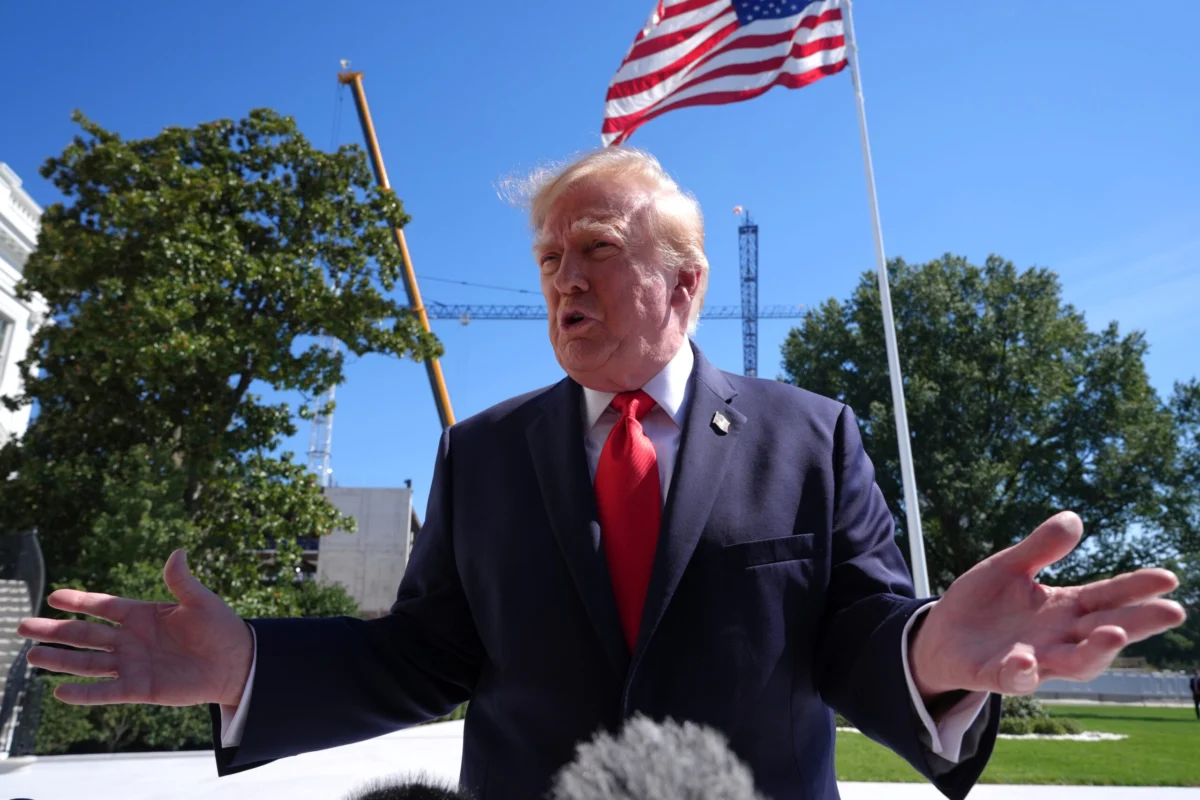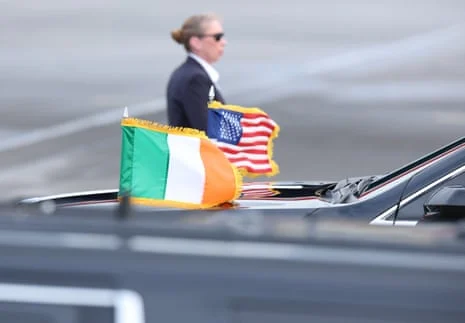
U.S. President Donald Trump arrived in the Irish capital on Saturday morning, touching down at Dublin Airport to initiate a high-stakes, two-day diplomatic and personal visit that will include meetings with top government officials and a stay at his private golf resort on the Atlantic coast. The visit began with a formal reception on the airport tarmac, where the American leader was greeted by Tánaiste Simon Harris before departing for a series of ceremonial events and policy discussions. This trip marks a pivotal moment in the complex relationship between Washington and Dublin, blending official state business with the President’s significant commercial interests in the country.

The President’s arrival was marked by the presence of a controversial Boeing aircraft, a $400 million "palace in the sky" gifted to him by the Qatari royal family. This specific aircraft has recently been the subject of intense security scrutiny following reports that it was used as a decoy during a previous trip to Turkey to evade potential threats. Despite these concerns, the President utilized the luxury jet for his transatlantic journey, landing under heavy security provided by a massive deployment of Gardaí and Secret Service personnel.
Immediately following his arrival, the President’s motorcade traveled to Áras an Uachtaráin, the official residence of the Irish president, for a meeting that has been the subject of intense speculation in the Irish press. The encounter with President Catherine Connolly is seen as a major test of diplomatic protocol, given Connolly’s history of vocal opposition to the U.S. President’s policies and rhetoric.

Strained Diplomatic Relations at Áras an Uachtaráin
The meeting at the presidential residence in Phoenix Park was characterized by formal pageantry and an underlying current of political tension. President Catherine Connolly, a long-standing critic of the Trump administration’s stances on immigration and Middle Eastern policy, received the American leader at the Portico of the historic building. The two leaders stood together at the end of the steps for a brief photo opportunity before Connolly led the President down the Francini corridor and into the state reception room.
Inside the residence, the President was invited to sign the visitors’ book, a tradition for visiting heads of state. The atmosphere was described by observers as professional but cool, reflecting the deep ideological divide between the two figures. Connolly has previously been critical of the President’s personal conduct, most notably after an incident where he mistakenly referred to her as a man. Despite these past frictions, the Irish government has emphasized the necessity of maintaining a working relationship with the United States, Ireland’s most significant source of foreign direct investment.

Following the signing ceremony, the leaders proceeded to the drawing room for private discussions. While the Irish presidency is a largely ceremonial role, Connolly’s influence as a moral and political voice in the country is significant. Many in the Irish public had called for her to use the meeting to challenge the President on humanitarian issues, while others urged restraint to avoid jeopardizing the economic ties that remain the bedrock of the bilateral relationship.
The Qatari Jet and Security Concerns
The choice of aircraft for this visit has reignited a debate regarding presidential security and the ethics of foreign gifts. The Boeing 747-8, which serves as the President’s primary mode of transport for this trip, was originally a gift from Qatar and underwent extensive modifications to meet presidential standards. However, military analysts have raised questions about whether the plane possesses the same level of defensive capabilities as the traditional Air Force One fleet.

These concerns are rooted in a dramatic incident that occurred in July during the President’s visit to Ankara. Reports emerged that the President was secretly moved off the Qatari-gifted jet via a catering truck and onto an older, more secure aircraft after intelligence suggested a possible Iranian threat. The original plane continued its flight as a decoy, carrying the U.S. Secretary of State, the Treasury Secretary, and the traveling press pool, none of whom were informed of the potential danger.
The use of the jet in Dublin has required a massive security perimeter around the airport. Gardaí vehicles lined the runway as the President disembarked, and the logistics of the motorcade have caused significant traffic disruptions throughout the city. The security operation is estimated to be one of the most expensive in Irish history, reflecting the high-profile nature of the visitor and the current global threat environment.

Economic Interests and the Doonbeg Resort
A primary focus of the President’s itinerary is his private golf resort at Doonbeg, located in County Clare. The President is scheduled to travel to the beachfront property on Saturday evening to attend the Irish Open, a major tournament currently being held at the course. This blend of private business and public office has drawn criticism from political opponents who argue that the President is using a state visit to promote his commercial brand.
Tánaiste Simon Harris, speaking to reporters at the airport, attempted to frame the visit as a celebration of the deep interpersonal links between the two nations. Harris noted that the President’s grandchildren are accompanying him on the trip, marking their first visit to Ireland. He also highlighted the Irish heritage of several senior White House staff members, including the Chief of Protocol, who has ancestral roots in County Cork.

"Alongside the politics and the pageantry, there is a reminder of the deep interpersonal links between our two countries," Harris stated. He emphasized that the President has a genuine affection for the Irish landscape and expressed pride in the Doonbeg resort. However, the economic impact of the President’s "America First" trade policies remains a point of concern for Irish business leaders who fear potential tariffs on Irish exports.
The Deerfield Reception and Business Ties
Before departing for the west coast, the President is scheduled to host a reception at Deerfield, the official residence of the U.S. Ambassador in Phoenix Park. The guest list for the event includes some of Ireland’s most prominent business and cultural figures. Ryanair CEO Michael O’Leary and entertainer Michael Flatley are among those expected to attend, reflecting the intersection of corporate interests and celebrity that often defines the President’s social circle.

The grounds at Deerfield have been transformed for the occasion, with a large marquee erected and decorated with American flags. In a signature touch, sound checks at the venue included several of the President’s favorite campaign rally songs, such as "God Bless the USA" and "YMCA." The event is intended to provide a forum for the President to speak directly to Irish and American business leaders about the future of transatlantic trade.
Ireland remains a critical hub for U.S. multi-national corporations, particularly in the technology and pharmaceutical sectors. Any shift in U.S. tax policy or trade regulations could have a profound effect on the Irish economy, which relies heavily on American investment. The Deerfield meeting is seen as an opportunity for the Taoiseach, Micheál Martin, to advocate for the continued stability of these economic arrangements.

Public Response and Local Disruption
While the official reception for the President has been characterized by diplomatic decorum, the reaction from the Irish public has been decidedly mixed. In Dublin, the massive security presence and road closures have frustrated residents and commuters. Taxi drivers and local business owners have complained that the "mayhem" caused by the visit has brought the city to a standstill.
"He’s causing mayhem in this city because he wants to go down to Doonbeg and play golf," said Christopher Fox, a Dublin taxi driver. "The world’s in turmoil and this fella’s down playing golf." This sentiment is echoed by various activist groups who have organized protests in the city center, citing the President’s environmental policies and his administration’s approach to global conflicts as their primary grievances.

In contrast, the atmosphere in Doonbeg is expected to be more welcoming. The resort is a major employer in the region, and many local residents credit the President’s investment with revitalizing the local economy. For the people of County Clare, the visit is seen as a significant promotional opportunity for Irish tourism, despite the controversy surrounding the man himself.
Geopolitical Context and Global Implications
The visit comes at a time of significant global uncertainty, with the war in the Middle East and ongoing tensions with Iran casting a shadow over international diplomacy. President Connolly’s expected focus on these issues highlights the divergent paths taken by the U.S. and Ireland on the world stage. Ireland has long maintained a policy of military neutrality, often serving as a vocal advocate for human rights and international law within the European Union.

The discussions between the President and Irish leaders are expected to touch upon the post-Brexit landscape and the status of the Northern Ireland Protocol. The U.S. has historically played a guarantor role in the Good Friday Agreement, and Irish officials are keen to ensure that Washington remains committed to peace and stability on the island. The President’s relationship with the European Union also remains a critical factor, as Ireland seeks to balance its EU membership with its special relationship with the United States.
As the President prepares for his second day in Ireland, the focus will shift from the formal corridors of power in Dublin to the fairways of Doonbeg. While the trip is ostensibly about strengthening ties between two old allies, the reality is a complex tapestry of business, personal brand-building, and high-stakes diplomacy. The events of the next 24 hours will be closely watched on both sides of the Atlantic for signs of how the U.S.-Ireland relationship will evolve in an increasingly volatile global environment.