A relentless Russian assault on Ukraine’s Kharkiv region claimed the lives of two police officers Saturday as they were engaged in an evacuation effort in the village of Seredniy Burlyk, underscoring the ongoing escalation of hostilities between Moscow and Kyiv. The attacks come amid a surge in reported "combat clashes" across the front lines.
The head of the Kharkiv regional administration, Oleh Syniehubov, confirmed that the city of Kharkiv and ten other populated areas endured Russian bombardment over the preceding 24-hour period. The deadly incident in Seredniy Burlyk, where five others sustained injuries from shelling, highlighted the perilous conditions civilians face even during official rescue operations.
"Over the past 24 hours, 175 combat clashes were recorded," Syniehubov stated, providing a stark overview of the intensity of fighting. "On the South-Slobozhansky direction, the enemy four times stormed the positions of our units in the areas of the populated settlements of Staritsa, Lyman, Vovchansky Khutory, and Krugle." This detailed account from the regional governor paints a picture of persistent Russian pressure along key sectors of the front.
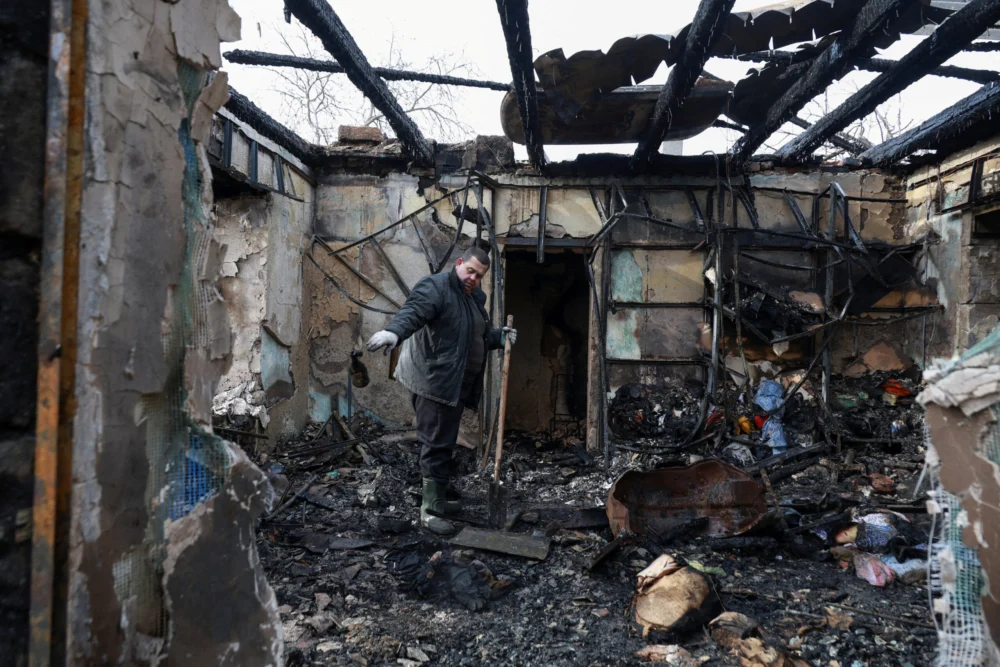
In a separate but related development, a Russian air strike targeted a residential area in Sumy, injuring three individuals. The National Police of Sumy Oblast reported that the attack destroyed two homes and damaged at least ten neighboring houses, along with a crucial gas pipeline. Among the injured were two children, aged five and 17, and a 70-year-old woman who required hospitalization.
Escalation of Cross-Border Strikes
The tit-for-tat attacks extended deep into Russian territory, as Ukrainian drones reportedly struck an industrial facility in Russia’s Udmurt Republic. Local health minister Sergei Bagin announced that 11 people were injured in the drone attack, with three requiring hospitalization. The head of the Udmurt Republic, Alexander Brechalov, confirmed that "one of the republic’s facilities was attacked by drones," acknowledging both casualties and damage without specifying the exact nature of the targeted site.
Unverified reports, however, analyzing resident-captured footage, suggest the strike may have targeted the Votkinsk Machine Building Plant. This facility is a significant state-owned defense enterprise known for its production of sophisticated weaponry, including the Iskander ballistic missile system, which has been extensively deployed by Russia against Ukraine. The plant is also implicated in the production of intercontinental ballistic missiles capable of carrying nuclear warheads, underscoring the strategic importance of any strike against it.
Ukraine’s military has since acknowledged the strike on the Votkinsk factory, posting on Facebook that "fire was recorded on the territory of the object. The results are getting real." This statement implies a successful and impactful Ukrainian operation against a key Russian defense manufacturing hub.
Further demonstrating Kyiv’s expanded strike capabilities, the Ukrainian army also reported hitting a Russian gas processing plant in the Samara region, which subsequently caught fire. These strikes against industrial and energy infrastructure indicate a strategic shift by Ukraine to disrupt Russia’s economic and military-industrial complex.
Russian Advances and Defensive Operations
Simultaneously, Russia has claimed incremental gains on the battlefield. Russia’s state news agency TASS reported that Moscow’s forces have taken control of the village of Karpivka in the eastern Donetsk region of Ukraine. This territorial shift, if confirmed, represents a minor but potentially significant advancement for Russian troops in a strategically contested area.
TASS also reported on attempted Ukrainian drone strikes against production facilities in Almetyevsk, located in Russia’s Tatarstan region. The head of the city indicated that air defense systems were actively engaged in repelling these aerial incursions, suggesting a widespread and coordinated effort by Ukraine to strike targets across Russia.
Background: The Prolonged Conflict and Shifting Tactics
The recent exchange of attacks underscores the evolving nature of the conflict that began with Russia’s full-scale invasion in February 2022. Initially characterized by large-scale ground offensives and conventional warfare, the conflict has increasingly seen both sides employ long-range strike capabilities, including drones and missiles, targeting military, industrial, and infrastructure assets.
Kharkiv, Ukraine’s second-largest city, has been a frequent target of Russian bombardment since the early days of the invasion. Its proximity to the Russian border makes it particularly vulnerable to artillery and missile attacks. The ongoing efforts to evacuate civilians from frontline areas, as seen in Seredniy Burlyk, remain a dangerous and critical undertaking, often placing rescue workers in direct harm’s way.
The Votkinsk Machine Building Plant, situated in the Udmurt Republic, approximately 700 miles east of Moscow, is one of Russia’s premier defense manufacturing facilities. Its output is crucial to the Russian military’s sustained offensive operations in Ukraine. A successful strike against such a facility carries significant symbolic and practical implications, potentially impacting Russia’s ability to replenish its arsenal of advanced weaponry.
The use of drones by both sides has become a defining feature of the modern warfare landscape. Ukraine has increasingly relied on domestically produced and acquired drones to conduct reconnaissance, target Russian logistics, and strike deep behind enemy lines, including within Russian territory. Russia, in turn, has utilized drones for surveillance and attack purposes.
Broader Implications and Public Impact
The intensification of cross-border strikes raises concerns about further escalation and the potential for wider regional instability. For civilians in both Ukraine and Russia, these attacks bring the realities of war directly into their communities, fostering fear and uncertainty. The loss of life, particularly among first responders like the police officers in Kharkiv, serves as a grim reminder of the human cost of this protracted conflict.
The economic impact of these attacks is also considerable. Damage to industrial facilities, infrastructure, and residential areas disrupts supply chains, necessitates costly repairs, and diverts resources that could otherwise be used for reconstruction and development. For Russia, strikes on its defense industry could affect its long-term military production capacity and potentially strain its economy.
Politically, these events put further pressure on international actors to continue supporting Ukraine and to maintain sanctions against Russia. The effectiveness of these measures, coupled with the ongoing military assistance to Ukraine, will be crucial in shaping the trajectory of the conflict.
Reactions and Next Steps
The Ukrainian government has consistently framed its strikes on Russian territory as defensive measures aimed at disrupting the aggressor’s war-making capabilities. The reported success at the Votkinsk plant will likely be presented as a significant achievement in this strategic effort.
Russia, conversely, has condemned such attacks as acts of terrorism and has vowed retaliation. The extent to which Russia will retaliate against Ukrainian cities or infrastructure remains a critical question, potentially leading to further civilian casualties.
The international community continues to monitor the situation closely, with many nations reiterating their calls for a peaceful resolution to the conflict. However, with both sides demonstrating a willingness to escalate their military actions, the prospects for an immediate de-escalation appear dim. The coming days and weeks will likely see continued military engagements and diplomatic maneuvering as the conflict grinds on.
The sustained intensity of the fighting in eastern and southern Ukraine, coupled with the growing reach of aerial attacks, paints a grim picture of a war that is far from over. The resilience of the Ukrainian people and the strategic implications of these strikes will undoubtedly continue to be a focal point of international attention.