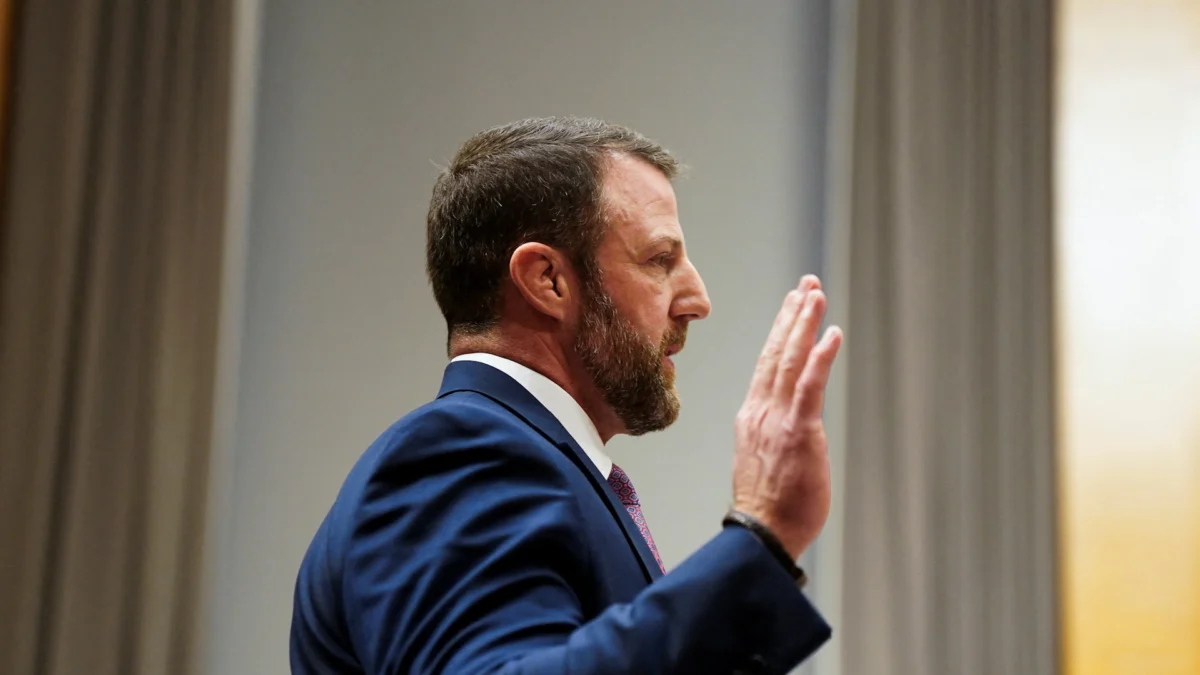
Markwayne Mullin, a staunch loyalist to former President Donald Trump and a former mixed martial arts fighter, has been appointed as the next Secretary of Homeland Security. This appointment marks a significant moment, as Mullin becomes the first Native American to lead the Department of Homeland Security (DHS). His tenure is expected to be defined by President Trump’s intensified efforts to secure the nation’s borders and implement stringent immigration policies.
Mullin, currently serving as a U.S. Representative for Oklahoma’s 2nd congressional district, brings a unique background to a department tasked with a wide range of critical national security responsibilities. His prior career as a professional MMA fighter, combined with his business acumen as an owner of Mullin Tanks, a plumbing and heating company, presents a departure from the typical profile of individuals who have held the top DHS post. Supporters point to his business experience and his direct communication style as assets that will allow him to effectively manage the vast and complex federal agency.
From the Octagon to Capitol Hill: A Political Ascent
Born in Tulsa, Oklahoma, Markwayne Mullin’s early life was shaped by his Cherokee heritage and a strong work ethic. He attended Oklahoma State University, where he competed in wrestling before embarking on a career in professional mixed martial arts. His fighting career, spanning from 2000 to 2009, saw him amass a respectable record and gain a reputation for toughness and determination. This background, he has often stated, instilled in him a discipline and resilience that he believes are transferable to public service.
Following his athletic career, Mullin returned to his family’s business, Mullin Tanks, expanding its operations and demonstrating significant entrepreneurial skills. His entry into politics began in 2012 when he successfully ran for the U.S. House of Representatives. Representing a largely rural and conservative district, Mullin quickly established himself as a vocal conservative voice, aligning himself closely with the Republican Party’s platform.
A Loyal Trump Advocate in Homeland Security
Mullin’s political trajectory has been characterized by unwavering support for Donald Trump. He was a prominent surrogate for Trump’s campaigns and has consistently championed the former president’s policy agenda, particularly on issues related to immigration and border security. His appointment to lead DHS is seen by many as a strategic move by Trump to ensure a dedicated and aligned leader at the helm of an agency central to his national security vision.
The Department of Homeland Security, established in the aftermath of the September 11, 2001 terrorist attacks, is responsible for preventing terrorism, securing borders, enforcing immigration laws, and responding to natural disasters. It encompasses a vast network of agencies, including Customs and Border Protection (CBP), Immigration and Customs Enforcement (ICE), the Transportation Security Administration (TSA), and the Federal Emergency Management Agency (FEMA). The sheer scale and scope of DHS operations require a leader with a broad understanding of national security imperatives and the ability to manage diverse operational units.
Navigating the Complex Landscape of Border Security and Immigration
President Trump’s approach to immigration has been a cornerstone of his political platform, often characterized by a focus on strict enforcement, border wall construction, and increased deportations. Mullin’s appointment signals a likely continuation and potential escalation of these policies. His public statements have often echoed Trump’s rhetoric on border security, emphasizing the need for robust measures to control illegal immigration and maintain national sovereignty.
The challenges facing the Department of Homeland Security are multifaceted and have become increasingly complex in recent years. Issues such as managing asylum claims, addressing humanitarian concerns at the border, combating human trafficking, and ensuring the efficient processing of legal immigration all fall under DHS’s purview. Mullin will be tasked with balancing these competing demands while implementing the Trump administration’s directives.
The Significance of a Native American Leader at DHS
Markwayne Mullin’s status as the first Native American to lead the Department of Homeland Security is a historically significant development. This achievement has been met with both celebration and scrutiny. For many in Native American communities, his appointment represents a milestone and an opportunity for greater representation within the federal government. His own statements have often highlighted his pride in his heritage and his commitment to serving all Americans.
However, his alignment with Trump’s immigration policies has also drawn criticism from some Native American advocacy groups who express concern about the potential impact of these policies on Indigenous populations and border communities. The complex relationship between federal policy and Indigenous sovereignty adds another layer of consideration to Mullin’s leadership at DHS. His ability to navigate these sensitivities while fulfilling his departmental responsibilities will be a key aspect of his tenure.
A Look at Key Policy Priorities and Potential Challenges
As the new Homeland Security chief, Mullin is expected to prioritize several key areas. Foremost among these will be the strengthening of border security. This could involve increased funding for border patrol agents, enhanced surveillance technologies, and the continued push for physical barriers along the U.S.-Mexico border. The Trump administration has consistently advocated for such measures, and Mullin’s leadership is likely to see a vigorous pursuit of these objectives.
Immigration enforcement is another critical area. Mullin will oversee the operations of ICE, which is responsible for enforcing U.S. immigration laws and deporting undocumented immigrants. It is anticipated that there will be a renewed emphasis on apprehending and removing individuals who have entered the country illegally or overstayed their visas. This will likely involve increased collaboration between federal agencies and state and local law enforcement.
The broader implications of Mullin’s appointment extend beyond immigration policy. DHS also plays a crucial role in cybersecurity, counterterrorism, and disaster response. His experience as a businessman and his background in wrestling and MMA, while unconventional, could inform his approach to these areas. For instance, his understanding of strategic planning and tactical execution might be applied to cybersecurity threats or emergency preparedness.
Public Reaction and the Road Ahead
The announcement of Markwayne Mullin’s nomination as Homeland Security chief has generated a range of reactions across the political spectrum. Supporters laud his loyalty to Trump and his commitment to border security, viewing him as a strong leader who will effectively implement the administration’s agenda. They often point to his business background as evidence of his capability to manage a large organization.
Conversely, critics have expressed concerns about his policy positions, particularly his views on immigration, and his perceived lack of extensive experience in national security or law enforcement. Some civil liberties advocates have voiced apprehension about the potential for increased enforcement actions and their impact on immigrant communities. The Native American community’s response, as noted, is also varied, reflecting both pride in representation and concern over policy implications.
The confirmation process for Mullin is expected to be rigorous, with Senate hearings likely to delve deeply into his policy views, past statements, and qualifications for the role. His ability to articulate his vision for DHS and to reassure lawmakers of his capacity to lead the department responsibly will be critical to securing Senate approval.
As the nation anticipates his leadership, the focus will be on how Markwayne Mullin navigates the complex and often contentious issues that fall under the Department of Homeland Security’s mandate. His tenure as the first Native American to hold this pivotal position will undoubtedly be closely watched, both for its policy outcomes and its symbolic significance. The challenges are immense, but his appointment signals a clear direction for the Trump administration’s priorities in national security and border control. His background, from the wrestling mat to the halls of Congress and now potentially to the helm of one of the nation’s most vital security agencies, presents a compelling narrative of a political figure whose journey continues to unfold on the national stage.