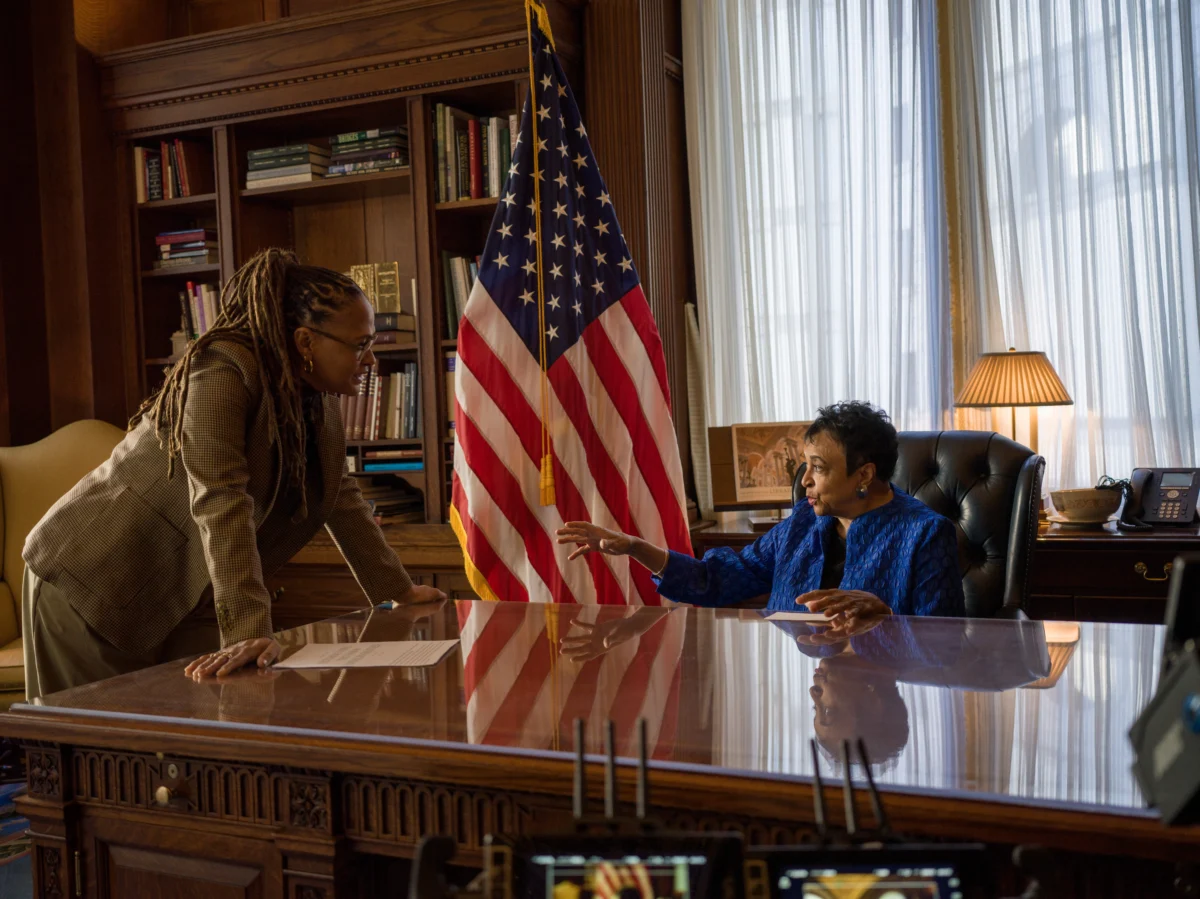
Filmmaker Ava DuVernay’s highly anticipated documentary, 14th, a profound examination of the 14th Amendment to the U.S. Constitution, is slated to make its global debut as the prestigious closing night selection for the 2026 New York Film Festival (NYFF). The announcement signals a significant moment for the festival and for DuVernay, whose previous work, 13th, inaugurated the same festival a decade prior.
A Landmark Constitutional Focus for DuVernay
The Netflix-backed film, 14th, is scheduled for a screening on October 9, 2026, marking a powerful continuation of DuVernay’s cinematic exploration of American justice and constitutional law. Following the critically acclaimed 13th, which delved into the history of racial inequality and mass incarceration through the lens of the 13th Amendment, 14th now turns its gaze to the 14th Amendment. This pivotal post-Civil War amendment, enacted in 1868, sought to redefine American citizenship and ensure fundamental rights for formerly enslaved people, establishing provisions for birthright citizenship, due process, and equal protection under the law, while also containing a controversial clause regarding insurrection by elected officials. DuVernay’s new work promises to dissect how these provisions, intended to unify and protect, have instead become subjects of enduring national debate and profound division.
The Enduring Legacy of the 14th Amendment
The 14th Amendment stands as one of the most transformative additions to the U.S. Constitution, profoundly altering the relationship between individuals, states, and the federal government. Its five sections address critical aspects of American identity and governance. Section 1, arguably the most impactful, defines national citizenship, stating that "All persons born or naturalized in the United States and subject to the jurisdiction thereof, are citizens of the United States and of the State wherein they reside." This clause is the bedrock of birthright citizenship, a principle that has faced increasing scrutiny and political challenge in recent years. Furthermore, Section 1 introduces the Due Process Clause, guaranteeing that no state shall "deprive any person of life, liberty, or property, without due process of law," and the Equal Protection Clause, which mandates that no state shall "deny to any person within its jurisdiction the equal protection of the laws." These clauses have been instrumental in advancing civil rights, expanding voting rights, and protecting individual liberties across diverse populations.
Beyond these foundational elements, the 14th Amendment also includes clauses addressing apportionment of representatives, disqualification from office for engaging in insurrection or rebellion, validity of public debt, and congressional enforcement powers. The Disqualification Clause (Section 3), specifically targeting individuals who have taken an oath to support the Constitution and subsequently engaged in insurrection, has seen renewed relevance in contemporary political discourse, particularly in the aftermath of events like the January 6, 2021, Capitol riot. DuVernay’s 14th documentary aims to untangle these complex historical and contemporary threads, illustrating how these century-and-a-half-old provisions continue to shape the nation’s political, legal, and social landscape.
From "Who Gets Caged" to "Who Gets Counted"
Director Ava DuVernay articulated the film’s central inquiry, drawing a direct parallel to her earlier work. "If 13th asked who gets caged, then 14th asks who gets counted," DuVernay stated when Netflix initially announced the project. This thematic progression highlights her ongoing commitment to examining systemic issues that define American identity and justice. 14th is not merely a historical retrospective but an urgent contemporary analysis, as DuVernay emphasized: "This is not a film about the past tense of freedom. I’m not interested in asking you to look back. The film asks what kind of country is being written beneath our feet now… while we’re busy believing the stories we’ve all been told." This forward-looking perspective suggests the documentary will weave historical scholarship with present-day headlines, creating a dynamic narrative that underscores the amendment’s living, evolving impact.
The 14th documentary promises a comprehensive and multi-faceted exploration, featuring insights from a diverse array of voices. The film includes perspectives from both Democratic and Republican politicians, such as Representatives Alexandria Ocasio-Cortez and Anna Paulina Luna, Senator Alex Padilla, and former Senator Jeff Flake. This bipartisan representation is critical to portraying the breadth of the debate surrounding the 14th Amendment. Complementing these political figures are esteemed legal experts like Sherrilyn Ifill, Robert Chang, and Stacey Abrams; influential commentators Donald T. Critchlow and Hasan Piker; and renowned historians Eric Foner and David Blight. This rich tapestry of expertise is designed to offer viewers a nuanced understanding of the constitutional principles at stake and their ramifications for modern society.
DuVernay’s Return to the New York Film Festival Stage
The selection of the 14th documentary as the NYFF closing night film carries particular resonance for DuVernay. "Exactly a decade after 13th opened the New York Film Festival, it feels especially meaningful to return with 14th as the 2026 closing night selection," DuVernay commented in a prepared statement. She underscored the festival’s unique role as a platform for robust intellectual exchange, stating, "NYFF has always been a place where films invite conversation rather than simply applause. To that end, 14th attempts to interrogate a promise powerful enough to change a nation — and controversial enough to divide it for more than 150 years. There’s no better place to begin that conversation than NYFF." Her gratitude extended to NYFF artistic director Dennis Lim and his team for their support of challenging, thought-provoking work. DuVernay expressed hope that the film would inspire audiences to engage in debate, question established narratives, and ultimately, imagine new possibilities for the nation.
Dennis Lim, the artistic director of the New York Film Festival, echoed DuVernay’s sentiments, highlighting the urgency and clarity of her new film. "We are honored to close this edition of the New York Film Festival with Ava DuVernay’s supremely timely follow-up to 13th," Lim stated. He characterized 14th as "a movie for the moment that sees through the fog of the present," praising DuVernay’s ability to provide clear insight into the complex issues at hand. "The great gift of this urgent and essential work is its clarity: Ava has made a film that shows us precisely what led us here and what is at stake right now," Lim added, emphasizing the documentary’s potential to illuminate current societal challenges.
Political Undercurrents and the 14th Amendment
The timing of the 14th documentary’s release and its focus on the amendment’s provisions is particularly pertinent given recent political developments. The film arrives at a moment when the principles enshrined in the 14th Amendment have been intensely scrutinized and challenged, particularly concerning birthright citizenship. Former President Donald Trump notably targeted the birthright citizenship provision, advocating for significant restrictions on this constitutional guarantee. His administration had pursued policies aimed at limiting birthright citizenship, culminating in an executive order designed to heavily restrict the constitutional right.
However, the Supreme Court ultimately intervened, striking down Trump’s executive order in June 2025 by a 6-3 vote. This judicial affirmation of the existing interpretation of the 14th Amendment underscored the enduring legal and societal significance of birthright citizenship, even as political debates surrounding immigration and national identity continue to rage. The 14th documentary is poised to provide essential historical context and analytical depth to these ongoing disputes, offering viewers a framework for understanding the constitutional underpinnings of these contentious issues. The film’s release will undoubtedly fuel further public discourse and legal analysis on the future of American citizenship and rights.
The Director’s Legacy and Production Details
Ava DuVernay, an Oscar-nominated, Emmy, and Peabody award-winning filmmaker, has consistently used her platform to shed light on critical social justice issues. Her filmography, including Selma, 13th, When They See Us, and Origin, demonstrates a powerful commitment to historical accuracy, empathetic storytelling, and challenging established norms. DuVernay directed and produced 14th through her production company, Array Film, a testament to her vision and control over the project’s narrative. She was joined in the production by Spencer Averick, Tammy Garnes, and Paul Garnes, a team known for their collaboration on impactful cinematic works. Their collective effort underscores the seriousness and dedication invested in bringing this crucial constitutional narrative to the screen.
The 64th New York Film Festival is scheduled to run from September 25 to October 12, 2026. The festival will open with the North American premiere of James Gray’s Paper Tiger, setting the stage for a lineup of diverse and thought-provoking films. The decision to feature Ava DuVernay’s 14th documentary as the closing night selection reinforces the festival’s reputation as a vital platform for films that not only entertain but also provoke significant societal reflection and dialogue. As audiences gather for its premiere, the 14th documentary is expected to ignite crucial conversations about the fundamental promises of American democracy and the ongoing struggle to fulfill them for all.