The Houthi militia’s recent declaration of intent to blockade Saudi shipping and vessels destined for Saudi ports in the Red Sea represents a significant escalation, signaling Iran’s latest gambit to test Riyadh’s strategic restraint through its proxy. This move is particularly dangerous as Saudi Arabia has, for nearly a decade, meticulously worked to avoid a wider regional conflict that Tehran appears increasingly eager to instigate. The Kingdom’s measured approach has not stemmed from military inadequacy but has been a calculated strategic choice aimed at preserving regional stability and enabling its ambitious economic transformation agenda. Faced with Saudi Arabia’s conventional economic and developmental prowess, Iran has increasingly resorted to asymmetric warfare, including proxy actions, maritime coercion, and economic intimidation.
Iran’s Proxy Strategy and Maritime Pressure
The Houthi movement has become the primary vehicle for Iran’s proxy strategy. By targeting maritime traffic in critical chokepoints like the Strait of Hormuz and the Bab al-Mandeb Strait, Tehran aims to exert pressure on Saudi Arabia from both its eastern and western maritime gateways. This strategy seeks not outright military victory but rather economic disruption, with the goal of undermining investor confidence, threatening vital energy exports, and projecting instability onto the Middle East’s largest economy.
The potential consequences of such disruptions extend far beyond the immediate region. Saudi Arabia, as the world’s largest crude oil exporter and OPEC’s leading producer, holds a unique position in global energy markets. Its substantial spare production capacity is crucial for stabilizing international energy supplies during crises, a role it notably fulfilled during the early phases of the Iran-Iraq War via its East West Pipeline. Any sustained disruption to Saudi exports would inevitably create cascading effects throughout international shipping, insurance markets, and global inflation, impacting economies worldwide.
Denying Iranian Logistical Support in Yemen
Iran’s efforts to bolster the Houthis have also involved attempts to re-establish direct logistical links. The recent, albeit brief, restoration of the Tehran-Sana’a air bridge was more than a symbolic gesture of renewed ties. It was perceived as an effort to create a direct logistical corridor for the rotation of operational planning advisors, missile specialists, drone technicians, and intelligence officers into Houthi-controlled territories. Such an air corridor would have facilitated not only the transfer of advanced weaponry but also critical operational expertise and command and control capabilities, significantly enhancing the Houthis’ offensive capacity.
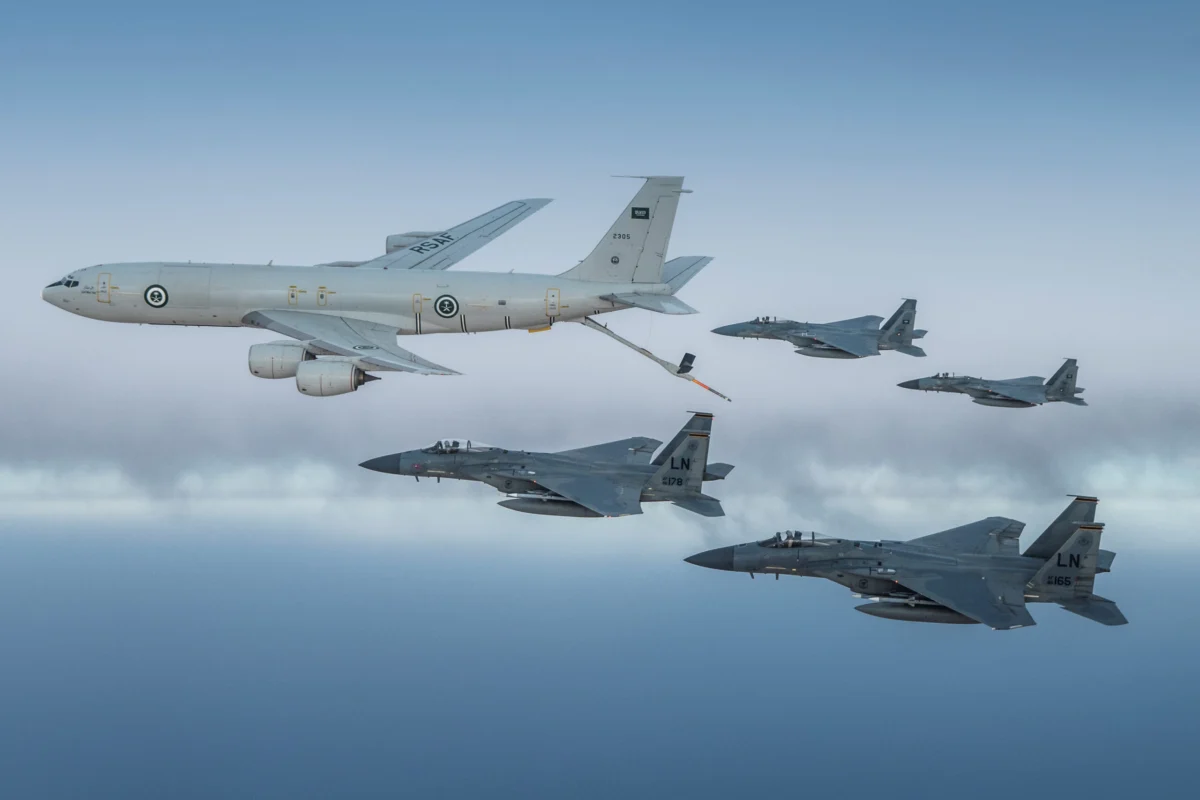
In response, the Royal Saudi Air Force (RSAF) strike on Sana’a International Airport was a decisive action aimed at preventing Iran from establishing a permanent logistical architecture. This move underscores Riyadh’s determination to thwart Tehran’s efforts to build a more sophisticated and sustained proxy campaign targeting Saudi Arabia’s economic and maritime interests.
Saudi Arabia’s Evolving Military Capabilities
Tehran’s current calculations appear to be based on outdated assessments of Saudi Arabia’s military strength. The Saudi-led Joint Forces Command (JFC) has undergone a profound transformation over the past decade. Hard-won lessons from past operational experiences have forged a highly integrated coalition characterized by persistent intelligence gathering, fused command and control systems, precision strike capabilities, advanced air and missile defense, and robust cyber operations.
Rather than functioning as disparate military commands, these capabilities now operate within a unified decision-making framework. This integrated architecture significantly compresses the timeline between intelligence acquisition and operational execution, enhancing responsiveness and effectiveness.
This evolution extends beyond the Saudi armed forces themselves. The JFC now encompasses over 650,000 personnel, drawing from Saudi Arabia and allied nations including Yemen, Pakistan, Sudan, and symbolic contingents from the Gulf Cooperation Council (GCC). Operating within a unified framework, this force leverages its strength not just in numbers but in its capacity to synchronize military effects across multiple domains, maintain operational tempo, and exercise centralized escalation control.
Demonstrations of Enhanced Operational Prowess
The maturity of the JFC was starkly demonstrated during the RSAF’s swift campaign that re-established control over southern Yemen in January, a feat accomplished in less than a week. This operation showcased an advanced command and control (C2) fused architecture that seamlessly integrated persistent intelligence, electronic warfare, precision targeting, and synchronized maneuver. The operational sequencing and command integration displayed marked a significant leap forward from earlier phases of the conflict.
Similar C2 sophistication was evident during coordinated Iranian missile and drone attacks launched from Iranian territory and by allied formations in Iraq. In response, the RSAF executed synchronized precision strikes across multiple theaters while maintaining rigorous centralized escalation control, showcasing a strategic and tactical adaptability.
Broader Geopolitical Ramifications
These operational successes have had significant geopolitical reverberations. Saudi Arabia’s demonstrated military effectiveness helped create the conditions for Pakistan to broker a ceasefire between Riyadh and Tehran. This, in turn, reinforced a new deterrence equation, where further direct Iranian military pressure carried substantially greater operational and political risks for Tehran. Iran’s subsequent cautious approach was not solely a diplomatic development but also an acknowledgment of Saudi Arabia’s entry into a new phase of military maturity.
This does not imply that the Houthis are incapable of imposing costs. Their arsenal of missiles, drones, maritime attack capabilities, and psychological operations can still generate disruption disproportionate to their size. However, sustained disruption is fundamentally different from engaging in a prolonged confrontation against an adversary possessing overwhelming advantages in intelligence, air power, maritime control, and operational endurance.
The Escalating Stakes for the Houthis
Each escalation by the Houthis, therefore, increases the likelihood of a comprehensive Saudi response. Such a campaign would not be limited to targeting individual missile launchers or drone facilities. Instead, it would aim to dismantle the entire network of command and control systems, logistics infrastructure, communications networks, intelligence apparatus, and operational support that underpins Houthi military operations.
The current trajectory is fraught with danger. Saudi Arabia has consistently prioritized stability and economic transformation over confrontation. Its overarching strategic imperative remains long-term national development. However, no sovereign state can indefinitely tolerate an Iranian-backed proxy force systematically threatening its economy, energy infrastructure, and vital maritime lifelines.
Ultimately, the Houthis are not testing Saudi military capability; years of operational adaptation have already provided that answer. They are, in fact, testing Saudi Arabia’s strategic patience. Historical precedent suggests that even the most profound strategic patience has its limits. If Tehran persists in utilizing the Houthis as an instrument of coercion against the Kingdom, Riyadh may eventually conclude that the costs of continued restraint have surpassed the costs of decisive action. Should that moment arrive, any ensuing campaign would bear little resemblance to the Yemen war of a decade ago. It would instead reflect years of coalition integration, built upon an elaborate C6ISR architecture, strategically prepared for such a contingency. At that juncture, Iran and its Houthi proxies may come to deeply regret testing the boundaries of Saudi Arabia’s strategic patience.