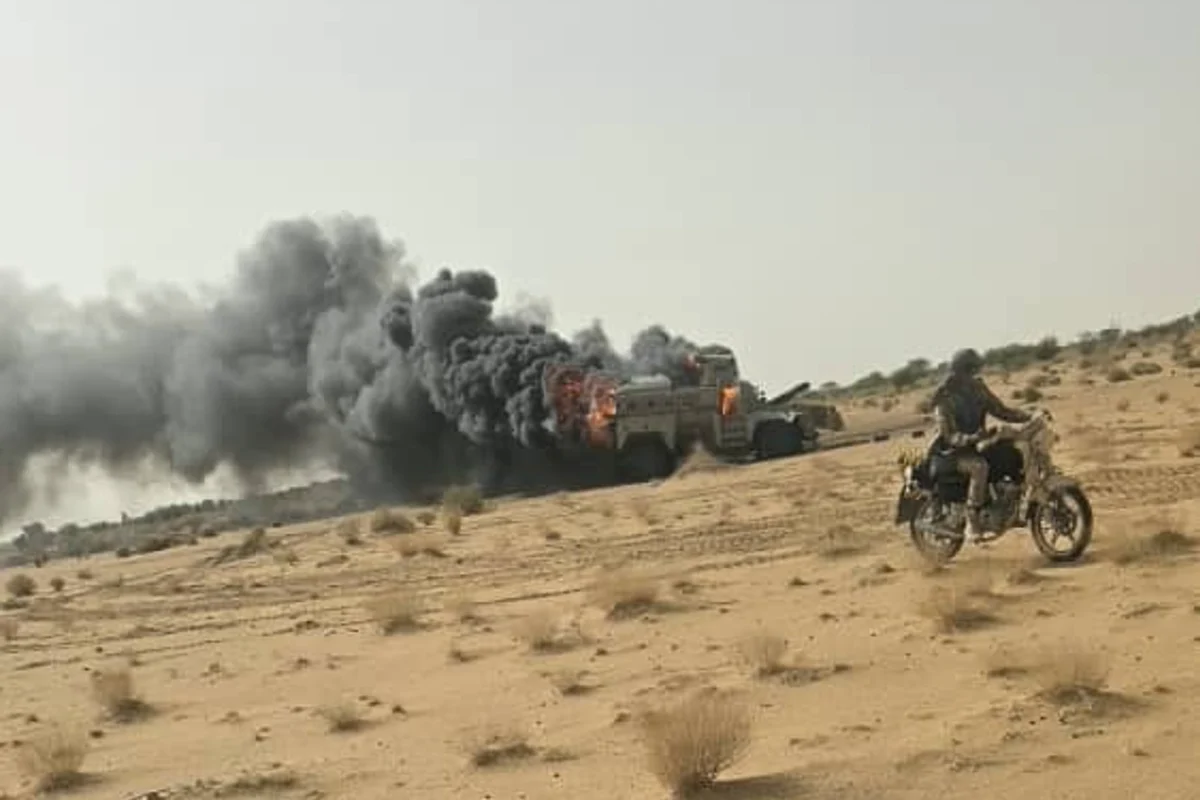
A deadly ambush on July 18 near Anefis, which claimed the lives of at least 50 Malian soldiers and struck a joint convoy of the Malian Armed Forces (FAMa) and Russia’s Africa Corps, signals a significant shift in the protracted conflict gripping Mali and potentially destabilizing the broader Sahel region. This attack, more than a mere military setback, underscores a growing coordination among Mali’s diverse armed factions and exposes the limitations of the ruling military government’s security strategy, even with intensified Russian military backing. The Malian military confirmed the assault and initiated counter-operations, while the Africa Corps released footage purportedly showing drone strikes against those responsible. This incident is the latest in a series of coordinated operations across northern Mali since April, prompting critical questions about the motivations behind this newfound inter-group cooperation, the efficacy of Bamako’s security approach, the true impact of Russia’s expanded military role, and the escalating ramifications for the entire Sahel.
The Unlikely Alliance: Separatists and Islamists Unite Against a Common Foe
The joint claim of responsibility for the July 18 ambush by the Azawad Liberation Front (FLA), a coalition of predominantly Tuareg separatist groups, and Jama’at Nusrat al-Islam wal-Muslimin (JNIM), an al-Qaeda affiliate operating in the Sahel, represents a significant and previously improbable development. These groups have historically harbored divergent long-term political objectives: the FLA seeks greater autonomy or outright independence for northern Mali, often referred to as Azawad, while JNIM is ideologically driven to establish governance based on its interpretation of Islamic law across the region.
Experts suggest this convergence is not rooted in shared ideology but rather in a pragmatic, shared battlefield enemy. Héni Nsaibia, a senior West Africa analyst at the Armed Conflict Location & Event Data (ACLED) monitor, explains that the Tuareg-led separatists and JNIM are currently united by their opposition to the Malian armed forces and their Russian partners from the Africa Corps. This cooperation functions as a potent force multiplier, enabling them to consolidate resources and synchronize efforts for more effective confrontation. Beyond strategic alignment, underlying kinship ties and a shared sense of defending ancestral lands against perceived external forces contribute to their mutualistic battlefield approach, despite ideological disparities.
Bamako’s Strategic Shift and the Erosion of Peace Frameworks
The Malian military government’s decision to formally abandon the 2015 Algiers Peace Agreement and demand the withdrawal of the United Nations Multidimensional Integrated Stabilization Mission in Mali (MINUSMA) has fundamentally reshaped the conflict’s dynamics. The dissolution of the peace framework eliminated one of the few existing mechanisms for managing relations between Bamako and the armed groups in the north. Concurrently, the military junta’s increasingly confrontational posture has inadvertently pushed former rivals toward coordinating their actions against a common adversary.
This evolving landscape became starkly evident in April with coordinated attacks across various regions of Mali, stretching Malian and Russian forces thin across multiple fronts. The recent fighting around Anefis further demonstrates the alliance’s capability not only for launching simultaneous operations but also for sustaining pressure on strategically vital military positions. With negotiations sidelined and military confrontation becoming the predominant strategy, armed groups that once vied for dominance are now finding greater incentives for battlefield cooperation. This strategic recalibration by Bamako has inadvertently fostered a more unified and adaptable opposition.
Russia’s Evolving Role: Bolstering Capabilities, Not Transforming the Conflict
Since assuming the mantle from the Wagner Group as Moscow’s primary military contingent in Mali, the Africa Corps has become an increasingly integral partner for the Malian army. Russian personnel have provided direct combat support alongside Malian troops, while Russian drones and aircraft have significantly enhanced the army’s surveillance and strike capabilities. These advancements have bolstered the Malian military’s capacity to respond to attacks and defend key strategic locations.
However, analysts argue that while Russia has bolstered Mali’s military, which was arguably on the verge of being overwhelmed, this support has not fundamentally altered the trajectory of the conflict. Nimi Princewill, a regional analyst specializing in West Africa and the Sahel, notes that the recent attacks and the earlier seizure and subsequent retaking of Kidal by Tuareg and allied fighters in November 2023 and April 2024, respectively, suggest that the Kremlin’s military assistance has not resolved the conflict’s deep-seated geographical and ideological dimensions, which continue to elude the junta’s grasp.

Instead of transforming the war, Moscow’s military backing appears to have strengthened the Malian army’s tactical battlefield capabilities without addressing the underlying political, governance, and security conditions that perpetuate the violence. Ongoing operations reinforce this assessment, with convoys traversing northern Mali continuing to face frequent ambushes, particularly along critical routes connecting Gao, Anefis, and other military outposts. This highlights the persistent vulnerability of military supply lines despite the increased Russian presence and capabilities.
The Shifting Landscape of International Support
The Malian junta’s pivot away from Western security partners has also altered the nature of available assistance. While the Africa Corps has enhanced Mali’s direct combat power, the departure of MINUSMA has eliminated an international presence that previously offered crucial logistics, monitoring, and intelligence support across vast swathes of northern Mali. The consequence is a Malian military that has become more adept in direct engagements but continues to struggle with securing expansive, remote territories against increasingly agile and coordinated armed groups.
Bamako’s Strategy: Gains on the Battlefield, Losses in Strategic Control
The limitations highlighted by the Anefis ambush raise profound questions about the efficacy of Bamako’s security strategy and its ability to translate battlefield gains into sustainable security. Since assuming power in 2020, Mali’s military government has prioritized a robust military-centric approach, severing long-standing cooperation with Western partners and deepening defense ties with Russia.
However, the persistent ambushes around Anefis and along key northern supply routes indicate that the measurable tactical successes of this approach have yet to translate into enduring strategic control over the territory. More fundamentally, the escalating cooperation among armed groups with disparate objectives suggests that Bamako’s strategy has not prevented them from adapting, coalescing, and reshaping the conflict landscape in ways that undermine government objectives. The military’s focus on kinetic operations, while strengthening its immediate response capabilities, has not addressed the grievances and political vacuums that continue to fuel insurgency.
Wider Sahelian Ramifications: A Spreading Instability
The implications of the Anefis ambush extend far beyond Mali’s borders, posing significant challenges to regional stability. JNIM, the al-Qaeda-affiliated group, already maintains a presence across Mali, Burkina Faso, and Niger, and the conflict continues its southward spread across the central Sahel. This evolving battlefield dynamic presents a formidable challenge to the Alliance of Sahel States (AES), whose member nations are grappling with persistent armed violence despite their expanding military cooperation. The AES was established to bolster collective security, but the increasing coordination among armed groups suggests that intergovernmental cooperation is being met with equally adaptable and potent counter-alliances.
Furthermore, Mali’s withdrawal from the Economic Community of West African States (ECOWAS) has diminished opportunities for crucial regional coordination with neighboring countries facing similar security threats. If the tactical partnership between the FLA and JNIM proves to be durable, it could inspire similar forms of cooperation among other armed factions across the Sahel. This could further complicate efforts to contain armed groups whose operational reach already transcends national borders.
A Niger-based security expert, speaking on condition of anonymity due to fear of reprisal, voiced concerns that the AES, while intended to ensure regional security ownership, has not stemmed the tide of violence. "When Mali bleeds, Niger bleeds with it, because the armed groups attacking those convoys do not recognise the Alliance of Sahel States any more than they recognised ECOWAS," the expert stated. "We traded one set of partners we did not trust for another, and the war is still coming south."
The long-term durability of the tactical partnership between the FLA and JNIM remains uncertain. However, the Anefis ambush serves as a stark indicator that as Mali’s security strategy undergoes transformation, armed groups are demonstrating remarkable adaptability. This evolving dynamic carries profound implications that could resonate far beyond Mali’s frontiers, potentially exacerbating an already precarious security situation across the Sahel.