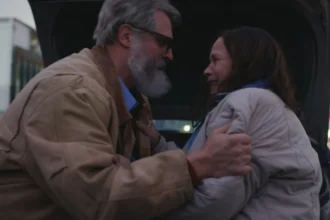
Larry David has returned to HBO Max with his new American history-centered sketch comedy series, Life, Larry and the Pursuit of Unhappiness, featuring an extensive roster of guest stars and cameos. The series, which premiered following the conclusion of David’s acclaimed long-running series Curb Your Enthusiasm, has quickly become known for its ambitious casting, with dozens of prominent celebrities embodying historical figures and fictional characters across its episodes. Executive producers Barack and Michelle Obama, through their Higher Ground Productions, have spearheaded the show, which blends educational historical contexts with David’s signature brand of observational humor and social commentary.
The show distinguishes itself not just through its premise—reimagining pivotal moments in American history with David at the center of often absurd scenarios—but also through the sheer volume and caliber of its celebrity participants. Each episode of Life, Larry and the Pursuit of Unhappiness consistently features over a dozen notable personalities, spanning from David’s former Curb Your Enthusiasm co-stars to major Hollywood icons and television luminaries. The ensemble includes figures like Samuel L. Jackson and Lin-Manuel Miranda, who don period attire, alongside comedic legends such as Jerry Seinfeld and Jon Hamm, all contributing to the series’ unique comedic tapestry.
Larry David’s Return to Television with Historical Satire
Following the critical and commercial success of Curb Your Enthusiasm, Larry David’s pivot to Life, Larry and the Pursuit of Unhappiness marks a significant evolution in his comedic career. The series departs from the semi-improvised, fictionalized reality of his personal life, instead immersing David in meticulously researched historical settings. This new format allows David to apply his distinctive comedic voice—characterized by social awkwardness, petty grievances, and curmudgeonly observations—to some of the most iconic and often revered moments in American history. The involvement of Higher Ground Productions underscores a commitment to blending entertainment with historical narrative, albeit through a highly satirical lens.
The show’s premise often sees David playing a fictional character or a lesser-known historical figure who inadvertently influences or complicates major historical events, or simply reacts to them with contemporary sensibilities. This approach allows for both a comedic re-evaluation of history and a vehicle for David’s familiar brand of humor. The show airs new episodes Friday nights at 9 p.m. on HBO and is available for streaming on HBO Max, maintaining a consistent release schedule that keeps audiences anticipating the next wave of celebrity guest stars and cameos.
Episode 1: “Livingston” – A Star-Studded Premiere
The premiere episode, titled “Livingston,” immediately established the series’ ambitious scope for guest stars and cameos. It opened with a meta-commentary from former President Barack Obama, appearing as himself, who lauded the nation’s upcoming semiquincentennial while playfully jabbing at Larry David. This introduction seamlessly transitioned into the show’s narrative, guided by the familiar and authoritative voice of Samuel L. Jackson as The Narrator, setting a high bar for the vocal performances throughout the series.
The first historical sketch delved into the drafting of the Declaration of Independence, with Henry Winkler portraying John Hancock, Chris Parnell as Benjamin Franklin, and Alan Tudyk as Thomas Jefferson. David’s character, Robert Livingston, attempts to insert trivial grievances into the document, leading to comedic friction with the founding fathers. The episode then featured David as Alexander Graham Bell, navigating an awkward demonstration of the telephone. This scene notably included Richard Kind, a Curb Your Enthusiasm alum, as Thomas Watson, alongside sitcom veterans Alison Becker (Parks and Recreation), Mary Sohn (A.P. Bio), and Rodney J. Hobbs (The Office) as demanding spectators. The segment highlighting World War I trench warfare starred Michael Chiklis (The Shield) as a sergeant overseeing David’s cowardly soldier, with Mike Castle (Comedy Bang Bang) and Jake Reiner, son of the late Rob Reiner, as fellow soldiers. The episode concluded with Jurnee Smollett’s poignant portrayal of civil rights icon Rosa Parks, seated next to David’s irritating bus passenger, encapsulating the series’ blend of historical gravitas and comedic disruption.
Episode 2: “Farewell” – Reunions and Final Performances
“Farewell” continued the trend of impressive guest stars and cameos, opening with a highly anticipated reunion between Seinfeld creators Larry David and Jerry Seinfeld. The iconic duo portrayed explorers Meriwether Lewis and William Clark, respectively, reimagining their monumental expedition through the Louisiana Territory as a convenient drinking buddy road trip, much to the chagrin of Mavis Lewis, Meriwether’s long-suffering wife, played by Rita Wilson. This sketch offered a fresh, anachronistic take on a foundational American journey.
The episode further explored political satire as David portrayed Samuel Tilden, who famously won the popular vote in the 1876 presidential election but lost the Electoral College, leading to a signature David-esque rant about electoral injustice. Curb alum Matthew Jones and Rich Fulcher (The Mighty Boosh) appeared as Tilden’s bewildered aides. A segment set during the Great Depression featured David attempting to exploit a grieving widow, Gloria (Kaley Cuoco), to cut a breadline, with Larry Wilmore and Colton Dunn (Superstore) adding to the comedic chaos as a soup server. The episode’s most poignant moment was the final screen appearance of Rob Reiner, portraying George Washington. Reiner’s Washington discussed term limits for the U.S. presidency, providing a platform for David’s townsman character to deliver thinly veiled criticisms of former President Donald Trump. Jimmy Kimmel also made a cameo as a crowd member, adding a meta-layer to the political satire.
Episode 3: “McCarthy” – Revolutionary Acts and Flight Pioneers
The third installment, “McCarthy,” sustained the series’ commitment to drawing top talent for its historical vignettes, presenting a new array of guest stars and cameos. The episode commenced with David’s character inadvertently crashing the Boston Tea Party, where Lin-Manuel Miranda, celebrated for his work on Broadway’s Hamilton, delivered a scene-stealing performance as one of the Tea Party ringleaders. Comedian Lou DiMaggio joined the sketch, playing off David’s character being excluded from the rebellion, further highlighting David’s role as the perpetual outsider.
A subsequent sketch featured J.B. Smoove as Jonesey Dean Sharpe, whose demanding presence along the Underground Railroad flummoxed David’s host character, with Smoove’s distinctive comedic energy enriching the historical narrative. The episode then shifted to the early days of aviation, where Jon Hamm and Sean Hayes portrayed the actual Orville and Wilbur Wright, preparing for their groundbreaking first flight. David, meanwhile, played a fictional, less-than-heroic Wright sibling, squabbling with his wife, played by Isla Fisher, over mundane domestic matters, providing a stark contrast to the historical significance unfolding around them. The episode concluded with David himself embodying Senator Joseph McCarthy, leading to the highly anticipated confrontation with Michael McKean (Better Call Saul) as attorney Joseph Welch, who delivered the iconic "Have you no decency, sir?" rebuttal. Rob Huebel (Human Giant) rounded out the cast as a senator moderating the infamous hearings, bringing a comedic edge to a dark chapter in American history.
Episode 4: “Deepthroat” – Watergate and Vaccine Debates
“Deepthroat” brought the Larry David treatment to more recent historical events and controversial scientific discoveries, featuring a diverse lineup of guest stars and cameos. The episode opened with a comedic take on the Watergate scandal, with David portraying the anonymous source "Deep Throat." However, David’s Deep Throat offers Washington Post reporter Bob Woodward, played by SNL alum Beck Bennett, only trivial and unhelpful information in their clandestine parking lot meeting, subverting the dramatic tension of the historical moment.
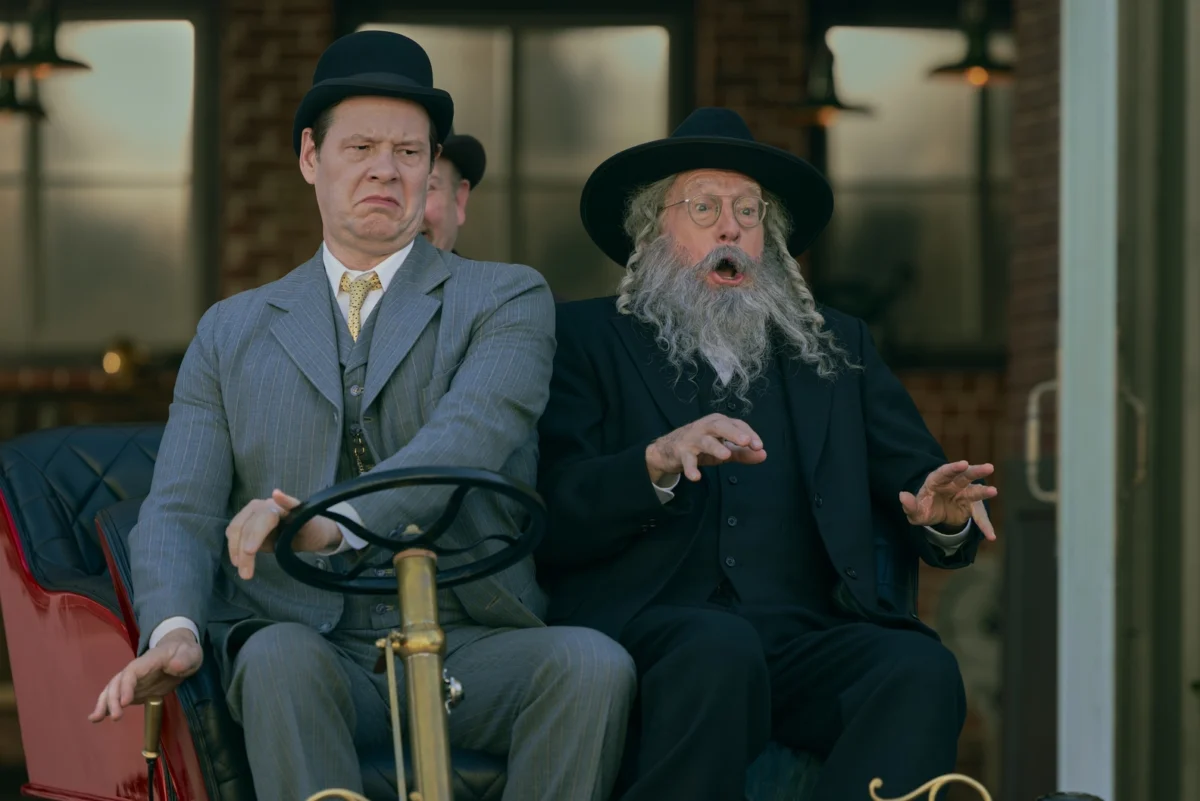
Next, Ike Barinholtz portrayed the notoriously antisemitic Henry Ford, visibly displeased by David’s rabbi character inspecting his new vehicle, a sketch that underscored Ford’s historical prejudices with David’s uncomfortable humor. David then appeared as President James Buchanan, awkwardly hitting on female guests at a party where he introduced the concept of passed appetizers. Jordana Brewster (Fast & Furious) and Katie Aselton (The League) were among the "unfortunate ladies" to encounter Buchanan’s advances, with Diallo Riddle (Marlon) as Buchanan’s assistant, John Appleton. The episode’s most talked-about segment was David’s revival of an old stand-up bit, playing Dora, the overly proud mother of Jonas Salk, bragging about her son’s polio vaccine discovery to neighbor Evelyn, played by Judy Gold. The sketch escalated into a parody of contemporary vaccine debates, with a young man named Bobby (Gregg “Jeep” Perrie) echoing anti-vaccine sentiments, a clear, satirical nod to the stark politics surrounding public health, particularly referencing figures like Robert F. Kennedy Jr.
Episode 5: “Lincoln” – Wild West Shootouts and Presidential Woes
The fifth installment, “Lincoln,” condensed its historical focus into two major moments, yet still delivered impactful guest stars and cameos. The episode first transported viewers to the O.K. Corral, reimagining the legendary 1881 shootout. Timothy Olyphant portrayed Wyatt Earp and Don Johnson appeared as Doc Holliday, engaging in a classic Curb-style, obnoxious conversation with David’s character about the logistics and timing of the famous confrontation. Marc Menchaca (Curb’s Klansman Joe) added to the comedic tension as a cowboy, calling out David’s “pig-parking” job, with Johnno Wilson as Virgil Earp and Maximo Salas as Young Clanton rounding out the cast of outlaws.
The episode’s latter half focused on the strained relationship between Abraham Lincoln and Mary Todd Lincoln, a subject recently explored in Broadway productions. Bill Hader (SNL, Barry) delivered a portrayal of a put-upon Abraham Lincoln who, in the sketch, conspires with his chief of staff, Lawrence Butterfield, to orchestrate Mary’s absence from Ford’s Theatre. Kathryn Hahn starred as Mary Todd Lincoln, bringing a comedic intensity to the "mentally unstable" first lady. The sketch ingeniously employed a game of telephone as Lincoln, Butterfield, and Mary watched Our American Cousin from their box seats, highlighting the miscommunications and personal grievances that could precede a national tragedy. The segment’s second part continued the domestic discord, featuring Butterfield and Mary arguing over a stolen sweater, a moment designed to feel ripped straight from Curb Your Enthusiasm. Lennon Parham as Laura Keene and Jay Renshaw as John Wilkes Booth also appeared, setting the stage for the inevitable historical conclusion.
Broader Implications and Cultural Impact
Life, Larry and the Pursuit of Unhappiness represents a significant comedic undertaking, leveraging the gravitas of historical events to underscore Larry David’s distinctive brand of observational humor. The show’s ability to attract such a high volume of A-list guest stars and cameos speaks to David’s enduring appeal and the unique creative freedom afforded by HBO Max. This ambitious casting strategy not only generates considerable buzz but also enriches the comedic texture of each sketch, allowing established talents to deliver fresh interpretations of historical figures.
The series stands as a unique entry in the current television landscape, offering a blend of satirical commentary, historical education, and celebrity spectacle. It serves as a testament to the continued evolution of sketch comedy, proving that historical narratives can be fertile ground for contemporary humor and pointed social critique. The Obamas’ involvement further elevates the series, signaling a commitment to projects that are both entertaining and culturally resonant. As new episodes continue to air, the show remains a focal point for discussion, demonstrating Larry David’s sustained ability to provoke thought and laughter through his uniquely curmudgeonly lens.