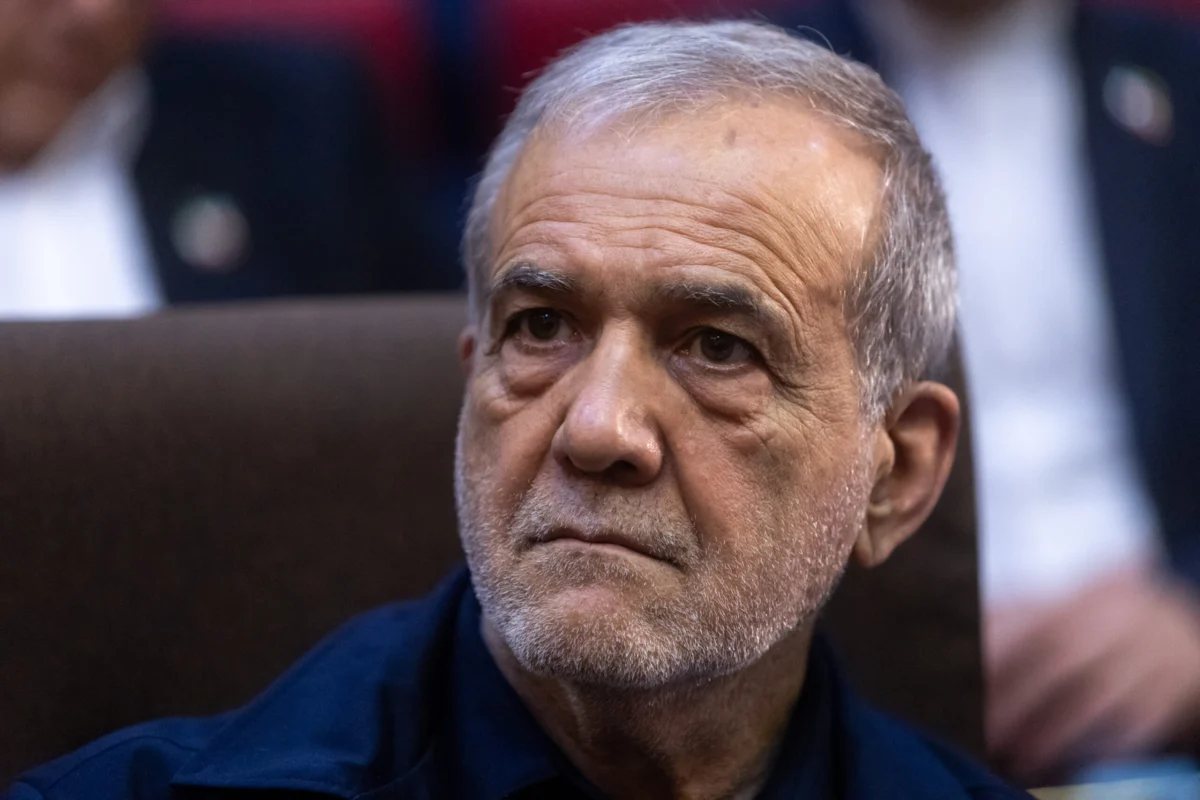
Tehran, Iran – A significant public schism has erupted between Iran’s government and its state television broadcaster over the portrayal of the nation’s ongoing military and diplomatic engagements with the United States, a development that complicates ongoing efforts by international mediators to steer both nations toward de-escalation and dialogue. The dispute centers on allegations of censorship by the state broadcaster, the Islamic Republic of Iran Broadcasting (IRIB), following the selective airing of President Masoud Pezeshkian’s recent remarks.
Government Accuses State Broadcaster of Censorship
The Government Information Council publicly rebuked IRIB on Friday, accusing the state broadcaster of "censorship" after significant portions of President Pezeshkian’s address earlier in the week were withheld from public broadcast. This move has ignited a public debate about media control and the narrative surrounding Iran’s complex relationship with Washington, particularly as mediation efforts intensify.
IRIB, an entity whose leadership is appointed by the Supreme Leader, responded on Saturday by vehemently rejecting the government’s "accusations and improper attributions." The broadcaster asserted its obligation to prevent "an incorrect and unreal suggestion of duality in the country’s leadership pillars," framing its editorial decisions as an effort to maintain a unified national image.
Pezeshkian’s Remarks on Previous Negotiations Spark Controversy
The contentious segment of President Pezeshkian’s speech that was reportedly cut involved his candid discussion of past diplomatic overtures. He recalled that following the 12-day conflict with Israel last year, former Supreme Leader Ayatollah Ali Khamenei had publicly declared a stance against negotiations with Washington. However, Pezeshkian revealed that Khamenei had privately granted approval for such talks.
"We went to the dear leader, explained the situation, and asked him what to do since he had said the ‘no war, no peace’ conditions are bad for the country," President Pezeshkian was quoted as saying. "He ordered us to go negotiate. We started the talks based on his order." This revelation, suggesting a divergence between public pronouncements and private directives on critical foreign policy matters, appears to have been the trigger for the subsequent media blackout.
Pattern of Editorial Control Surfaces
The government’s statement elaborated that the decision to omit this particular part of the president’s speech was not an isolated incident. It pointed to a series of "unusual actions" by state television concerning recent statements from other senior government officials, including the heads of the parliament and the judiciary.
Earlier in the month, a segment of an interview with Parliament Speaker and chief negotiator Mohammad Bagher Ghalibaf, which addressed the ongoing negotiations, was also reportedly edited out by IRIB. Similarly, a portion of a speech by Judiciary head Gholam-Hossein Mohseni-Ejei, in which he expressed support for the president’s initiatives, was also not broadcast. This pattern suggests a deliberate effort to control the flow of information and shape public perception regarding sensitive policy discussions.
Foreign Minister Criticizes Media Coverage
Foreign Minister Abbas Araghchi also voiced his discontent with IRIB’s coverage. In an interview released on Saturday, he described his efforts in wartime interviews with prominent U.S. media outlets like Fox News and CNN as a fierce advocacy for Iran’s position. Araghchi expressed his expectation that state television would showcase how Iran’s case was being forcefully presented to American audiences and policymakers.
However, he lamented that only minimal excerpts, essentially one or two subtitles, from these crucial interviews were aired. This lack of comprehensive coverage, according to Araghchi, fails to adequately represent Iran’s diplomatic efforts on the international stage and potentially misinforms the domestic audience.
Araghchi also directly challenged hardline narratives that sought to portray the recently suspended memorandum of understanding with the U.S. as an imposition on the new Supreme Leader, Mojtaba Khamenei. He characterized the agreement as the most advantageous outcome achievable under the prevailing circumstances, a view that has met resistance from more hardline factions within the Iranian political spectrum.
Allegations of Factional Influence within IRIB
The government’s statement further implicated "a political faction within" state television in these editorial decisions, strongly hinting at the influence of the Paydari Front, an ultrahardline political group. The government council warned that such actions could jeopardize national security and undermine social cohesion by creating internal divisions and confusion.
IRIB, in its counter-statement, maintained that broadcasting the president’s full segment would have created a misleading impression of division within the leadership. This highlights a fundamental disagreement on how to present Iran’s internal dynamics to the public, especially during times of external pressure and delicate negotiations.
Both the government and IRIB accused each other of working against the directive issued by Mojtaba Khamenei to foster "sacred unity" amidst escalating military, economic, and diplomatic pressures from the United States. This mutual accusation underscores the deep-seated tensions and differing priorities at play within the Iranian political establishment.
Parliamentary Oversight and Media Criticism
Mohammad Mirzaei, a member of parliament and spokesperson for a committee overseeing IRIB, stated on Saturday that the directors of the state broadcaster had been cautioned about the imperative to present diverse viewpoints and to act as a symbol of national unity. This indicates that parliamentary bodies are attempting to intervene and regulate IRIB’s editorial policies.
However, independent commentary from media professionals paints a bleaker picture. Conservative journalist Mohammad Mohajeri described the current state of the broadcaster as its "most expensive and least effective." Reformist activist Mohammad-Sadegh Javadi-Hesar articulated the problem more pointedly, suggesting, "one government being installed and another government called IRIB operating against it." This view suggests a deeply entrenched institutional conflict, where the state broadcaster operates with a degree of autonomy that can directly counter government objectives.
President Reportedly Confronts IRIB Chief
Further fueling the narrative of internal discord, the reformist Entekhab news outlet reported, citing an unnamed source, that President Pezeshkian had sharply reprimanded IRIB chief Peyman Jebeli during a cabinet meeting following the controversy over the negotiations coverage. Jebeli, who was appointed by Ali Khamenei in 2021, previously served as media deputy at the Supreme National Security Council. Notably, Saeed Jalili, a hardline figure and the only council member reportedly to have opposed an interim deal with the U.S. last month, was the council’s secretary during Jebeli’s tenure. This connection may hint at underlying ideological alignment and influence shaping IRIB’s editorial stance.
There have also been reports of potential budgetary repercussions. Hardline lawmaker Meysam Zohourian claimed that the president had threatened to cut state television’s budget, although the administration has not officially confirmed this assertion. Such a threat, if true, would represent a significant escalation in the government’s efforts to rein in the broadcaster.
Mediators Active Amidst Internal Tensions
The internal public relations battle within Iran is unfolding against a backdrop of active diplomatic engagement. Mediators from Oman were in Tehran on Friday, focusing on discussions related to the management of the Strait of Hormuz. This vital maritime chokepoint has become a focal point of contention between the U.S. and Iran, with any potential escalation in tensions carrying significant global economic implications.
U.S. Stance and Iranian Response
Across the Atlantic, U.S. President Donald Trump characterized the ongoing conflict as progressing "extremely well" and announced that Israeli Prime Minister Benjamin Netanyahu would visit Washington in the coming days. Trump confirmed that channels of communication with Iran remained open through intermediaries but expressed skepticism about an imminent agreement.
When questioned about the potential for systematic attacks on Iranian power plants and bridges in the event of war escalation, President Trump declined to comment on whether such actions would constitute war crimes. This ambiguous stance from the U.S. president adds another layer of uncertainty to the already volatile geopolitical situation.
In response to the escalating rhetoric and perceived threats from the U.S., Mohammad Bagher Zolghadr, the secretary of Iran’s Supreme National Security Council, stated on Saturday that missile and drone launches across the region would persist "until the full surrender of the enemy" and to avenge the deaths of civilians killed during the war. This declaration signals Iran’s readiness to continue its regional activities and retaliatory actions, underscoring the challenging environment for diplomatic breakthroughs. The internal friction between Iran’s government and its state media adds a domestic dimension to these complex international relations, potentially impacting the coherence and effectiveness of Iran’s external messaging and strategic decision-making.