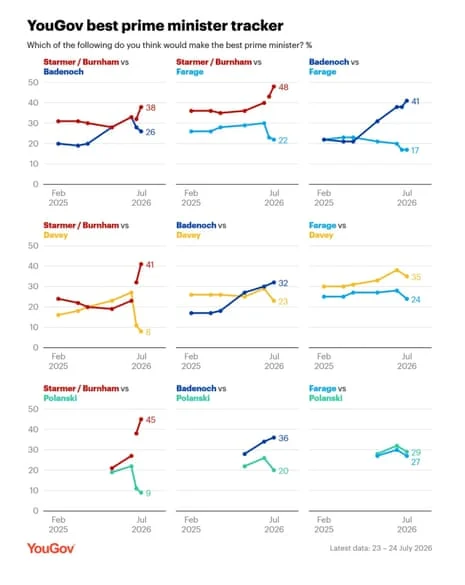
New polling data released Tuesday indicates that Prime Minister Andy Burnham has maintained a commanding advantage over his political rivals, reinforcing his position at the head of a fractured British political landscape. According to the latest figures from YouGov, Burnham has a clear lead over other party leaders on who would make best PM, a metric that analysts say is often the most reliable predictor of future electoral success. While the Labour Party continues to face stiff competition in general voting intention, Burnham’s personal approval ratings have significantly eclipsed those of his predecessor, Keir Starmer, and his current challengers in the Conservative and Reform UK parties.
The YouGov data comes on the heels of a separate survey by More in Common, which placed Labour four points ahead of Reform UK. However, the YouGov results suggest a much tighter race for the parties themselves, with Labour and Reform UK tied at 22% and the Conservatives trailing narrowly at 21%. Despite this three-way statistical deadlock in party preference, the "best Prime Minister" metric shows a stark divergence. Burnham’s ability to draw support from across the political spectrum appears to be his primary strength, particularly as voters express growing fatigue with the leadership of opposition figures.

New Polling Shows Burnham Has Clear Lead Over Other Party Leaders on Who Would Make Best PM
The significance of the "best PM" measure cannot be overstated in modern British politics, where individual leadership often outweighs party branding. The YouGov figures show that Burnham has successfully cultivated an image of competence that resonates beyond the traditional Labour base. While Keir Starmer maintained respectable numbers during his tenure, Burnham has easily surpassed those benchmarks, positioning himself as a more relatable and decisive leader in the eyes of the public.
Political analysts suggest that Burnham’s lead is bolstered by a perceived decline in the effectiveness of opposition leaders. The polling suggests that while party loyalty remains fluid, the public’s desire for a stable figurehead at Number 10 favors the incumbent. This personal popularity provides a crucial buffer for the Labour government as it navigates a series of domestic crises, including prison overcrowding and a sluggish transition in the national education system.
Declining Support for Reform UK and Nigel Farage
A notable takeaway from the recent YouGov data is the apparent erosion of support for Nigel Farage. Earlier this year, the Reform UK leader held a lead over Conservative leader Kemi Badenoch on the "best PM" measure, but that dynamic has shifted dramatically. Badenoch now leads Farage by more than a two-to-one margin in head-to-head comparisons. Furthermore, the ratings for Liberal Democrat leader Ed Davey and Green Party leader Zack Polanski have also dipped since the beginning of 2026.
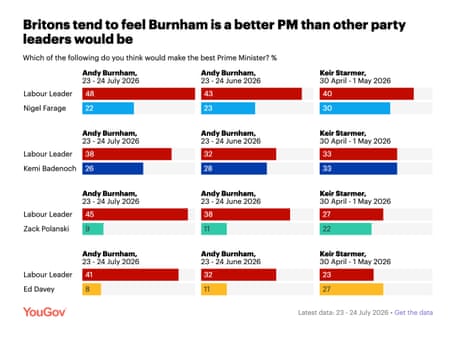
Dylan Difford, a researcher for YouGov, noted that Farage’s high "dislike" ratings are a significant factor in these shifts. In head-to-head scenarios, voters from the Liberal Democrats and the Green Party overwhelmingly prefer Burnham or even Badenoch over Farage. For instance, while roughly half of Lib Dem and Green voters view Burnham as more capable than Badenoch, that preference jumps by 25 points when the alternative is Farage. This "anti-Farage" effect suggests that while Reform UK may be polling high as a party, its leader remains a polarizing figure who struggles to win over centrist or undecided voters.
The Prison Overcrowding Crisis and Conservative Apology
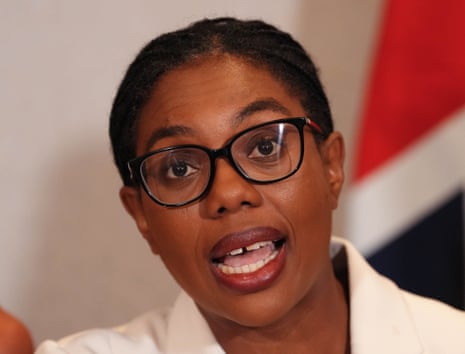
While the polling provides a boost for the government, the political reality remains dominated by the ongoing crisis in the British prison system. Conservative leader Kemi Badenoch held a press conference Tuesday morning, during which she took the unusual step of apologizing for the previous government’s record on jail capacity. Badenoch admitted that the 14,000 prison places created during the 14 years of Conservative rule were "nowhere near enough" to meet the demand of the country’s growing inmate population.
Badenoch blamed the COVID-19 pandemic for derailing the Conservative party’s prison-building program, but she remained sharp in her criticism of the current administration. She urged Prime Minister Burnham to revoke a commencement order that would see the early release of thousands of prisoners on September 2. Badenoch argued that the government should instead consider renting prison space in foreign countries, citing Sweden’s use of Estonian facilities as a potential model. She also called for the accelerated deportation of foreign offenders and urged the public to support the construction of new jails, noting that "not in my backyard" (NIMBY) attitudes have hindered progress.
Education Reform: Shifting from Degrees to Technical Skills
Prime Minister Burnham spent much of Tuesday promoting his new vision for the English education system, which emphasizes vocational and technical training over the traditional university route. During a visit to Alstom Transport in Derby, Burnham argued that the UK has long suffered from a "university-or-failure" mindset that has left many young people without the practical skills needed for the modern economy. His plan involves allowing students as young as 14 to opt into technical pathways that combine core subjects like English and Math with hands-on work experience.
This policy marks a significant departure from the era of Tony Blair and Keir Starmer, both of whom championed a target of sending 50% of young people to university. Burnham’s approach focuses on "localism," giving regional mayors and business leaders the power to shape curricula based on local industry needs. The initiative has received endorsements from 14 major UK corporations, including Rolls-Royce, Amazon, and Barclays. Sarah Armstrong, Chief People Officer at Rolls-Royce, stated that a "pipeline of engaged and enthusiastic talent" is essential for keeping the UK at the forefront of advanced manufacturing.
However, the plan has met with skepticism from both the left and the right. Reform UK’s Suella Braverman welcomed the "technical renaissance" but expressed doubt that the government would actually deliver, calling the current system a "university scam." Meanwhile, the Conservative Party argued that Burnham’s plans contradict the Schools Act passed only months ago, claiming the government is stripping schools of their autonomy while simultaneously calling for local tailoring.

Channel Security and the Small Boats Dispute
Immigration remains a flashpoint for the Burnham administration, with nearly 900 people arriving via small boats across the English Channel in the past week alone. Shadow Home Secretary Chris Philp sparked a diplomatic and security row on Tuesday by accusing a French warship of firing "warning shots" near his vessel while he was monitoring crossings for a BBC interview. Philp claimed 17 live rounds were fired without notice, describing the incident as an act of "intimidation."
In response, Prime Minister Burnham defended his government’s record, noting that overall boat crossings are down 45% compared to this time last year. Burnham attributed this decline to a "rigorous plan" implemented by Home Secretary Shabana Mahmood. While acknowledging that "much more needs to be done," Burnham insisted that the trend is moving in the right direction, with removals of illegal arrivals on the rise. Home Office figures support this claim, showing 13,007 arrivals so far this year—a significant decrease from the same period in 2024 and 2025.
Leadership Renewal in Scottish Labour
As the national government grapples with these challenges, the Scottish Labour Party is beginning its own process of renewal. Following the resignation of Anas Sarwar, MSP Michael Marra has officially announced his candidacy for the leadership. Marra, the party’s finance spokesperson, emphasized the need for a "moment of renewal" after successive election defeats in Scotland. He joins Monica Lennon in the race, with the final leader expected to be announced on September 19.
Marra’s campaign is expected to focus on the "moral purpose" of the Labour Party, aiming to rebuild the party’s legacy in a region that has seen a long period of dominance by the Scottish National Party. The leadership contest in Scotland will be a key test of whether the "Burnham effect" can trickle down to regional branches of the party and help consolidate Labour’s power across the United Kingdom.
The political week ahead remains packed with high-stakes meetings, including a session of Labour’s National Executive Committee and further media appearances by Education Secretary Lucy Powell. While Prime Minister Burnham enjoys a clear lead over other party leaders on who would make best PM, the true test of his leadership will be his ability to convert that personal popularity into legislative success and tangible improvements in the country’s infrastructure and public services. For now, the "King of the North" turned Prime Minister remains the dominant figure in a volatile political landscape.