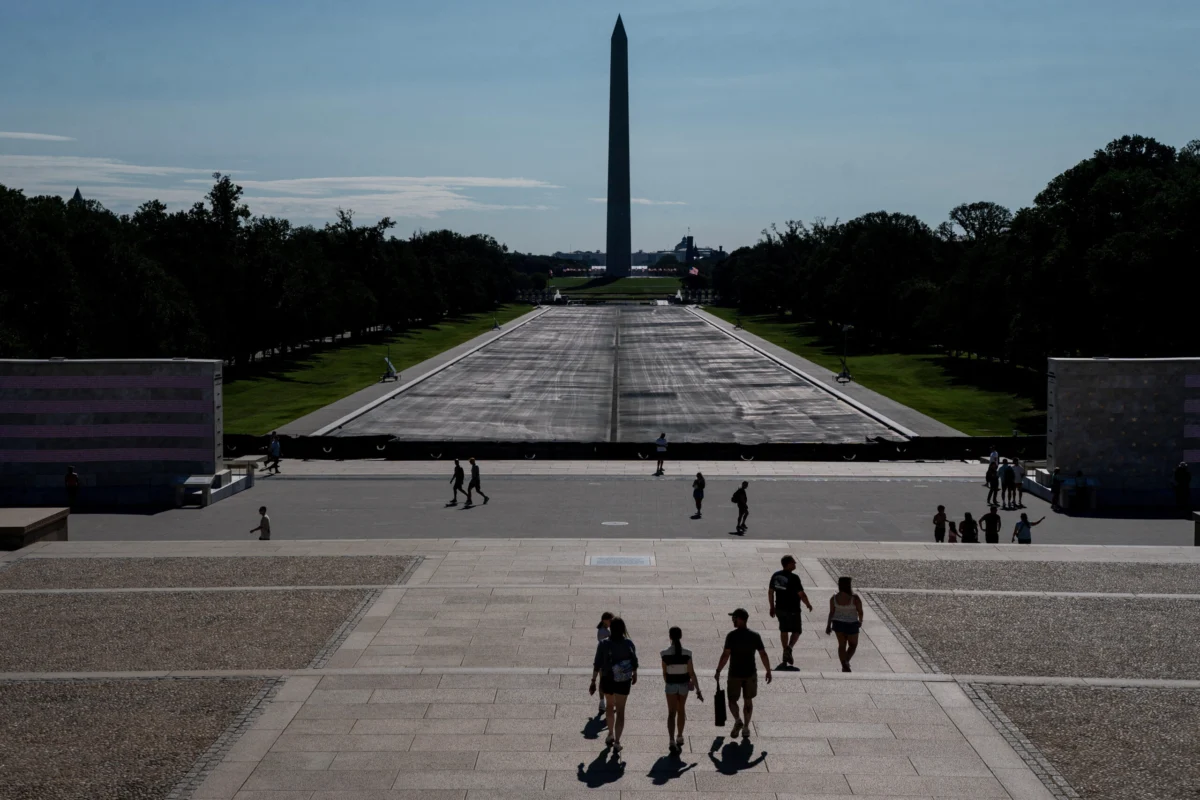
In a significant reversal, the Trump administration has moved to drop all criminal charges against former Olympic athlete David Hearn, who had been accused of vandalizing the Lincoln Memorial Reflecting Pool. The U.S. Attorney’s Office for Washington, D.C. filed a motion Friday afternoon acknowledging that the evidence did not substantiate the allegations of vandalism. This development marks a dramatic shift from the initial accusations that Hearn had "forcefully and violently" damaged the newly installed liner of the iconic pool.
The decision to dismiss the charges comes after prosecutors received new information indicating the damage was a result of a flawed installation process, rather than deliberate sabotage. U.S. Attorney Jeanine Pirro stated in the court filing that her office was not fully apprised of the situation until after Hearn’s indictment. She attributed some of the initial misrepresentation to "barebones police reports" provided by the Department of the Interior.
Unraveling the Reflecting Pool Incident
The controversy surrounding the Reflecting Pool began earlier this month when Hearn, an Olympic canoeist, was indicted on charges of destruction of government property. Pirro had described his alleged actions as "an affront to the dignity of our shared history," with Hearn facing a potential sentence of up to 10 years in prison. The indictment followed President Donald Trump’s own vocal accusations that individuals had vandalized the pool, even suggesting they used a sharp object and fertilizer.
However, the narrative presented in Friday’s court filings paints a starkly different picture. Pirro emphasized that critical information about the installation’s shortcomings only surfaced after the indictment was returned. The Department of the Interior subsequently provided additional documentation to the U.S. Attorney’s Office, revealing that the damage incurred in June 2026 was indeed attributable to a contractor’s errors.
The pressure to complete the Reflecting Pool renovation project ahead of the Independence Day holiday, which marked the 250th anniversary of the United States, is cited as a contributing factor to the project’s failure. President Trump had planned several high-profile events for the occasion, underscoring the urgency. Pirro explained that the "rush to complete the project led to hasty and botched work that was not remediated before the project was finished and the fencing removed." She pointed to a confluence of issues including delayed installation, adverse weather conditions, and repeated testing failures that culminated in a compromised outcome.
A Legacy of Ambitious Public Works
The Reflecting Pool renovation is part of a broader initiative by the Trump administration to reshape the landscape of Washington, D.C. During his tenure, President Trump has pursued several high-profile public works projects aimed at leaving a lasting mark on the nation’s capital. These efforts have included the demolition of the White House East Wing, the re-gilding of various statues, and proposals for monumental structures such as a triumphal arch near Arlington National Cemetery.

More recently, a substantial $22.5 billion project to revamp Dulles International Airport, the primary air terminal for the capital region, was unveiled. Not all of these endeavors have proceeded without challenge, with several public works projects facing legal scrutiny. The attempt to rename the John F. Kennedy Center for the Performing Arts after the President also generated considerable opposition.
The Reflecting Pool renovation, in particular, proved to be one of the administration’s most contentious undertakings. The 618-meter-long pool holds significant historical weight, serving as the backdrop for pivotal moments in American history, including Martin Luther King Jr.’s iconic "I Have a Dream" speech during the 1963 March on Washington. Situated between the Washington Monument and the Lincoln Memorial, it is a focal point for tourists and a symbol of national heritage. However, the pool had long suffered from persistent leaks along its granite edges and concrete base.
The "American Flag Blue" Project and Its Unraveling
In April, President Trump announced an abrupt plan to address the pool’s issues by resurfacing its bottom with a specialized pool topping, described as "American Flag Blue." He assured the public that the project would be completed "long before July 4" and at a minimal cost to the government. By early June, the administration declared the renovation complete.
However, the resolution was short-lived. Within days, the pool’s surface became obscured by a thick layer of green algae, and the "American Flag Blue" pool topping began to crack, with visible sheets of paint peeling away into the water. The awarding of the government contract for the renovations also drew significant criticism.
The Trump administration awarded a $13.1 billion contract to Atlantic Industrial Coatings, a company with which the President claimed past dealings as a real estate developer. The company is reportedly led by one of the President’s donors. This substantial deal was finalized without the standard competitive bidding process, justified by the administration on the grounds of immediate necessity.
Evidence of Flawed Installation Emerges
According to Pirro’s account, a National Park Service engineer observed the peeling of the Reflecting Pool’s new lining just two days after the site’s final inspection on June 11. The engineer’s report indicated that the damage appeared to stem from "over spraying and delamination," suggesting a manufacturing or application defect rather than intentional damage.
Despite this emerging evidence, President Trump continued to publicly advocate for the vandalism narrative. At a press conference in June, he stated, "We caught some people vandalizing our beautiful Reflecting Pool." He elaborated that "they took a cutter, a box cutter, or something very sharp. Can you imagine? Where do these people come up with this? And they threw a little fertilizer in the water." He further suggested that those responsible should face "years in jail."

David Hearn, a three-time Olympian representing the United States, maintained his innocence throughout the ordeal. He acknowledged being among the curious onlookers drawn to the controversy surrounding the Reflecting Pool’s renovation. In media interviews, Hearn admitted to cycling past the pool, reaching in to feel the peeling sealant out of curiosity, but vehemently denied causing any damage to the property.
Hearn was ultimately one of seven individuals charged in connection with the damage to the Reflecting Pool. U.S. Attorney Pirro announced his indictment at a press conference on July 2. Friday’s motion to dismiss the charges arrived just four weeks later, a swift turnaround that highlights the rapid shift in the prosecution’s stance.
A Shift in Legal Strategy and Public Perception
In her motion, Pirro explicitly acknowledged that the peeling of the pool liner was not the result of vandalism. Her office became aware of the extensive damage and the true cause of the problem around July 17, when the Reflecting Pool site was once again drained for repairs. It was at this juncture that the U.S. Attorney’s Office requested all pertinent documents from the Department of the Interior regarding the pool’s lining.
The subsequent receipt of "695 megabytes of additional documents" provided the crucial evidence revealing "a rushed and flawed installation process." This information directly contradicted the initial claims of deliberate vandalism.
The U.S. Attorney’s Office for Washington, D.C. has faced scrutiny regarding the prosecution of Hearn, with questions raised about whether the office was pursuing justice or acting under political pressure to protect the President’s image following the widely publicized botched renovation. The withdrawn indictment also comes at a time when courts have been increasingly questioning the Department of Justice on prosecutions that appear to be hastily submitted and lack robust evidence.
During an earlier press conference concerning Hearn’s case, a reporter posed a pointed question to Pirro: "Did you ultimately decide to charge this so harshly at the president’s direction?" Pirro responded at the time, "I didn’t charge anything harshly. I charge according to the evidence."
Calls for Accountability and Apology
In the wake of the dismissal motion, Hearn’s legal team issued a statement characterizing the case as an "abuse of government power." They asserted that the Trump administration owes their client an apology for the ordeal. The swift turnaround from indictment to dismissal underscores the importance of thorough investigation and the potential for political pressures to influence legal proceedings, particularly in high-profile cases involving presidential projects. The incident serves as a reminder of the complexities involved in public works, the challenges of large-scale renovations, and the imperative for transparency and accuracy in the justice system.