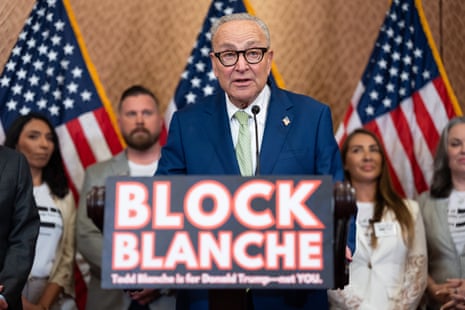
The United States Senate narrowly confirmed Todd Blanche as the nation’s 87th Attorney General early Saturday morning, a move that critics argue fundamentally compromises the independence of the Department of Justice. In a 50-49 vote that fell largely along party lines, the chamber elevated Donald Trump’s former personal defense attorney to the highest law enforcement office in the land. The decision has sparked a firestorm of criticism from Democratic leadership, with Senate Minority Leader Chuck Schumer declaring that the appointment represents a direct assault on the rule of law and the traditional boundaries between the presidency and the judiciary.
Senate Minority Leader Chuck Schumer issued a blistering response following the vote, asserting that the Blanche confirmation allows Trump to continue ‘pervasive, breathtaking corruption’ by installing a loyalist at the helm of the Justice Department. Schumer argued that Senate Republicans have "handed Trump an excuse on a silver platter" to bypass ethical norms and use the federal government as a tool for personal and political gain. "If you want to wipe out corruption, you can’t have the president’s personal attorney as the attorney general," Schumer wrote in a public statement. "You don’t need a PhD in political science to know that. Todd Blanche has no intention of stopping Trump’s corruption. He advanced his career enabling it."

The Road to the Blanche Confirmation and the Erosion of Judicial Independence
The confirmation process was marked by weeks of intense debate and a marathon overnight session that lasted into the pre-dawn hours of Saturday. Todd Blanche, who previously served as the Deputy Attorney General following the ouster of former Attorney General Pam Bondi in April, has been acting in the lead role for months. His permanent installation comes at a time when the Department of Justice is embroiled in several high-profile investigations and controversial policy shifts.
Republican Senator Bill Cassidy of Louisiana emerged as the deciding vote, despite having expressed significant reservations as recently as Wednesday. Cassidy had previously stated he needed to be convinced that Blanche would act as the "people’s lawyer" rather than the "president’s lawyer." Ultimately, Cassidy joined 49 of his colleagues to push the nomination through, explaining on the Senate floor that while Blanche "is not perfect," the alternative of a continuing series of acting officials would be less effective for the department’s stability.
Only two Republicans, Senators Susan Collins of Maine and Lisa Murkowski of Alaska, broke ranks to vote against the nomination. Their opposition drew a swift and sharp rebuke from the White House, with Donald Trump taking to his Truth Social platform to amplify messages calling Murkowski a "traitor." The polarization of the vote underscores the deep schisms within the Senate regarding the proper role of the Attorney General and the extent of executive influence over federal prosecutions.
The Epstein Files Controversy and the Impact of the Blanche Confirmation
One of the most significant hurdles during the confirmation process was the scrutiny of Blanche’s handling of the Jeffrey Epstein investigation files. Under bipartisan legislation, the Department of Justice was required to disclose all records related to the late sex offender by a December 19 deadline. However, the rollout under Blanche’s acting leadership was widely criticized for being "sloppy" and "obfuscatory."
Survivors of Epstein’s crimes and their legal advocates pointed out that the Department failed to meet the congressionally mandated cutoff for many documents. Furthermore, the records that were released contained heavy redactions of information that lawmakers argued should have been public, while simultaneously and erroneously disclosing the names of survivors who had been promised anonymity. Representative Melanie Stansbury of New Mexico joined Schumer in his critique, labeling the Blanche confirmation as a "dark moment" and accusing the new Attorney General of "actively obstructing the Epstein case" to shield powerful interests.
During his confirmation hearings, Blanche initially refused to meet with Epstein survivors, only relenting after significant political pressure. The survivors who eventually met with him described the encounter as "performative," claiming they received few answers regarding the Department’s failure to provide transparency. This controversy has led many Democrats to fear that the Blanche confirmation allows Trump to continue ‘pervasive, breathtaking corruption’ by ensuring that sensitive investigations are managed by a figure whose primary loyalty appears to lie with the executive branch.

A Midnight Slate of Appointees and the Legislative Recess
The confirmation of Todd Blanche was part of a broader "midnight slate" of over 70 Trump nominees pushed through by Senate Republicans before the chamber adjourned for a five-week summer recess. The resolution confirmed a variety of roles, including ambassadors, federal judges, and U.S. attorneys. Among the most controversial was the appointment of P. Wells Griffith as the U.S. Ambassador to the International Atomic Energy Agency (IAEA) in Vienna.
Griffith, a former Republican campaign operative and Trump aide, had previously defied a subpoena to testify during the 2019 House impeachment inquiry. His appointment to a sensitive diplomatic post involving nuclear oversight in Iran has raised alarms among national security experts. Critics argue that the rapid-fire confirmation of such figures—many of whom have records of resisting congressional oversight—further consolidates Trump’s control over the administrative state.
While the Senate delivered Trump a major win with the Blanche confirmation, they stopped short of meeting all his demands. The President had pushed for the passage of the SAVE America Act, a piece of legislation that would impose strict proof-of-citizenship requirements for voting across the country. Republican leadership reportedly convinced Trump to delay the vote on this act until September, promising to include portions of it in a broader GOP budget package aimed at funding the ongoing conflict in Iran and replenishing the Pentagon’s resources.

Political Retribution and the Future of the Justice Department
The Democratic caucus remains unified in its belief that the Blanche confirmation allows Trump to continue ‘pervasive, breathtaking corruption’ through the systematic targeting of political rivals. During Blanche’s tenure as acting head of the department, the DOJ has pursued indictments against former FBI Director James Comey and New York Attorney General Letitia James. Legal experts have characterized these cases as "thin" and "politically motivated," suggesting that the Department is being used as a law firm for the president’s personal grievances.
Furthermore, the Department has attempted to bring criminal charges against sitting Democratic Senators Elissa Slotkin and Mark Kelly. Judges across the country have already rebuked Department lawyers for making misrepresentations in court, a trend that Schumer and others believe will only accelerate now that Blanche has permanent authority. The creation of a $1.8 billion "anti-weaponization fund" and the granting of tax immunity to the president’s business interests have also been cited as evidence of a department that has abandoned its neutral mandate.
Broader Political Context: The Health of Joe Biden and the Texas Shift
As the Blanche confirmation reshapes the executive branch, other significant political developments continue to unfold. Former President Joe Biden, 83, is reportedly facing a severe health crisis. In an interview with the BBC, Hunter Biden disclosed that his father’s prostate cancer has metastasized into his bones, causing "debilitating pain." This revelation comes after years of speculation regarding the former president’s health, which became a central theme of the last election cycle.

Simultaneously, the political map appears to be shifting in unexpected ways. In Texas, a state that has not seen a Democratic statewide victory in three decades, recent polling shows a dead heat between Republican Attorney General Ken Paxton and Democratic challenger James Talarico. Former Republican strategists have noted that Paxton’s legal troubles and his close alignment with Trump may finally be creating an opening for Democrats in the Lone Star State, further raising the stakes for the upcoming midterm elections.
Conclusion: The Stakes of the Blanche Confirmation
The permanent installation of Todd Blanche as Attorney General marks a turning point in the relationship between the White House and the Department of Justice. For supporters, Blanche represents a necessary force to "clean house" and align the department with the president’s agenda. For opponents, the Blanche confirmation allows Trump to continue ‘pervasive, breathtaking corruption’, effectively ending the era of the Justice Department as an independent arbiter of the law.
As the Senate enters its five-week recess, the implications of this week’s votes will begin to manifest in federal courtrooms and agency offices across the country. With the midterms approaching and the administration’s power expanding, the debate over the rule of law and the limits of executive authority has moved into a volatile new chapter. Senate Democrats have vowed to continue their resistance, but with Blanche now firmly in control of the nation’s legal apparatus, the path forward for oversight remains increasingly narrow.