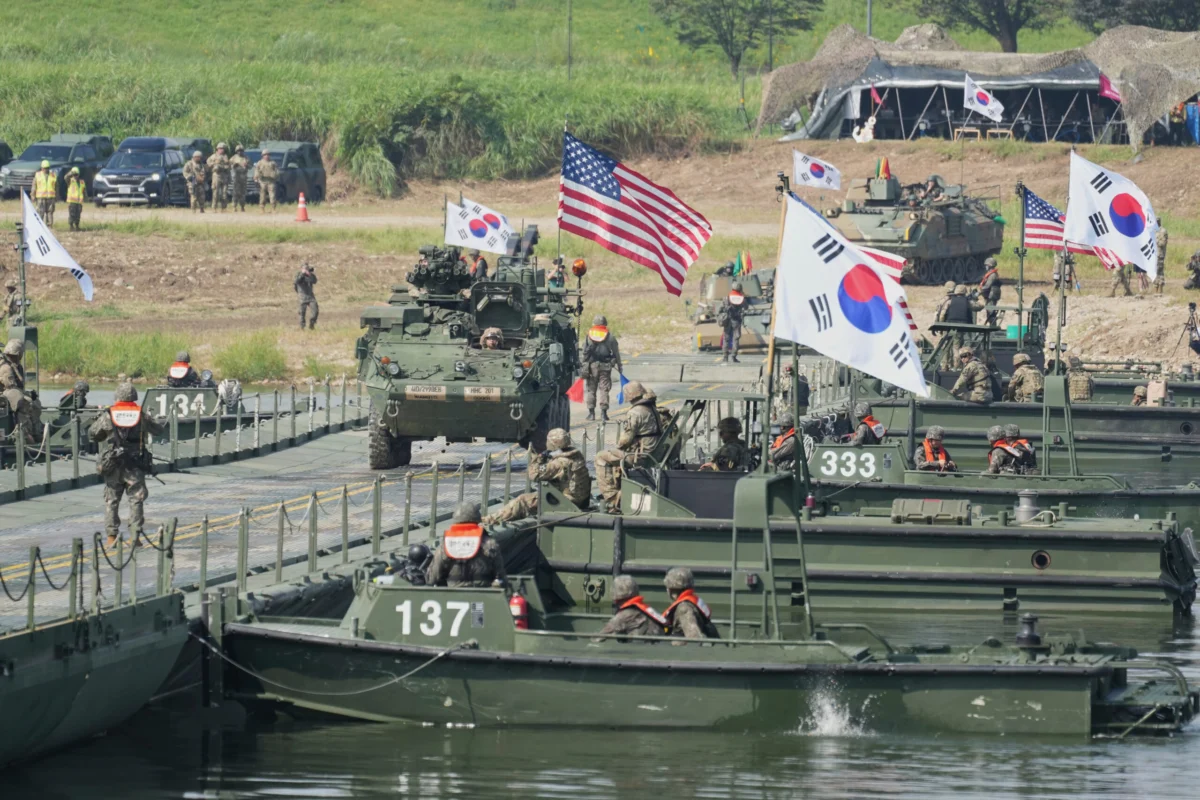
Pyongyang has issued a furious condemnation of upcoming joint military exercises between the United States and South Korea, labeling them a grave provocation that is escalating tensions to the precipice of nuclear conflict. The stern warning from North Korea underscores the persistent volatility of the Korean Peninsula, a region long accustomed to cycles of heightened rhetoric and military posturing.
The spokesperson for North Korea’s Foreign Ministry, speaking on Friday according to the state-run Korean Central News Agency (KCNA), declared that the deepening military cooperation between the U.S., Japan, and South Korea is evolving into a de facto nuclear alliance. In response, North Korea vowed to meet any perceived escalation in threat with a commensurate increase in its own deterrent capabilities. This declaration signals Pyongyang’s intent to maintain a high state of military readiness, mirroring the perceived threat from its adversaries.
This is not the first time North Korea has reacted with outrage to joint military exercises conducted by the U.S. and South Korea. Such drills are routinely denounced by Pyongyang as rehearsals for invasion and as a direct affront to its sovereignty, fueling a cycle of reciprocal threats and displays of military might. These pronouncements from the North Korean Foreign Ministry are a consistent feature of the geopolitical landscape on the peninsula.
The impending drills, officially designated "Ulchi Freedom Shield," are scheduled to commence on August 17 and will continue through August 27. This iteration of the exercises is designed to incorporate a sophisticated array of simulated scenarios, including responses to drone attacks, sophisticated GPS jamming techniques, and complex cyber warfare operations. These adaptations reflect the growing recognition by the U.S. and its allies of North Korea’s increasingly advanced and diverse military capabilities, necessitating a more comprehensive and nuanced training regimen.
The North Korean Foreign Ministry spokesperson highlighted specific concerns about the nature of the upcoming exercises. Citing announcements from the U.S., the spokesperson noted that these drills are purportedly distinct from those conducted over the past five years, with a stated objective of enhancing the ability to prosecute warfare based on the evolving dynamics of modern combat. This assertion from Pyongyang suggests a keen awareness and analysis of the strategic intentions behind the U.S.-South Korea military alliance.
"It is our consistent principle of ensuring security to respond to a new level of a threat with a new level of a deterrent," the statement, as reported by KCNA, emphatically stated. This declaration serves as a stark reminder of North Korea’s unwavering commitment to its nuclear weapons program as its primary security guarantee and its readiness to deploy this capability in response to perceived existential threats. The rhetoric underscores the deeply entrenched adversarial relationship between North Korea and the U.S.-led alliance.
Lessons Learned from the Ukraine Conflict Inform Military Planning
The geopolitical landscape surrounding the Korean Peninsula is increasingly being shaped by lessons drawn from ongoing global conflicts, most notably the war in Ukraine. North Korea’s reported involvement in the conflict, with an estimated 12,000 to 15,000 soldiers deployed to fight alongside Russian forces, has provided valuable, albeit costly, battlefield experience. Reports suggest that Pyongyang may be preparing to send an additional 10,000 troops, a move that underscores its strategic alignment with Russia.
While thousands of North Korean soldiers reportedly perished in the conflict, the engagement is believed to have yielded significant benefits for Pyongyang. These advantages are thought to include invaluable real-world combat experience, alongside crucial provisions of arms, energy resources, and direct financial assistance. This exchange has solidified a growing military and economic interdependence between North Korea and Russia, a development closely monitored by regional powers.
Colonel Ryan Donald, a spokesperson for the U.S. and South Korean Combined Forces Command, recently commented on the implications of North Korea’s participation in the Ukraine war. He acknowledged that the lessons learned by North Korean forces on the European battlefield have been integrated into their operational planning back on the peninsula. "They’ve taken those lessons they learned there and brought them back to North Korea," Colonel Donald stated to reporters. "Our training accounts for that threat." This statement highlights the proactive approach taken by the U.S. and South Korea to adapt their defensive strategies to evolving North Korean military doctrine and capabilities.
The North Korean Foreign Ministry’s statement also emphasized the timing of the U.S.-South Korea drills, asserting that they are being conducted "at a time when the military and political situation is becoming more serious with each passing day in Europe, the Middle East, and other parts of the world." This framing suggests Pyongyang views the exercises not in isolation, but as part of a broader pattern of global instability, and potentially as a contributing factor to escalating international tensions.
Heightened Nuclear Rhetoric and Missile Tests
Beyond verbal condemnations, North Korea has also reiterated its intention to bolster its nuclear deterrent. The regime accused the United States of lowering its threshold for the use of nuclear weapons, a claim that fuels Pyongyang’s narrative of being under existential threat. This rhetoric, coupled with repeated missile tests, paints a picture of a nation aggressively pursuing its nuclear ambitions and employing a strategy of deterrence through provocation.
The accusations of pushing the world "to the brink of nuclear war" are a consistent theme in North Korean state propaganda, designed to elicit international condemnation of U.S. policy and to justify its own military buildup. This hyperbolic language serves to amplify the perceived danger and to rally domestic support for the regime’s policies.
Adding a concrete element to its heightened rhetoric, North Korea conducted a ballistic missile launch towards the sea off its east coast on Wednesday. This test occurred just six days after another missile firing, signaling a deliberate and escalating pattern of military activity. These launches are widely interpreted as a direct response to the perceived threat posed by the upcoming Ulchi Freedom Shield drills and as a demonstration of its ballistic missile capabilities.
Scale and Scope of Ulchi Freedom Shield Drills
The Ulchi Freedom Shield exercises are a significant undertaking, involving a substantial deployment of personnel from both allied nations. The drills will see the participation of approximately 18,000 South Korean soldiers, working in close coordination with their counterparts from the 28,500-strong U.S. contingent stationed in South Korea. This substantial force presence underscores the seriousness with which both nations approach the security challenges on the Korean Peninsula.
The comprehensive nature of these exercises, encompassing various modern warfare domains, reflects a strategic shift to address the evolving threat landscape presented by North Korea. By simulating responses to a wide range of potential aggressions, from cyberattacks to drone warfare, the U.S. and South Korea aim to ensure their forces are adequately prepared to defend against a multifaceted and adaptive adversary. The drills are a critical component of maintaining deterrence and stability in a region fraught with tension. The ongoing exchange of threats and the conduct of military exercises serve as a stark reminder of the precarious security situation on the Korean Peninsula, where diplomatic solutions remain elusive and military preparedness is paramount.