International rescue operations and humanitarian organizations are mobilizing a massive response to reach isolated mountain communities in Nepal and Tibet following a series of catastrophic flash floods that have left at least 359 people dead and more than 1,300 missing. The urgency of the mission intensified on Thursday as meteorological and geological authorities issued a dire warning that a newly formed barrier lake, created by the massive debris of the initial disaster, is at imminent risk of a secondary breach that could send a fresh wall of water downstream.
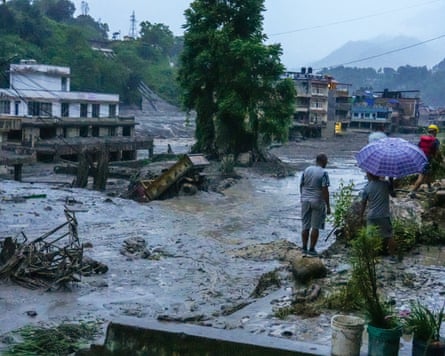
The disaster, which struck with little warning on Wednesday, obliterated entire villages and decimated critical infrastructure across the rugged Himalayan border region. According to the latest reports from Nepali police and Chinese state media, the death toll is expected to rise significantly as search teams reach previously inaccessible areas. The "tsunami from the sky," as some survivors described it, has transformed the picturesque trekking routes of the Bagmati province and the Tibetan plateau into a landscape of mud, overturned trucks, and splintered timber.
The Impending Threat of a Secondary Breach
As the international community monitors the race to get aid into Nepal and Tibet, the focus has shifted toward a precarious geological situation at the confluence of the Tsogyal and Purupqiangzangbu rivers. Chinese authorities confirmed on Thursday that a barrier lake formed by the recent landslides is now overflowing. If the natural dam created by rock and ice collapses, it could trigger a secondary flood event that would threaten survivors and rescue workers already struggling in the disaster zone.
Nepal’s National Disaster Risk Reduction and Management Authority has issued an emergency appeal for residents and rescuers to maintain a safe distance from the swelling waters. The risk of the flood lake bursting has halted some ground-based recovery efforts, forcing teams to rely almost exclusively on aerial surveillance and high-altitude helicopter extractions. The volatility of the terrain, combined with the potential for further glacial movement, has created a race against time for logistical teams trying to deliver food, medicine, and clean water.
Infrastructure Collapse and the Search for the Missing
The scale of the destruction has made the search for the missing an logistical nightmare. Officials report that dozens of bridges have been swept away, and approximately 25 miles of critical roadway have been erased from the mountainsides. This damage has effectively cut off the Rasuwa, Nuwakot, and Dhading districts from the rest of Nepal, leaving thousands of people stranded without electricity or communication.
Among the 1,300 people currently unaccounted for are hundreds of foreign nationals. Tourism officials in Kathmandu noted that more than 500 foreigners are missing on the Nepali side, including 177 from India, 90 from the United States, 34 from Australia, 33 from Britain, and 25 from Canada. Many of these individuals were in the region for high-altitude trekking or were partaking in the sacred pilgrimage to Kailash Mansarovar, a site of immense spiritual significance for Hindus and Buddhists located across the border in Tibet.

In Tibet, the situation is equally grim but shrouded in a degree of uncertainty due to strict information controls. Chinese state media has reported at least 558 people missing, including 260 foreign nationals. While the official death toll on the Chinese side remains low at three confirmed fatalities, local officials have expressed fears of "major casualties" following a massive mudslide that struck a key border crossing and destroyed several residential structures.
Scientific Reevaluation of the Disaster’s Cause
Initial reports from local authorities suggested that a 4.4-magnitude earthquake might have triggered the glacial collapse. However, the U.S. Geological Survey (USGS) later corrected this assessment, clarifying that no tectonic earthquake had occurred. Instead, the seismic shock recorded by sensors was the result of the disaster itself—a massive volume of glacial rock and ice falling from a high-altitude peak, which generated enough force to mimic a moderate earthquake.
This phenomenon, often referred to as a Glacial Lake Outburst Flood (GLOF) or a massive debris flow triggered by ice-fall, highlights the increasing instability of the Himalayan cryosphere. Scientists noted that the power, volume, and speed of the water were so great that they created a "wall of water" that gave those in its path almost no time to flee. Satellite imagery captured before and after the event shows the dramatic disappearance of a lower glacial section, which disintegrated into a slurry of ice, boulders, and water that thundered down the narrow valleys.
Personal Accounts of Survival and Loss
The human toll of the disaster is most evident in the stories of those who survived the initial surge. Girilal Budhathoki, a 36-year-old resident of the Rasuwa district, returned to his home to find it completely erased from the landscape. Budhathoki, who was away when the floods hit, lost his wife and four children to the torrent. He described a scene of total darkness and a roar so loud it felt like the earth was splitting open.
"Everything turned completely black, and I couldn’t understand what was happening," Budhathoki told reporters near an army base. "Suddenly, something heavy crushed me and I fell down. I searched desperately for my wife and children but I couldn’t find them. I am all alone now."
In the village of Chilime, Kamal Kharel was working at a local hydropower plant when the facility began to shake violently. Kharel and several colleagues managed to survive by climbing a nearby ridge, where they watched as waves—described as being as high as those seen in the open ocean—obliterated the infrastructure below. They remained on the hillside for nearly 24 hours before Nepali Army helicopters were able to extract them on Thursday morning.
Humanitarian Response and the Race to Get Aid Into Nepal and Tibet
The United Nations has moved quickly to address the burgeoning humanitarian crisis. Tom Fletcher, the UN’s humanitarian chief, described the situation as "horrifying" and announced an initial allocation of $2 million from disaster funds. This money is earmarked for emergency medical care, temporary shelter, and the restoration of clean water supplies to prevent the outbreak of waterborne diseases.
Srijana Gurung, the acting Nepal director for Plan International, emphasized that the region is suffering from "climate shock after shock." She noted that while landslides and floods are seasonal risks in the Himalayas, the intensity and frequency of these events have reached unprecedented levels. The immediate priority, Gurung stated, is supporting families in their search for loved ones and ensuring that children, who are particularly vulnerable in the wake of such trauma, receive psychological support and basic necessities.
The logistics of the aid mission remain the primary hurdle. With roads destroyed, the Nepali Army has deployed a fleet of helicopters to ferry the injured to Kathmandu for advanced medical treatment. At an army training center in Bagmati province, hundreds of people have gathered, clutching lists of missing relatives and hoping for news. In the absence of electricity, police officers are using mobile phone torches to record the names of the missing as the sun sets over the devastated valley.
Geopolitical Challenges and Information Access
The disaster has also highlighted the stark differences in information transparency between the two affected regions. While Nepal has been open about the scale of the crisis and the involvement of international NGOs, information from Tibet remains tightly controlled by Beijing. Foreign journalists are largely barred from the region, and Tibetans face significant risks when communicating with international media.
Maya Wang, the deputy Asia director at Human Rights Watch, raised concerns about whether the Chinese government could have done more to mitigate disaster risks. She pointed to long-standing criticisms from experts regarding rapid, state-led development in Tibet, often conducted without the input of local communities. Wang called on the Chinese authorities to allow international researchers and journalists unfettered access to the region to conduct a rigorous investigation into the disaster’s causes and the efficacy of the state’s response.
Long-term Consequences and the Road to Recovery
As the race to get aid into Nepal and Tibet continues, the long-term economic and social consequences are beginning to take shape. The destruction of hydroelectric power plants in Nepal will likely lead to prolonged energy shortages in the Bagmati province, further hindering recovery efforts. Furthermore, the loss of 25 miles of roads in a region dependent on tourism and pilgrimage traffic will have a devastating impact on the local economy for years to come.
For the village of Soley in Nuwakot, the future is even more uncertain. The settlement, which once housed 25 families, has been almost entirely wiped out. Nirajan Paudyal, a journalist whose family lived in the village, expressed a sentiment shared by many in the region: a fear that the "missing" will never be found, and that the geography of their homes has been permanently altered by the weight of the mud and stone.
The international community remains on high alert as the threat of the barrier lake bursting looms over the rescue operations. While the immediate focus is on saving lives and recovering the dead, the disaster serves as a grim reminder of the fragile nature of life in the high Himalayas and the increasing volatility of a region on the front lines of global environmental change. The recovery will require not only immediate financial aid but a sustained international effort to rebuild infrastructure that can withstand the increasingly violent cycles of the mountain landscape.