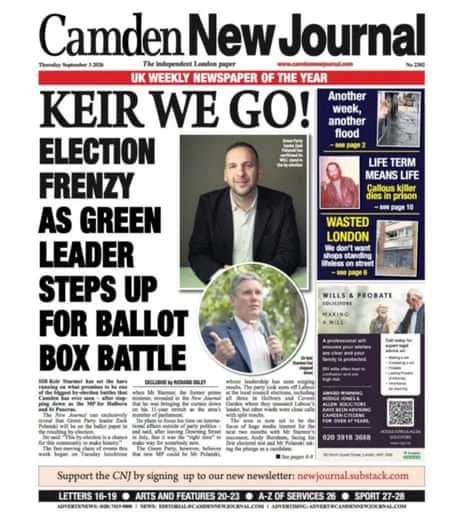
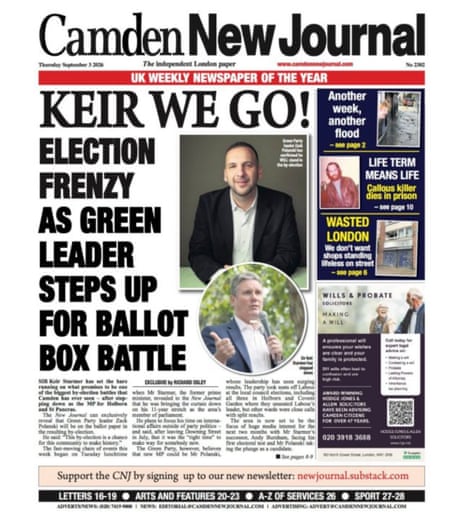
Zack Polanski, the leader of the Green Party, officially confirmed his candidacy for the Holborn and St Pancras by-election on Thursday, launching a pointed critique against a Labour Party he described as being under the influence of corporate interests. The announcement, made during an interview with the Camden New Journal, sets the stage for a high-stakes political battle in the London constituency recently vacated by Keir Starmer. Polanski, who secured the Green Party leadership last year with 84% of the member vote, framed his campaign as a necessary alternative for voters disillusioned by mainstream political donor culture and the "party whip" system.
The by-election was triggered by the unexpected resignation of Keir Starmer from Parliament, a move that has already shifted the internal dynamics of the Labour Party. With Andy Burnham now at the helm of the party, the upcoming contest in Holborn and St Pancras is being viewed by analysts as a "proof of concept" for the new leadership. While Labour has historically held the seat with significant majorities, Polanski’s entry into the race introduces a formidable challenge from the progressive left, potentially siphoning off votes from younger residents, students, and those critical of Labour’s recent policy shifts.
Polanski Targets Labour as Party of ‘Corporations and Big Money’
In his opening campaign remarks, Polanski emphasized his deep ties to the local community, stating that he has lived and worked in the area for many years. He argued that the constituency, which includes major landmarks and academic institutions like University College London (UCL), has been "held back" by successive governments that failed to implement meaningful social change. Polanski’s rhetoric centered on the economic struggles of everyday citizens, contrasting their hardships with the perceived wealth of Labour’s financial backers.
“We know that the Greens can win here,” Polanski stated, asserting that voters deserve a representative who is “never scared of big donors.” He specifically accused the Labour Party of standing up for “corporations and big money” while neglecting those struggling to pay basic utility bills. By positioning himself as a candidate dedicated to "making life more affordable," Polanski aims to capture the "protest vote" that surfaced during the 2024 general election, where independent and Green candidates combined to take nearly 30% of the local vote share.
The Strategic Importance of Holborn and St Pancras
The Holborn and St Pancras constituency has a long-standing history as a Labour stronghold. Since its creation in 1983, it has been represented by only two individuals: the late Frank Dobson and Keir Starmer. In the 2024 general election, Starmer retained the seat with 48.9% of the vote. However, the emergence of independent candidate Andrew Feinstein, who secured 18.9%, and the Greens, who took 10.4%, signaled a fracturing of the traditional Labour base. Much of this dissent was attributed to Starmer’s stance on international conflicts and a perceived drift toward the political center.

Political observers note that the seat’s demographic makeup—comprising a high density of students, young graduate professionals, and diverse ethnic minority communities—makes it particularly susceptible to Green Party messaging. The Greens have already seen success in the area, making notable gains in the May local elections within the London Borough of Camden. For Andy Burnham, defending this seat is not merely about maintaining a parliamentary majority; it is about proving that his version of the Labour Party can retain the trust of urban progressive voters who feel alienated by the party’s national trajectory.
Conservatives Propose Defense Hikes Linked to Welfare Cuts
As the Green Party looks to squeeze Labour from the left, the Conservative Party is attempting to reclaim the narrative on national security and fiscal responsibility. Kemi Badenoch, a leading figure in the Conservative shadow cabinet, delivered a major speech on Thursday outlining a plan to increase defense spending to 3% of the UK’s GDP by 2030. The proposal involves a £10 billion annual increase in military funding, which Badenoch argues is essential given the deteriorating global security environment.
However, the funding mechanism for this increase has sparked immediate controversy. The Conservatives intend to finance the defense surge through significant cuts to the national welfare budget. Key measures include:
- Saving £4 billion through reforms to housing benefits.
- Saving £3.1 billion by reimposing the controversial two-child benefit cap.
- Ending VAT exemptions for Motability vehicles, estimated to save £1 billion.
- Redirecting £2 billion from civil research and development budgets into defense.
Labour spokespeople have dismissed the plan as "dodgy economics," claiming the Conservatives have already "spent" these notional savings on other pledges. The exchange highlights a deepening divide over national priorities, with the Tories prioritizing military readiness and Labour focusing on economic stability under Burnham’s leadership.
Burnham Meets Macron Amid Migration Crisis Talks
While domestic electioneering intensifies, Andy Burnham has also taken to the international stage, hosting French President Emmanuel Macron at Downing Street. The meeting follows a symbolic visit to the British Museum to view the Bayeux Tapestry, which King Charles III recently described as a symbol of the "entente amicale" between the two nations. The primary focus of the diplomatic talks, however, remains the ongoing migration crisis in the English Channel.
The UK and France have announced a surge in resources to combat human smuggling networks that have recently shifted tactics. Intelligence reports indicate that smugglers are now utilizing "mega dinghies"—vessels up to 15 meters long capable of carrying over 200 people. To counter this, a new 75-strong unit has been deployed to northern France, bringing the total number of officers in the region to nearly 1,050. Despite a drop in the overall number of crossings this summer, the increased capacity of these larger vessels has kept the total number of arrivals high, putting immense pressure on both governments to find a sustainable solution.
The Impact of the Polanski Candidacy on UK Politics
The decision by a national party leader to run in a by-election is a rare and risky maneuver. If Zack Polanski wins, it would provide the Green Party with a high-profile platform in the House of Commons and potentially trigger a wider realignment of the British left. If he loses, it could be seen as a rejection of the Green platform in one of its most favorable territories. Professor Rob Ford, an elections specialist, noted that Polanski’s candidacy changes the fundamental question of the election from a party choice to a personality choice: "Would you like the national leader of the Green party or a generic Labour backbencher as your representative?"
There are also practical complications for the Green Party. Election rules regarding broadcast neutrality may limit the amount of media coverage Polanski can receive during the Green Party’s national conference in October. This mirrors the challenges faced by Nigel Farage during previous election cycles, where candidate status restricted his ability to represent his party on major television networks.
Public Reaction and the Road to the Polls
Public sentiment in Holborn and St Pancras remains mixed. While many residents express loyalty to the Labour Party’s historical roots, there is a palpable sense of frustration regarding the cost-of-living crisis and the perceived lack of distinction between the major parties’ economic policies. Polanski’s focus on "struggling people" versus "big money" is designed to resonate with the thousands of renters and low-income workers in the borough who have seen their disposable income evaporate due to inflation and rising housing costs.
Labour is expected to "throw everything" at defending the seat. Party insiders suggest that Burnham will utilize his reputation as a "man of the people" to bridge the gap between traditional working-class voters and the younger progressive wing. The outcome of this contest will likely serve as a bellwether for the next general election, indicating whether Labour can successfully consolidate the left-wing vote or if the Green Party will emerge as a permanent and powerful third force in urban British politics.
As the campaign officially begins, the eyes of the country will be on this North London constituency. The battle between the Green Party’s message of corporate-free politics and Labour’s attempt to project a stable, governing alternative will define the political narrative for the coming months. With the Conservatives and Reform UK also vying for relevance, the Holborn and St Pancras by-election is shaping up to be one of the most consequential local contests in recent memory.