Larry David has made a highly anticipated return to HBO Max with his new American history-centered sketch comedy series, Life, Larry and the Pursuit of Unhappiness, following the conclusion of his acclaimed long-running series Curb Your Enthusiasm. The show, which features former President Barack Obama and Michelle Obama as executive producers through their Higher Ground Productions, has quickly become a star-studded affair, showcasing an extensive roster of celebrity guest stars and cameos portraying historical figures and original characters.
The series distinguishes itself not merely with sporadic guest appearances, but with a consistent influx of high-profile talent across every episode. Each installment of Life, Larry and the Pursuit of Unhappiness boasts over a dozen celebrity guests, ranging from David’s familiar collaborators on Curb Your Enthusiasm to major Hollywood icons. The show also notably features the late Rob Reiner in what would become his final screen performance, adding a poignant layer to the comedic ensemble. Prominent actors like Samuel L. Jackson and Lin-Manuel Miranda have donned period attire, alongside television stalwarts such as Jerry Seinfeld and Jon Hamm, creating a unique blend of comedic and dramatic talent.
A New Chapter in Larry David’s Comedic Legacy
Life, Larry and the Pursuit of Unhappiness marks a significant pivot for Larry David, moving from the semi-improvised, everyday annoyances of Curb Your Enthusiasm to a more structured, yet equally irascible, exploration of American history. The series leverages David’s signature curmudgeonly persona, injecting it into pivotal moments and mundane footnotes of the past. This format allows David to play multiple roles, often as an anachronistic irritant or a relatable, exasperated observer caught in historical scenarios. The involvement of the Obamas as executive producers brought considerable buzz, signaling a high-caliber production with a distinct blend of humor and historical engagement.
The premise sees David’s characters interacting with figures across different eras, from the Founding Fathers to the Civil Rights Movement, and beyond. This approach provides a vast canvas for comedic situations, many of which echo the social awkwardness and petty grievances that defined Curb Your Enthusiasm. The show airs new episodes on Friday nights at 9 p.m. on HBO and is available for streaming on HBO Max, with The Hollywood Reporter diligently tracking the evolving list of guest stars who contribute to its unique appeal.
Episode-by-Episode Breakdown of Guest Stars and Cameos
The inaugural episodes have already delivered a remarkable parade of talent, each contributing to the show’s distinct blend of historical satire and David’s brand of cringe comedy.
Episode 1 – “Livingston”
The series premiere immediately set a high bar for its guest stars and cameos. Former President Barack Obama appears as himself, offering a meta-commentary on the nation’s semiquincentennial and playfully jabbing at David. Samuel L. Jackson provides his distinctive voice as The Narrator, setting a tone of historical gravitas that is often undercut by David’s antics.
The episode’s first sketch features Henry Winkler as John Hancock, Chris Parnell as Benjamin Franklin, and Alan Tudyk as Thomas Jefferson, humorously clashing with David’s Robert Livingston over additions to the Declaration of Independence. David then embodies Alexander Graham Bell, forced into an awkward telephone debut with Curb alum Richard Kind as Thomas Watson, surrounded by demanding "revelers" played by Alison Becker, Mary Sohn, and Rodney J. Hobbs, who parody modern consumers. A World War I trench warfare segment sees David as a cowardly soldier under the command of Michael Chiklis as a sergeant, alongside Mike Castle and Jake Reiner, son of the late Rob Reiner. The premiere concludes with a powerful yet comedic sketch where David portrays an irritating bus passenger next to Jurnee Smollett’s perfectly cast Rosa Parks, showcasing the show’s willingness to tackle sensitive historical moments with David’s characteristic irreverence.
Episode 2 – “Farewell”
The second episode continued the trend of significant guest stars and cameos. Samuel L. Jackson returns as The Narrator. A highly anticipated reunion between Seinfeld creators Larry David and Jerry Seinfeld occurs, with Seinfeld portraying William Clark alongside David’s Meriwether Lewis. Their expedition, commissioned by Thomas Jefferson, becomes a comedic exploration of male bonding and long-suffering spouses, personified by Rita Wilson as Mavis Lewis.
David then skewers the Electoral College as Samuel Tilden, the 1876 presidential candidate who won the popular vote but lost the election. His ranting is amplified by aides played by Curb alum Matthew Jones and Rich Fulcher. A segment set during the Great Depression features Larry Wilmore and Colton Dunn, with Kaley Cuoco delivering a memorable performance as a grieving widow whom David attempts to exploit to cut a breadline. The episode culminates in the much-discussed final screen appearance of Rob Reiner as George Washington, discussing presidential term limits. His performance, viewed by a crowd including Jimmy Kimmel, subtly sets up David’s character to take veiled comedic jabs at contemporary political figures without explicit naming.
Episode 3 – “McCarthy”
Episode three delves into more American historical moments with another strong lineup of guest stars and cameos. Samuel L. Jackson continues his narrative role. The Boston Tea Party sketch sees David as a bystand trying to join the rebellion, interacting with Lin-Manuel Miranda, whose Revolutionary War pedigree from Hamilton makes his appearance as a Tea Party ringleader particularly apt, and comedian Lou DiMaggio.
J.B. Smoove brings his signature comedic energy to the Underground Railroad sketch as Jonesey Dean Sharpe, whose demanding presence flabbergasts David’s host character. The Wright Brothers segment introduces Jon Hamm and Sean Hayes as Orville and Wilbur Wright, preparing for their first flight, while David plays a fictional, less-than-heroic third Wright sibling, squabbling with his wife (Isla Fisher) over butter-churning skills. The episode’s climax features David himself as Senator Joseph McCarthy, with SNL alum Michael McKean as attorney Joseph Welch, delivering the iconic "Have you no decency, sir?" rebuttal, alongside Rob Huebel as a moderating senator in one of McCarthy’s infamous hearings.
Episode 4 – “Deepthroat”
The fourth episode applied the Larry David treatment to more recent history and scientific breakthroughs, featuring notable guest stars and cameos. Samuel L. Jackson once again narrates. The Watergate scandal is revisited with David portraying "Deep Throat," the anonymous source. However, David’s version offers Beck Bennett’s Bob Woodward (of SNL fame) only trivial, unhelpful information in a parking lot rendezvous.
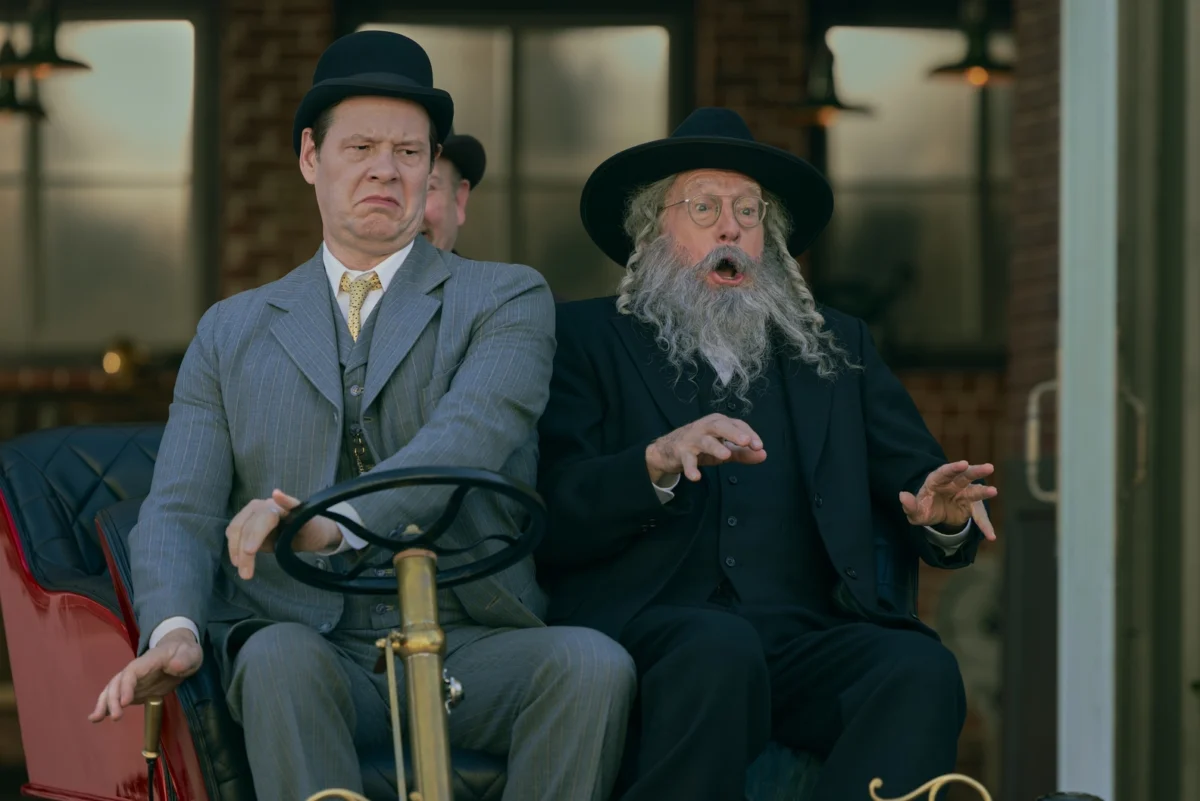
Ike Barinholtz appears as the notoriously antisemitic Henry Ford, humorously uncomfortable showing his new vehicle to David’s rabbi character. David then embodies President James Buchanan, awkwardly hitting on female guests at a party where he introduces the concept of passed appetizers. Jordana Brewster and Katie Aselton play some of the "unfortunate ladies," with Diallo Riddle as Buchanan’s assistant, John Appleton. The episode’s most talked-about segment revives an old David stand-up bit, with him playing Dora, the overly proud mother of Jonas Salk (Adam Lustick), bragging about the polio vaccine to her neighbor Evelyn (Judy Gold). This sketch cleverly parodies modern vaccine skepticism, with a young man named Bobby (Gregg "Jeep" Perrie) voicing concerns, drawing parallels to contemporary debates and implicitly mocking figures like Robert F. Kennedy Jr.
Episode 5 – “Lincoln”
Episode five focuses on two significant historical events with a concentrated cast of guest stars and cameos. Samuel L. Jackson narrates. The first segment transports viewers to the O.K. Corral, featuring Timothy Olyphant as Wyatt Earp and Don Johnson as Doc Holliday. David’s character injects Curb-style logistical arguments into the famous shootout, with Marc Menchaca, Johnno Wilson, and Maximo Salas rounding out the cast of outlaws.
The second, more extensive sketch explores Abraham Lincoln’s strained relationship with Mary Todd Lincoln. Bill Hader delivers a put-upon Lincoln, while Kathryn Hahn brilliantly portrays Mary Todd Lincoln. The sketch features Lincoln (Hader) conniving with his chief of staff to escape Mary’s presence at Ford’s Theatre, leading to a comedic game of telephone and an argument over a stolen sweater that could be straight out of Curb Your Enthusiasm. Lennon Parham, Jay Renshaw (as John Wilkes Booth), and Seth Morris (as Andrew Johnson) also appear, adding layers to this historical and interpersonal comedy.
Episode 6 – [Untitled]
The sixth installment continues to span vast periods of American history, from before the American Revolution to the 1969 Apollo 11 mission, showcasing a diverse range of guest stars and cameos. Samuel L. Jackson is again The Narrator. The episode opens with Paul Revere’s historic ride, featuring Kyle Mooney as Revere, and David as a colonial resident bickering with his wife, Elsbeth (Isla Fisher), amidst the stress of the British arrival.
Next, Keegan-Michael Key delivers a comedic turn as a doofus Davy Crockett during the Texas Revolution, arguing with David’s character about his secret defecation spot outside the Alamo and the myths surrounding his persona. The third sketch reunites Larry David with Curb Your Enthusiasm co-star Susie Essman, who plays suffragette Susan B. Anthony. Essman hosts a booze-free dinner party, much to the annoyance of David’s obnoxious guest, showcasing their undeniable comedic chemistry. Wayne Federman and Jane Krakowski also appear. The episode concludes with a humorous take on the 1969 moon landing, with Paul Rudd as Neil Armstrong bickering and ultimately duking it out with David’s Buzz Aldrin.
Broader Implications and Cultural Impact
Life, Larry and the Pursuit of Unhappiness has successfully transitioned Larry David’s unique comedic voice into a new, expansive format. The sheer number and caliber of guest stars and cameos attest to David’s enduring influence and the appeal of working with a comedic legend. The show’s ability to attract A-list talent, coupled with the prestige of the Obama’s production company, solidifies its position as a must-watch series.
The series not only provides ample laughs but also cleverly uses historical events to comment on contemporary issues, often through David’s signature lens of petty grievances and social transgressions. The blend of meticulously researched historical backdrops with David’s anachronistic and often absurd interactions creates a fresh take on sketch comedy. It demonstrates how David’s comedic principles, honed over decades, can be applied to virtually any context, making historical figures relatable in their flaws and frustrations. The show has generated significant buzz, with each new episode sparking discussions about its unique comedic interpretations of American history and the parade of famous faces. As the series continues, anticipation remains high for which historical moments will be lampooned next and which prominent actors will join David in his pursuit of unhappiness.