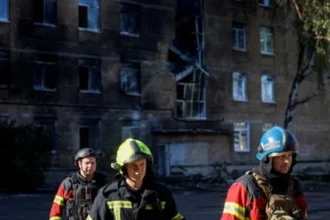
A fast-moving wildfire in Reno, Nevada, forces thousands to evacuate homes as the blaze, known as the Hawk Fire, exploded to more than 13,000 acres early Sunday morning. The fire, which originated in the Sierra Nevada foothills, is currently pushing toward the heart of the city, prompting emergency officials to issue mandatory "GO NOW" orders for approximately 42,000 residents. The flames have reached the perimeter of the University of Nevada, Reno (UNR) campus, threatening densely populated neighborhoods and critical infrastructure in the Truckee Meadows region.
The situation remains fluid as high-velocity winds and historically low humidity levels create a "perfect storm" for fire propagation. According to Truckee Meadows Fire and Rescue, the fire’s rapid advancement has been fueled by an abundance of dry vegetation and erratic gusty winds that are whipping the flames in multiple directions. In addition to those under mandatory evacuation, another 45,000 residents remain under evacuation warnings, with officials urging them to prepare for a multi-day displacement to ensure that emergency routes remain clear for first responders and heavy equipment.
Explosive Growth and Emergency Declarations
Governor Joe Lombardo declared a state of emergency for Washoe County late Saturday night, a move that authorized the immediate mobilization of the Nevada National Guard. The state’s response includes the deployment of 60 troops to assist local law enforcement with security in evacuated zones and two helicopter crews dedicated to aerial water drops. Despite these resources, the fire’s behavior has remained unpredictable.
"Approximately 400 personnel are currently working on the incident, with resources coming together from local, state, and federal agencies," Truckee Meadows Fire and Rescue said in a public update. The unified command structure includes ground crews, air tankers, and municipal fire departments from across the region. However, the sheer speed of the Hawk Fire has outpaced initial containment efforts, as the blaze jumped several natural firebreaks during the overnight hours.
Reno Mayor Hillary Schieve issued a stern warning to residents, emphasizing that property can be replaced but lives cannot. "If you have been told to evacuate, please don’t wait," Schieve stated. She confirmed that multiple structures have already been lost to the flames and that early evacuation is the only way to allow firefighters to focus on active suppression rather than life-saving rescue operations. As of Sunday afternoon, authorities confirmed that three civilians and three first responders have sustained injuries, though the severity of their conditions has not been publicly released.
Fast-moving Wildfire in Reno, Nevada, Forces Thousands to Evacuate Homes Near UNR
The proximity of the fire to the University of Nevada, Reno, has created a logistical challenge for city officials and university administration. The campus, which saw an enrollment of approximately 24,000 students in the fall of 2025, is currently in the midst of its move-in week. While the first day of classes is scheduled for August 24, many new students moved into dormitories as early as August 13.
While the campus itself remained just outside the mandatory evacuation zone as of Sunday morning, university officials have activated an emergency response plan. This plan includes the potential for a full-scale campus evacuation should the fire breach the current containment lines near the northern edge of the property. The university’s proximity to the Sierra foothills makes it particularly vulnerable to spot fires caused by wind-blown embers, which can travel miles ahead of the main fire front.
Further complicating the situation is the impact on local infrastructure. Nearly 10,000 homes and businesses in Washoe County were without electricity on Sunday as NV Energy shut off power to prevent downed lines from sparking new fires and to protect crews working near high-voltage equipment. Portions of US Route 395, a critical north-south artery for the region, were closed to all non-emergency traffic, creating significant bottlenecks as residents attempted to flee the southern and western portions of the city.
A Community Under Siege: Evacuations and Shelter Logistics
The scale of the displacement has forced Washoe County emergency officials to open the Reno-Sparks Convention Center as a primary staging area for evacuees. However, the facility’s inability to house pets has led to the establishment of secondary locations. Small animals are being directed to local shelters, while large livestock, including horses from the surrounding rural properties, are being moved to the Reno-Stead area.
In a show of community solidarity, several of Reno’s major casino-resorts have stepped in to offer discounted room rates and emergency vouchers for those displaced by the Hawk Fire. This support is vital for a city of 280,000 people where hotel capacity is often stretched thin during the summer tourism season.

The Reno-Tahoe International Airport remains operational for commercial flights, though the smaller Reno-Stead Airport has been restricted to firefighting aircraft only. The aerial battle is being fought with a mix of VLATs (Very Large Air Tankers) and helicopters, though visibility issues caused by dense smoke have occasionally grounded flights.
Firefighting Challenges: Staffing and Environmental Factors
The Hawk Fire highlights a growing concern among emergency management experts regarding the national shortage of wildland firefighters. Federal and state agencies have sounded alarms for years about the difficulty of maintaining adequate staffing levels as fire seasons grow longer and more intense. In Nevada, the "wildland-urban interface"—areas where residential development meets undeveloped wildland—has expanded significantly, putting more homes in the direct path of seasonal blazes.
The environmental conditions in the Great Basin are also a major factor. The region has seen a buildup of fine fuels, such as cheatgrass, which ignite easily and carry fire rapidly across open terrain. When combined with the "Washoe Zephyr"—a localized wind pattern common in the Reno area—even a small ignition can transform into a catastrophic event within minutes.
This is the second major fire event for the region in less than a month. Just weeks ago, three separate wildfires north of Reno forced 13,000 residents to evacuate. The cumulative stress on local resources and the exhaustion of fire crews are becoming evident as the Hawk Fire continues to burn without significant containment.
Infrastructure Risks and the Washoe County Detention Facility
Beyond residential neighborhoods, authorities are monitoring high-risk facilities located near the fire’s path. Washoe County Sheriff Darin Balaam noted that a county detention facility is situated just a few blocks from the current evacuation warning zone.
"We have those inmates in mind and we are making sure that we have plans in place in case we may have to evacuate the facility," Balaam said. Evacuating a jail presents unique security and logistical hurdles, requiring coordinated transport and temporary housing in a high-security environment.
As the fast-moving wildfire in Reno, Nevada, forces thousands to evacuate homes, the economic impact is also being tallied. With US 395 closed and power outages affecting commercial districts, the local economy—heavily dependent on logistics, gaming, and outdoor recreation—is facing a temporary standstill. The cost of suppression efforts, combined with property damage and lost business revenue, is expected to reach into the tens of millions of dollars.
Long-term Outlook and Regional Impact
The Hawk Fire serves as a grim reminder of the increasing volatility of wildfires in the Western United States. Climatologists point to a trend of "flash fires" that escalate in size much faster than historical averages due to prolonged drought and rising average temperatures. For Reno, a city that has branded itself as a hub for technology and outdoor living, the persistent threat of wildfire is becoming a central issue for urban planning and public safety.
As of Sunday evening, fire crews are focusing on establishing a perimeter on the fire’s eastern flank to prevent it from moving further into the city’s core. Meteorologists expect the wind to remain a factor through Monday, meaning the danger is far from over.
Residents are being told to stay tuned to local emergency alert systems and to avoid returning to evacuated areas until a formal "all clear" is given. The process of damage assessment will begin only once the fire has been sufficiently suppressed, a task that may take several more days given the current weather forecast. For now, the focus remains on life safety and the protection of Reno’s critical infrastructure in the face of one of the most aggressive fires the city has seen in recent memory.