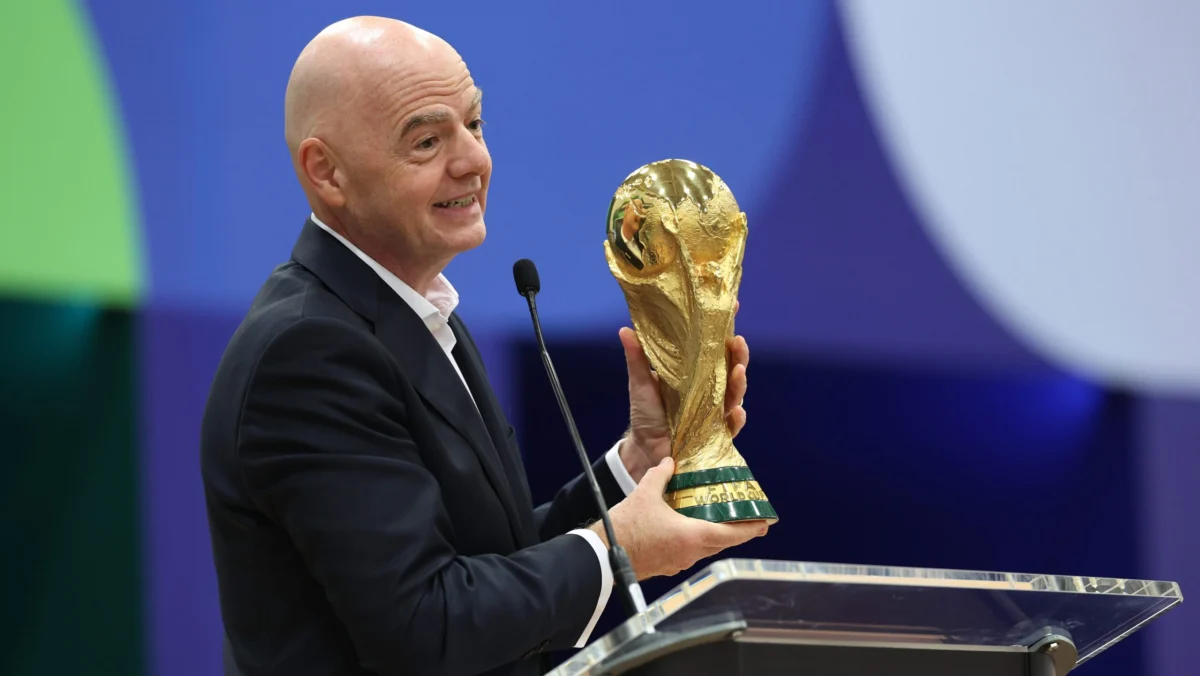
Gianni Infantino, the president of the global soccer governing body FIFA, has officially reversed his organization’s controversial proposal to sell a significant stake in the World Cup to private investors, a decision that comes swiftly after widespread condemnation and threats of boycott from major football confederations, most notably Europe’s UEFA. The abrupt retraction, announced by Infantino on Friday, signifies a significant climbdown for FIFA and its leadership, acknowledging that the plan had generated "divisions" detrimental to the sport’s overarching objectives.
The proposed financial restructuring, unveiled earlier in the week, aimed to establish a new commercial entity, the FIFA Forward Enterprise (FFE). This new venture was intended to consolidate FIFA’s various money-making operations, including media rights, sponsorship deals, and merchandising related to major tournaments like the World Cup. Under the original scheme, a substantial 20 percent stake in FFE was slated for sale to Thrive Capital, an investment group led by Joshua Kushner, brother of former U.S. President Donald Trump’s son-in-law, Jared Kushner. The rationale presented by FIFA was to create a robust financial basis for strengthening its 211 member associations and supporting the growth of soccer worldwide, particularly in developing nations.
The Genesis of the World Cup Sell-Off Proposal
FIFA’s pursuit of new financial models is not new, reflecting an ongoing drive to diversify revenue streams and enhance support for its global initiatives. The FIFA Forward program, initially launched in 2016, represents the organization’s flagship development project, channeling significant funds back to member associations for investments in infrastructure, youth development, and women’s football. The proposed FIFA Forward Enterprise was presented as an evolution of this concept, designed to optimize the commercial value of FIFA’s assets and generate even greater resources for these initiatives.
Proponents within FIFA argued that bringing in private equity expertise through a stake sale could unlock untapped commercial potential, streamline operations, and provide a substantial upfront capital injection. This capital, they suggested, would be ring-fenced for development projects, providing a more stable and predictable funding source than traditional cycles of sponsorship and broadcasting rights sales. The idea was to create a dedicated commercial arm that could operate with greater agility and focus on maximizing profits, allowing FIFA itself to concentrate more purely on governance and sporting matters. However, details surrounding the valuation of the proposed 20 percent stake and the precise mechanisms for how new revenue would be distributed remained opaque to external observers, fueling skepticism from the outset.
A History of Financial Scrutiny and Governance Challenges
FIFA has a complex and often troubled history with financial management and governance, particularly in the wake of the extensive corruption scandals that rocked the organization in the mid-2010s, leading to the downfall of then-President Sepp Blatter and numerous high-ranking officials. Gianni Infantino, who assumed the presidency in 2016, campaigned on a platform of reform, transparency, and good governance, pledging to restore trust in the institution.
Since his election, Infantino has overseen significant changes, including stricter compliance measures, increased financial oversight, and a greater emphasis on development programs. However, the organization still faces the challenge of reconciling its commercial ambitions with its role as a non-profit global sports governing body. The memory of past financial improprieties has left a lingering skepticism among football stakeholders and the public, making any major commercialization effort, especially one involving a private equity firm with political connections, subject to intense scrutiny. This historical context amplified the immediate and forceful pushback against the World Cup sell-off plans, with critics fearing a slippery slope towards further commercial exploitation and a potential return to less transparent financial dealings.
Intense Backlash Prompts Reversal of World Cup Sell-Off
The reaction to the proposed World Cup sell-off was swift, widespread, and unequivocally negative across much of the global football landscape. European football’s governing body, UEFA, emerged as the most vocal and powerful opponent, issuing a stern warning that it would boycott FIFA events, including future World Cups, if the plan proceeded. This threat carried immense weight, given that European national teams and clubs form the financial and sporting bedrock of the World Cup, consistently providing the majority of finalists and a significant portion of the global viewership. The 2026 men’s World Cup, for instance, saw three of its four semi-finalists hail from Europe, including the reigning champion, Spain. A UEFA boycott would effectively cripple the tournament’s sporting credibility and commercial viability.
Beyond UEFA, criticism mounted from various other quarters. National football federations, player unions, and prominent fan organizations voiced their alarm, expressing concerns that such a sale would dilute the World Cup’s integrity, prioritize profit over sporting tradition, and alienate the very fans who sustain the sport. The sentiment that "football belongs to the people" became a rallying cry against the commercialization effort. Political figures also weighed in, with U.K. Prime Minister Andy Burnham releasing a scathing statement online. Burnham’s remarks, which quickly gained traction, asserted that "football does not belong to investors. It belongs to the people who fill the stands and who stand on the touchline week in, week out, rain or shine. The World Cup is not a product. It is the greatest competition in world sport, and it was never anyone’s to sell. Dress the deal up however you like. Once you have sold a piece of it, you have sold out." Such strong public and institutional opposition left FIFA with little room to maneuver, forcing Infantino to reassess the feasibility and political cost of proceeding with the plan.
Infantino’s Retreat: A Strategic Reassessment
In his Friday statement announcing the withdrawal of the proposal, President Infantino framed the decision as a response to stakeholder feedback and a commitment to unity. "The FIFA Forward Enterprise project was intended to provide a basis for further strengthening our FIFA Member Associations and our sport worldwide, especially in those countries where support is most needed," Infantino said. He emphasized that the plan was always contingent on majority support from member associations and subject to extensive consultation with the FIFA Council, Confederations, and wider stakeholders.
However, Infantino conceded, "Having listened carefully to all the views, it has become clear that the project has created divisions of a nature that, regardless of the level of support, are no longer in the interest of the objective set out in the first place. Our purpose has always been – and will always be – to unite and improve. As a result, this proposal will not proceed." This statement, while couched in diplomatic language, effectively acknowledges the comprehensive failure to garner sufficient support and the immense reputational damage the proposal had caused. It represents a strategic retreat, prioritizing the cohesion of the global football family over a potentially lucrative, but deeply unpopular, commercial venture. The rapid reversal also underscores the significant power wielded by confederations like UEFA when their interests are perceived to be directly threatened, demonstrating that even FIFA’s top leadership must contend with powerful internal political dynamics.
Broader Implications of the World Cup Sell-Off Cancellation
The decision to scrap the World Cup sell-off plans carries significant broader implications for the future of global football governance and its commercial strategies. Firstly, it undeniably reinforces the powerful influence of UEFA, which successfully leveraged its economic and sporting clout to halt a major FIFA initiative. This episode could set a precedent, empowering other confederations or groups of national federations to more assertively challenge FIFA’s decisions in the future, particularly those that touch upon core assets or perceived integrity of the game. The incident highlights a persistent tension between FIFA’s global mandate and the regional interests of its most powerful constituents.
Secondly, the failed proposal signals a cautionary tale for the increasing trend of private equity investment in sports. While private capital has flowed into various leagues and clubs worldwide, the attempt to privatize a stake in a global sporting spectacle like the World Cup, which transcends national and club allegiances, met with fierce resistance. It underscores a fundamental philosophical divide within sports: whether iconic tournaments are purely commercial products to be monetized by investors or cultural assets that belong to a broader public and must be protected from excessive commercialization. This pushback suggests a limit to how far stakeholders are willing to allow the commercial imperative to dictate the future of cherished sporting institutions.
The Path Forward for Global Football Governance
Looking ahead, Infantino stated his intent to "bring all interested parties back together in the coming days and weeks in the spirit of shared interest in our game, and with the objective to continue growing football everywhere, particularly in those countries that mostly need our support." This suggests a pivot towards a more consultative and collaborative approach to addressing FIFA’s financial needs and development goals. The organization will likely need to explore alternative, less controversial methods for generating revenue and funding its ambitious "FIFA Forward" programs.
This could involve re-evaluating existing commercial partnerships, exploring new digital opportunities, or devising financial models that distribute risk and reward more equitably among stakeholders without ceding direct ownership of core assets. The episode serves as a powerful reminder that while commercial growth is essential for modern sports organizations, it must be balanced with the cultural significance, historical traditions, and collective ownership perceptions of major events like the World Cup. Any future financial strategy from FIFA will undoubtedly face heightened scrutiny, demanding greater transparency, broader stakeholder engagement, and a clear articulation of how such initiatives truly serve the best interests of global football, rather than just commercial entities.
The rapid withdrawal of the World Cup sell-off proposal marks a critical moment in the ongoing evolution of football’s global governance. It demonstrates that even the highest authority in international soccer must ultimately bow to the collective will of its most influential members and the passionate sentiment of the sport’s global fanbase. The World Cup, in this instance, proved to be more than just a valuable asset; it is a cultural touchstone whose perceived integrity and accessibility remain paramount for millions worldwide.