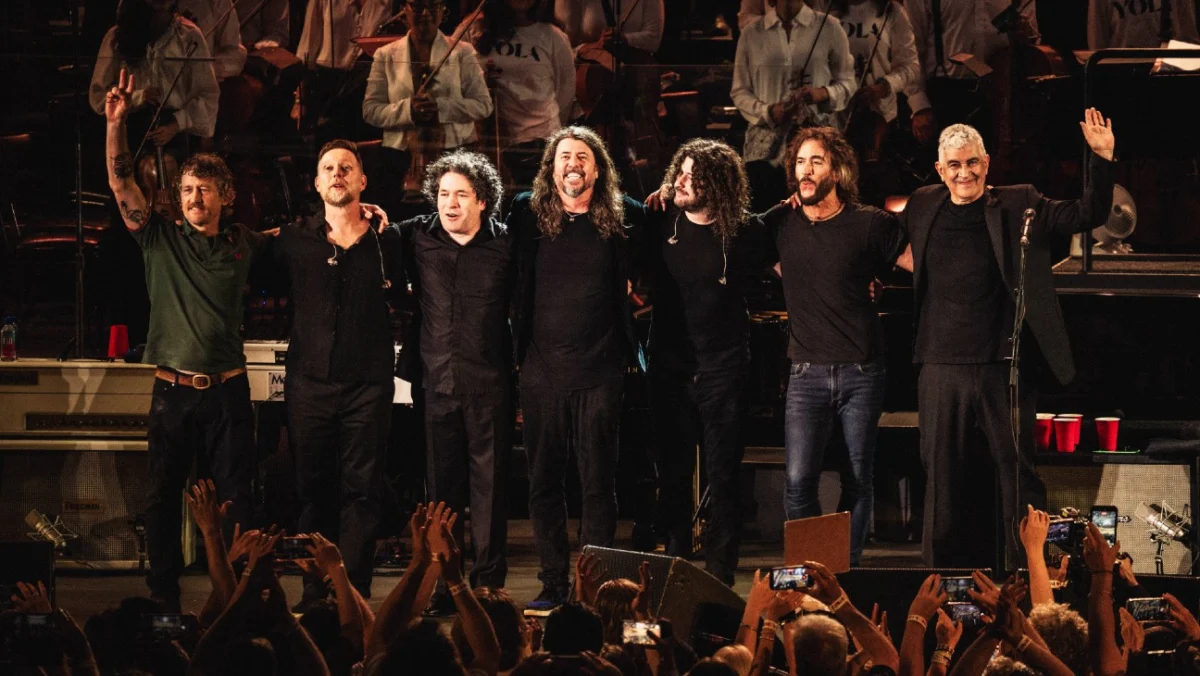
A momentous convergence of rock and classical music captivated audiences at the iconic Hollywood Bowl on Saturday, as the Grammy Award-winning Foo Fighters made their historic debut at the legendary venue, accompanied by the acclaimed Los Angeles Philharmonic under the baton of departing music and artistic director Gustavo Dudamel. The unique concert served as a poignant capstone to Dudamel’s illustrious 14-year tenure with the L.A. Phil, marking his farewell weekend in Los Angeles before embarking on his new role with the New York Philharmonic next month.
A Historic Collaboration Unfolds
The atmosphere was charged with anticipation as Dave Grohl, the band’s charismatic frontman, took the stage, visibly reflecting on the magnitude of the evening. This unprecedented collaboration brought together one of the world’s premier rock bands with a symphonic orchestra known for its innovative programming and world-class musicianship, creating a truly unique spectacle for the thousands in attendance. Grohl’s sentiment, hinting at the unparalleled nature of the event, underscored the special occasion for both the band and their devoted fanbase.
The Hollywood Bowl, an open-air amphitheater steeped in over a century of musical history, has long been a revered stage for diverse acts, from classical legends to contemporary pop icons. However, a full-scale rock concert by the Foo Fighters, enhanced by the expansive sound of the Los Angeles Philharmonic, represented a distinctive milestone even for a venue accustomed to groundbreaking performances. The meticulous arrangements for the 15-song set blended the raw energy of rock anthems with the rich textures of a full orchestra, promising an auditory experience unlike any other.
Dudamel’s Farewell and a New Chapter
The event held particular significance for Gustavo Dudamel, the Venezuelan maestro who has become synonymous with the L.A. Philharmonic since his appointment in 2009. His farewell weekend at the Hollywood Bowl was not merely a series of performances but a grand celebration of a transformative era for the orchestra and the city of Los Angeles. Dudamel’s dynamic leadership, youthful vigor, and unwavering commitment to music education, particularly through programs like "El Sistema," have left an indelible mark on the cultural landscape of Southern California.
His move to the New York Philharmonic represents a significant shift in the global classical music scene, prompting both reflection on his accomplishments in Los Angeles and anticipation for his future contributions in New York. The decision to collaborate with the Foo Fighters for one of his final L.A. Phil performances underscored his adventurous spirit and his belief in bridging musical genres, a characteristic hallmark of his tenure. This specific concert, therefore, became a powerful symbol of his legacy: a maestro unafraid to explore new frontiers while maintaining artistic excellence.
The Maestro’s Legacy in Los Angeles
Gustavo Dudamel’s arrival in Los Angeles was met with immense fanfare, and he quickly established himself as a charismatic force, not just in the concert hall but throughout the community. Under his direction, the L.A. Philharmonic flourished, attracting new audiences and expanding its repertoire to include contemporary works and innovative cross-genre collaborations. His tenure saw the orchestra achieve new heights in international acclaim, regularly touring and recording critically praised albums. He championed inclusivity and accessibility, making classical music a vibrant part of Los Angeles’s diverse cultural fabric.
His impact extended beyond performances, deeply influencing music education initiatives through the YOLA (Youth Orchestra Los Angeles) program, inspired by Venezuela’s "El Sistema." YOLA provided free music instruction to thousands of underserved children, fostering artistic talent and community engagement. This dedication to youth and community development solidified his status as a beloved figure in Los Angeles, making his departure a bittersweet moment for many. The Foo Fighters concert, with its broad appeal, served as a fitting and inclusive send-off for a conductor who consistently sought to broaden classical music’s reach.
An Unforgettable Setlist: Rock Meets Symphony
During the 15-song set, Dave Grohl addressed the enthusiastic crowd, setting the tone for the unique evening. "Tonight, we’re going to play as many things as we can before we have to stop," Grohl announced, acknowledging the band’s usual marathon performances. "We usually play for three hours a night, but tonight, we picked the best songs that we can perform with our friends in the L.A. Phil and Mr. Gustavo Dudamel. Some of these you may have never heard before, so sit back and enjoy." This promise of a curated experience was eagerly received by fans, many of whom were witnessing a truly once-in-a-lifetime musical event.
Indeed, the setlist was a carefully crafted blend, showcasing the Foo Fighters’ versatility and the orchestra’s dynamic range. Alongside beloved staple singles such as "Times Like These," "All My Life," "The Pretender," "My Hero," and "Best of You," the band delved into their extensive catalog to unearth deep cuts rarely performed live. Among these were "Razor," a track the band had not played in concert since 2006, and "Home," which last graced a Foo Fighters setlist in 2007. These selections, reimagined with orchestral arrangements, offered fresh perspectives on familiar tunes and introduced new sonic dimensions to the band’s acclaimed discography.
Weaving Rock Anthems with Classical Grandeur

The collaboration with the L.A. Phil was not merely an add-on; the orchestra was deeply integrated into the fabric of the Foo Fighters’ sound. The symphonic arrangements provided a grander, more cinematic backdrop to the band’s powerful rock anthems, elevating the emotional resonance of each song. The precision and artistry of the Los Angeles Philharmonic, guided by Dudamel, added layers of complexity and majesty, creating a truly immersive experience. From soaring string sections to dramatic brass swells, the orchestra accentuated the melodic and harmonic nuances of the Foo Fighters’ music, demonstrating the powerful synergy achievable when rock and classical genres converge.
During the performance, Grohl engaged directly with Dudamel, playfully asking, "Gustavo, how you doing?" The frontman, known for his affable stage presence, went on to quip about the sheer scale of the orchestral and choir accompaniment. "So I figure we just get 14 more buses and take them on tour for the rest of our lives. Good plan?" This lighthearted exchange highlighted the camaraderie and mutual respect between the rock band and the classical ensemble, further endearing the unique performance to the audience. The spectacle underscored the adventurous spirit of both the Foo Fighters and Dudamel, celebrating the boundless possibilities of musical expression.
A Tribute to a Fallen Friend and a Powerful Finale
A particularly poignant moment arrived with the performance of "Aurora," which Dave Grohl dedicated to the band’s late drummer, Taylor Hawkins. Hawkins, a beloved figure in the music world and a longtime friend and collaborator of Grohl, tragically passed away in 2022 at the age of 50. Grohl’s voice carried a mix of fondness and melancholy as he remarked with a soft laugh, "He would have loved this." The orchestral backing for "Aurora" amplified its already emotional melody, creating a moving tribute that resonated deeply with the audience, many of whom still mourn the loss of the iconic drummer.
The concert concluded with the Foo Fighters’ signature hit and standard closing song, "Everlong." This particular rendition was a powerful and fitting climax, enhanced by the full orchestral arrangement and culminating in a spectacular fireworks display that lit up the Hollywood Hills. The combination of the band’s enduring anthem, the sweeping symphonic sound, and the visual grandeur of the pyrotechnics created an unforgettable farewell for Dudamel and a triumphant debut for the Foo Fighters at the Bowl. Grohl’s final words to the crowd ahead of "Everlong" captured the essence of the extraordinary evening: "I wish that we could do this every fucking night for the rest of our lives with all of these amazing people. What an honor to be invited to this hallowed ground, this special place, to be able to give Gustavo one more big rock show before he has to leave this wonderful city. And then to share this experience with all of you guys, it’s so amazing."
The Broader Cultural Impact of a Crossover Event
The collaboration between the Foo Fighters and the L.A. Philharmonic, orchestrated for Gustavo Dudamel’s farewell, transcends a mere concert; it represents a significant cultural moment. It highlights a growing trend of genre-bending performances that challenge traditional boundaries between rock and classical music. Such high-profile crossover events attract diverse audiences, introducing classical music enthusiasts to the power of rock and exposing rock fans to the majesty of a symphonic orchestra. This fusion not only broadens musical horizons but also fosters a greater appreciation for the artistry inherent in both forms.
For Los Angeles, a city renowned for its vibrant and eclectic arts scene, the concert reaffirmed its status as a global cultural hub. It showcased the city’s capacity to host innovative and groundbreaking performances, bringing together seemingly disparate artistic worlds into a harmonious and spectacular whole. The event also underscored the lasting legacy of Dudamel’s tenure, marked by a spirit of experimentation and a commitment to making music accessible and exciting for everyone.
Shaping Future Musical Landscapes
The success of the Foo Fighters’ Hollywood Bowl debut with the L.A. Philharmonic and Gustavo Dudamel could serve as a blueprint for future collaborations across the music industry. It demonstrates that when executed with artistic integrity and mutual respect, the blending of genres can yield truly transcendent results. Such events can inspire other artists and orchestras to explore new creative avenues, pushing the boundaries of live performance and enriching the global musical landscape. The energy and enthusiasm generated by this concert suggest a strong public appetite for these innovative fusions.
As Dudamel transitions to the New York Philharmonic, the impact of his Los Angeles tenure, exemplified by events like this, will undoubtedly shape his approach to his new role, potentially fostering similar cross-genre explorations in New York. For the L.A. Phil, the concert closes a significant chapter, but also opens the door for its next musical director to build upon Dudamel’s legacy of innovation and community engagement.
Looking Ahead: New Beginnings and Enduring Legacies
Gustavo Dudamel’s departure from the Los Angeles Philharmonic marks the end of an extraordinary era, but also the beginning of an exciting new chapter for both the maestro and the L.A. Phil. His move to the New York Philharmonic is poised to inject his distinctive energy and vision into another venerable institution. Meanwhile, the Foo Fighters, currently on tour supporting their latest album, Your Favorite Toy, continue to solidify their place as one of rock’s most enduring and dynamic acts, consistently finding new ways to connect with their audience.
The unique Hollywood Bowl concert, a powerful blend of rock spectacle and symphonic grandeur, will undoubtedly be remembered as a landmark event in the cultural history of Los Angeles. It celebrated not only the distinct talents of the Foo Fighters and Gustavo Dudamel but also the unifying power of music itself, leaving an indelible mark on all who witnessed this unforgettable artistic collaboration.