As record-breaking temperatures swept across the United Kingdom and Europe this summer, a distinct narrative emerged within the studios of GB News and TalkTV, where presenters and guests repeatedly characterized climate warnings as state-sponsored alarmism. Despite meteorological data confirming the most extreme heatwave ever recorded in Europe, these broadcast outlets maintained a consistent tone of skepticism, often dismissing public health alerts as "asinine snowflakery" and "psyops." The divergence between scientific consensus and the rhetoric broadcast to millions of viewers has sparked a renewed debate over media responsibility and the politicization of extreme weather events.
The rhetorical pushback began on May 23, during the season’s first significant temperature spike. GB News host Cristo Foufas expressed frustration with the implementation of heat alerts, suggesting that the public was being patronized by officials. Foufas advised viewers to simply "drink some water" and reduce their consumption of rosé wine while in the sun. His co-host, Dr. Renée Hoenderkamp, a medical professional, went further, remarking that such survival instincts used to be referred to as "Darwinism."
Dismissal of Heatwave Severity and Public Health Risks
When the heat intensified in late June, reaching levels that climate scientists classified as impossible without the influence of human-induced atmospheric changes, the messaging on GB News and TalkTV remained largely unchanged. Presenters frequently utilized anecdotal comparisons to downplay the statistical risks of extreme heat. Will Kingston, a contributor for GB News, argued that because people die from rare occurrences like falling vending machines or falling coconuts, the heat should be viewed as a standard "reality of life." Kingston asserted that the weather did not necessitate structural changes to lifestyle or policy.
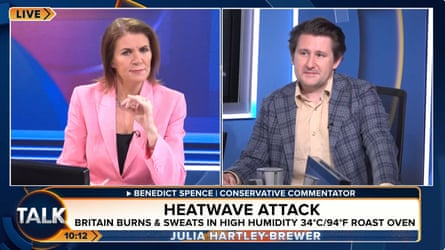
On TalkTV, the sentiment was mirrored by host Julia Hartley-Brewer. During a June 24 broadcast, Hartley-Brewer stated that while individual deaths were regrettable, they did not justify restrictions on air travel or meat consumption—policies that, at the time, were not being proposed as emergency heatwave measures. Her guest, conservative commentator Benedict Spence, supported this view, suggesting that mortality is inevitable regardless of environmental factors.

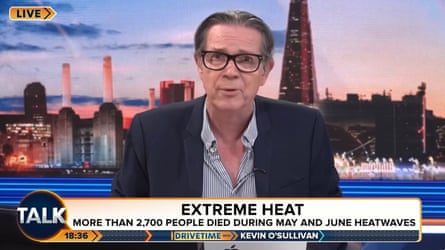
This period of broadcasting coincided with a peak in atmospheric pressure that saw temperatures in some regions of the UK exceed previous historical markers. As the mercury rose, TalkTV’s Kevin O’Sullivan criticized what he termed "hysterical hysteria" over climate change. He argued that "nice days" were being rebranded as "death risks" by a fearful establishment, a sentiment that resonated with a viewership increasingly skeptical of government intervention.
The Conflict Over Mortality Data and Scientific Modeling
The tension between the broadcasters and the scientific community reached a boiling point following the release of mortality data in mid-July. An analysis of the May and June heatwaves suggested that approximately 2,700 people in England and Wales had died prematurely due to heat-related complications. The report, which utilized established statistical relationships between temperature and mortality, was immediately challenged on air.
Kevin O’Sullivan dismissed the findings as "disgraceful climate change scaremongering" and "absolute poppycock." He argued that the figures were "gamed by computer programs" rather than representing actual casualties. GB News presenter Kingston echoed this distrust of data, suggesting that the public had learned from the COVID-19 pandemic that scientific modeling was merely "guesswork" from individuals with "an ideological agenda."
However, the skepticism of the broadcasters was later countered by official government records. On July 30, the UK Health Security Agency (UKHSA) confirmed that 2,877 excess deaths were directly attributable to the May and June heatwaves. Unlike the earlier estimates, these figures were based on actual recorded death certificates. The data highlighted a significant vulnerability among the elderly and those with pre-existing conditions, a demographic that some commentators, such as Ross Clark, suggested were "perhaps on the point of dying anyway."
Challenging the Scientific Consensus and Meteorological Maps
A recurring theme across both channels was the rejection of the fundamental link between fossil fuel emissions and rising global temperatures. Despite reports from the Intergovernmental Panel on Climate Change (IPCC)—signed off by nearly 200 national governments—stating that 100% of global heating since 1950 is due to human activity, broadcasters often sought alternative explanations.
On GB News, presenter Nana Akua labeled the climate crisis a "scam," while Dr. Hoenderkamp pointed to solar cycles, a theory frequently debunked by NASA and other space agencies. Fashion designer Jeff Banks, a regular contributor, falsely claimed that carbon dioxide levels in the atmosphere had been declining for 150 million years. In reality, atmospheric CO2 has surged to levels not seen in millions of years due to industrial activity.
The skepticism even extended to the visual representation of weather. TalkTV host Ash Gould accused meteorological services of using "psyops" by changing the color of weather maps to deep reds and blacks. Gould suggested that the color schemes were designed to manipulate public perception and create a sense of "nuclear holocaust" rather than provide accurate temperature readings. Alex Armstrong, another TalkTV host, referred to those designing the maps as "climate fanatics."
The Political Battle Over Net Zero and Energy Policy
The heatwave coverage frequently pivoted to an attack on "Net Zero," the policy framework aimed at neutralizing greenhouse gas emissions by 2050. Presenters characterized the transition to green energy as a "deranged religion" and a "crazy ideology." Much of the ire was directed at Ed Miliband, the former energy secretary and current political figure, with TalkTV’s André Walker baselessly claiming Miliband’s policies would eventually lead to 100,000 deaths.
The debate over cooling technology also became a focal point of misinformation. Foufas claimed on GB News that UK residents were being told to "rip out" their air conditioning to comply with Net Zero targets. Hartley-Brewer further claimed that it was "illegal" to fit air conditioning in new-build homes. Fact-checks by government departments later confirmed that no such ban exists, and air conditioning remains legal for both new and existing residential properties.
The economic argument against climate action was championed by figures like Sir Jacob Rees-Mogg on GB News. Rees-Mogg, a former energy secretary, argued that it would be more cost-effective to deal with the consequences of climate change as they happen rather than invest in prevention. This position contradicts the findings of the UK’s independent Climate Change Committee and the landmark Stern Review, both of which concluded that the costs of inaction far outweigh the investment required for a green transition.
Broader Implications for Public Discourse and Media Ethics
The rhetoric observed on GB News and TalkTV during the summer heatwaves reflects a broader cultural shift in British media, where environmental issues are increasingly framed within the context of "culture wars." By casting climate mitigation as a form of "socialist-style control" or "climate lockdowns," these outlets have tapped into a vein of populist resentment against perceived elite overreach.
Bev Turner of GB News expressed this sentiment when discussing school closures during extreme heat. She argued that sending children home was a way of "priming" the next generation for "climate lockdowns." This conspiratorial framing suggests that public health measures are not responses to physical reality, but rather tools for social engineering.
As the summer concluded, the data painted a stark picture of the physical reality the UK faces. For the first time in recorded history, heat-related deaths in England and Wales in 2025 (2,805) exceeded cold-related deaths (2,244). This shift challenges the long-held argument used by many skeptics that global warming is a net benefit because it reduces winter mortality.
The financial and operational background of these channels adds another layer to the controversy. Both GB News and TalkTV are backed by significant private investment but have reported heavy financial losses. Despite these losses, they continue to exert a powerful influence on the political landscape, often forcing mainstream outlets and politicians to respond to their narratives.
The summer of 2026 will likely be remembered not just for its record temperatures, but for the visible fracture in how those temperatures were reported. While scientific institutions urged caution and adaptation, a significant segment of the broadcast media urged defiance and disbelief. As global temperatures continue their upward trajectory, the conflict between empirical data and ideological broadcasting remains one of the most significant challenges to a unified response to the changing climate.