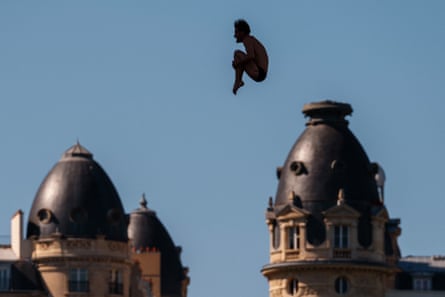
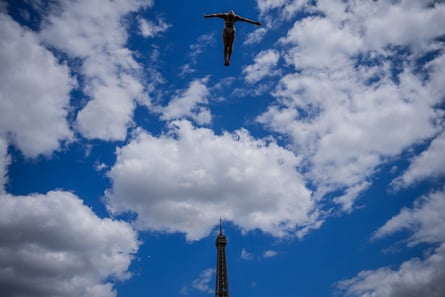
Elite athletes launched themselves from a 20-meter platform suspended over the Seine on Friday, marking the first time the French capital has hosted a high-diving competition in its central waterway. Positioned directly in front of the Eiffel Tower at the Pont de Bir-Hakeim, the event serves as a high-stakes demonstration of the city’s multi-year, multi-billion-euro initiative to transform the river into a viable venue for international sports. While the spectacle drew thousands of spectators to the riverbanks, the lead-up to the competition highlighted the persistent challenges and environmental sensitivities involved in maintaining water quality in an active urban artery.
The competition is a marquee feature of the 38th European Aquatics Championships, an event that carries deep historical resonance for the city. Paris last hosted the championships in 1931, and the current iteration marks the centenary of the inaugural event held in Budapest in 1926. By bringing high diving and open-water swimming back to the Seine, municipal officials are attempting to cement the legacy of the 2024 Olympic and Paralympic Games, which used the river as a centerpiece for both the opening ceremony and several triathlon events.
Navigating Environmental Risks in the Heart of Paris
The path to Friday’s successful dives was not without complications, illustrating the inherent difficulty of managing a natural river system in a metropolis of millions. Training sessions originally scheduled for Thursday were abruptly suspended after officials detected traces of hydrocarbons upstream. The presence of these pollutants, often linked to river traffic or industrial runoff, temporarily halted preparations and raised questions about the stability of the river’s ecosystem.

However, the French Swimming Federation confirmed by Friday morning that the affected area had been successfully treated and monitored. Following rigorous testing, the water was deemed safe for the athletes to return, allowing the preliminary rounds to proceed as scheduled. This quick turnaround was cited by city officials as evidence of the robust monitoring systems now in place, which allow for rapid response to localized pollution incidents that would have gone unaddressed in previous decades.
High Divers Take the Plunge in Paris Amid Water Quality Monitoring
Maxime Sauvage, the Paris deputy mayor overseeing sports and sports facilities, addressed the incident with a mixture of pragmatism and optimism. He noted that while certain factors remain within the city’s control, such as infrastructure and waste management, the nature of outdoor sports always introduces an element of the unknown. "There are things that are within our control, and there are uncertainties that are inevitably linked to any outdoor activity," Sauvage stated, emphasizing that the "magical" quality of such events often stems from their integration into the natural and historical landscape.
Sauvage highlighted the massive investments made by the city and its partners to reach this point. Before the recent surge in sporting activity, the Seine was largely considered off-limits for swimming, with a formal ban in place since 1923 due to high levels of pollution and the dangers posed by heavy barge traffic. The reversal of this century-old status has required an investment of approximately €1.4 billion (roughly $1.5 billion), a project accelerated by the urgency of hosting the Olympic Games.
Engineering a Swimmable Seine: The €1.4 Billion Initiative
The technical backbone of the river’s reclamation involves a sophisticated overhaul of the city’s sanitation and stormwater infrastructure. For decades, heavy rainfall would frequently overwhelm the Parisian sewer system, causing a mixture of rainwater and untreated wastewater to overflow directly into the Seine. To combat this, the city constructed the Austerlitz storage basin, a massive underground reservoir capable of holding 50,000 cubic meters of water—the equivalent of 20 Olympic-sized swimming pools.
This reservoir, along with miles of new piping and upgraded treatment plants, acts as a buffer during storms, preventing the bacterial spikes that previously made the water hazardous. Additionally, the city has worked to ensure that thousands of houseboats and riverside homes are correctly connected to the municipal sewage network rather than discharging waste into the current. These efforts have successfully lowered levels of E. coli and enterococci bacteria, the primary indicators used to determine if water is safe for human contact.
Mitigating the Fragility of Reclaimed Seine Water
Despite these engineering triumphs, the "fragility" of the ambition remains a talking point among environmentalists and urban planners. A river is a dynamic system, and its quality can be influenced by factors far beyond the city limits, including agricultural runoff from the surrounding Ile-de-France region and the sheer volume of commercial traffic that continues to use the Seine for transport. The hydrocarbon scare on Thursday served as a reminder that even with billion-euro filters, the river remains an active, working environment.
The European Aquatics Championships provide a rigorous testing ground for these systems over a sustained period. With over 1,000 athletes competing across five disciplines—swimming, diving, artistic swimming, open-water swimming, and high diving—the demand for consistent water safety is unprecedented. The event runs through August 16, requiring daily monitoring and a commitment to transparency regarding the river’s health.
Public Engagement and the Transformation of Urban Space
For the residents and tourists who gathered along the banks on Friday, the technicalities of water filtration were secondary to the visual drama of the competition. High diving, a sport where athletes plummet from heights of 20 meters (for women) and 27 meters (for men) in other formats, is inherently spectator-friendly. The 20-meter platform at the Pont de Bir-Hakeim allowed passersby to witness elite sport without the need for stadium seating or tickets.
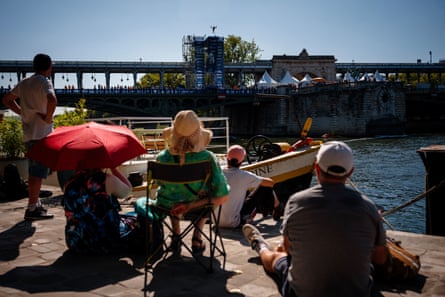
Among the crowd was Rebecca Kapogiannis, a visitor from London, Ontario, who was in Paris to celebrate her daughter’s graduation. Like many international tourists, she found the use of the river for high-level athletics to be a surprising and innovative use of urban space. "I was not expecting a competition to take place in the Seine, but I think it’s such a cool use of this water that runs right through the city," Kapogiannis said. Her daughter had even traveled with a swimsuit, hoping for an opportunity to swim in the river herself—a testament to the changing global perception of the Seine.
Other spectators, like Cynthia and Sean Matz, noted that the accessibility of the event was its greatest strength. By hosting the competition in a public thoroughfare, the city removed the barriers typically associated with elite athletics. "Anybody can go," Cynthia Matz observed. "I don’t have to know anything about diving. I can just say, ‘This is really cool to see.’" This "stumble-upon" factor is a core component of the city’s broader strategy to democratize access to sports and reclaim the riverfront from being a purely commercial or transit-oriented zone.
Technical Challenges of the 20-Meter Dive
From a technical perspective, high diving into a river presents unique challenges compared to a controlled pool environment. Divers hitting the water from a 20-meter height reach speeds of up to 85 kilometers per hour (approximately 53 mph). At these velocities, the surface tension of the water can cause significant impact injuries if the entry is not vertical. In the Seine, divers must also account for river currents, varying visibility, and the presence of safety divers who must remain vigilant in moving water.
Gary Hunt, a prominent figure in the high-diving world who represents France, was among the athletes navigating these conditions. The presence of the Eiffel Tower in the background provides a iconic frame for the dives, but for the athletes, the focus remains on the precision of their rotations and the safety of their entry into the reclaimed water. The competition concludes on Saturday with the final two rounds and medal presentations, which are expected to draw even larger crowds to the river’s edge.
Looking Ahead: The Legacy of a Reclaimed River
The success of these events is viewed as a precursor to a wider opening of the Seine to the general public. While elite athletes are the current pioneers, the city has announced plans to open several public swimming areas along the river starting in 2025. This move aims to provide Parisians with a way to cool off during increasingly frequent summer heatwaves, while also revitalizing the "quais" as centers of community life.
As the European Aquatics Championships continue, the focus remains on the intersection of environmental stewardship and urban lifestyle. The sight of high divers taking the plunge in Paris for a new test of reclaimed Seine’s water is no longer just a one-off experiment for the Olympics; it is becoming a recurring feature of the city’s identity. The transition from a polluted industrial artery to a world-class sporting venue remains a work in progress, but the events at the Pont de Bir-Hakeim suggest that the vision of a swimmable Seine is closer to reality than it has been in over a century.