Anthropic’s flagship artificial intelligence platform, Claude, experienced a significant service disruption on Wednesday, leaving thousands of users unable to access the chatbot, its developer tools, and enterprise services. The company confirmed that the incident, which began in the morning hours, affected the primary Claude.ai interface, the Claude API, and specialized tools including Claude Code and the collaborative platform Cowork. While engineers successfully restored services by mid-afternoon, the outage highlighted the growing pains and infrastructure challenges facing one of the world’s leading AI firms during a period of unprecedented user growth.
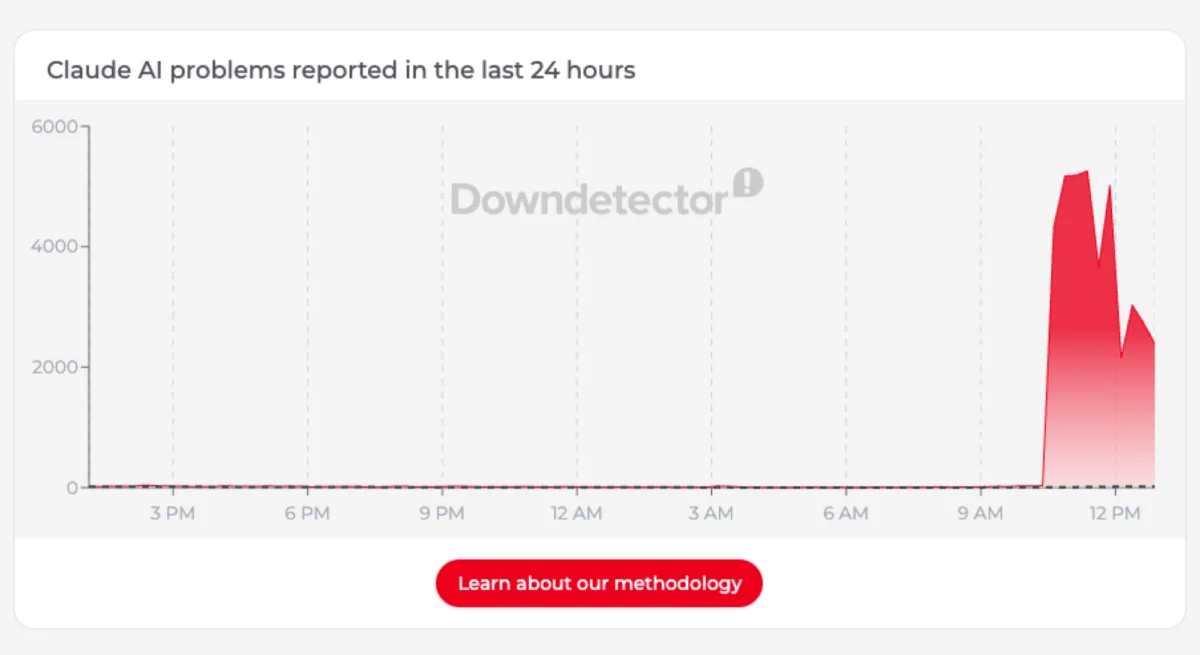
The disruption was first noted by users at approximately 10:30 a.m. ET, when a sharp spike in error reports appeared on independent monitoring platforms. Anthropic’s internal status monitoring later confirmed the severity of the situation, classifying the event as a "major outage" that lasted for 40 minutes, followed by a "partial outage" that persisted for another 73 minutes. By 2:08 p.m. ET, the company issued a final update stating that the incident had been fully resolved and that all systems were returning to normal operational capacity.
An Anthropic spokesperson addressed the situation shortly after the resolution, expressing appreciation for the user base’s patience. The spokesperson confirmed that the issues were widespread, impacting not just the free web-based version of the chatbot but also the critical infrastructure used by developers and businesses. "Claude.ai and Cowork are currently down for most users, and some users may also have trouble logging into Claude Code," the company had stated during the height of the disruption.
Technical Breakdown of the Service Disruption
According to the Anthropic status page, the technical failure was not limited to a single point of entry. The outage manifested as a complete inability to log in for many, while others encountered specific error messages related to message limits and server capacity. One of the most common issues reported by users was a message claiming they had hit their limit for Claude messages, even if they had not sent a single prompt that day. This suggested a failure in the platform’s authentication and usage-tracking subsystems.
The "major outage" designation indicates a total loss of service for a significant portion of the global user base. In cloud computing and AI services, such events are often linked to database failures, DNS issues, or unsuccessful deployments of new software updates. While Anthropic did not provide a specific root cause for the Wednesday failure, the company noted that its overall uptime over the past 90 days has averaged 98.79 percent. While seemingly high, this figure sits below the "three nines" (99.9%) or "five nines" (99.999%) standard typically expected of mission-critical enterprise software.
The impact on Claude Code, a recently launched tool for developers, was particularly notable. As more software engineers integrate AI into their daily workflows, a 40-minute total blackout can lead to significant delays in development cycles. Reports indicated that the login mechanism for Claude Code, which relies on the Claude.ai authentication layer, was entirely non-functional during the peak of the incident.
User Reports and Statistical Impact
Data from DownDetector, a popular service that tracks website outages through user-submitted reports, showed a massive surge in complaints starting around 10:30 a.m. ET. The geographical distribution of these reports suggested the outage was global, though the timing primarily affected users in North America and Europe during their peak working hours. By 1:00 p.m. ET, the volume of reports had begun to subside, though many users continued to report "intermittent connectivity" and "slow response times."
A statistical breakdown of the user reports revealed that 38 percent of affected individuals were struggling specifically with the Claude Chat interface. Another 29 percent reported issues with Claude Code, while 25 percent cited problems with the mobile application. These figures suggest that the backend infrastructure supporting the Claude API was the likely source of the problem, as it serves as the foundation for all three access points.
For free users, the experience was particularly frustrating. Many encountered a pop-up stating, "Service is temporarily busy. You can try again shortly," alongside suggestions to upgrade to the Claude Pro plan for higher limits. However, even Pro subscribers reported being unable to access the service, confirming that the issue was a fundamental system failure rather than a simple capacity throttle for non-paying users.
Rapid Growth and Infrastructure Strains
The timing of the outage comes as Anthropic navigates a period of historic expansion. In early 2026, the company reported that it was adding more than one million new users per day. This level of scaling is almost unprecedented in the software industry and places immense pressure on server clusters and load-balancing systems. Maintaining a 98.79 percent uptime rate while managing such a rapid influx of data and traffic requires constant infrastructure adjustments.

Industry analysts suggest that the "major outage" on Wednesday may be a symptom of these scaling challenges. As AI models become more complex and the user base shifts from casual hobbyists to enterprise professionals, the cost of downtime increases. Anthropic has been aggressively hiring infrastructure and site reliability engineers (SREs) to bolster its defenses against such disruptions, but the physical reality of GPU availability and data center throughput remains a bottleneck for all major AI players.
Furthermore, the surge in popularity has been driven by the release of increasingly sophisticated models that require more computational power per interaction. If the underlying infrastructure is not scaled in lockstep with the model’s complexity, "busy" signals and timeout errors become more frequent. The Wednesday incident appears to be the most significant test of Anthropic’s reliability since its massive growth spurt began in late 2025.
Political and Regulatory Context
The outage also occurred against a backdrop of heightened political tension involving the company. Anthropic has recently been embroiled in a public dispute with the Pentagon and the current administration regarding the use of AI in national security and government contracts. These external pressures have placed the company under a microscope, with critics often pointing to service reliability as a key factor in whether AI companies should be trusted with critical government infrastructure.
In March 2026, reports surfaced of a feud between Anthropic leadership and federal regulators over safety protocols and data privacy. While there is no evidence to suggest that the Wednesday outage was related to external interference or cyberattacks, the incident provides ammunition for those who argue that the private AI sector is not yet ready to support "always-on" public utility services.
The company’s response to the outage—providing real-time updates via its status page and issuing a prompt resolution—is seen as an attempt to maintain transparency and build trust with both the public and government stakeholders. However, the recurring nature of "partial outages" over the last 90 days suggests that the path to enterprise-grade stability is still a work in progress for the San Francisco-based firm.
Impact on the AI Ecosystem and Competitors
The AI industry is currently characterized by fierce competition between Anthropic, OpenAI, and Google. Reliability is becoming a primary differentiator for corporate clients choosing which API to integrate into their products. When a service like Claude goes down, it often leads to a temporary migration of traffic to competitors like ChatGPT or Gemini, as developers seek to maintain their own service-level agreements (SLAs) with their customers.
The "Claude Code" and "Claude API" outages are particularly sensitive because they affect the "B2B" (business-to-business) segment of the market. Companies that have built their own applications on top of the Claude API found their services paralyzed for nearly two hours on Wednesday. This ripple effect can cause millions of dollars in lost productivity across the global economy, especially in sectors like fintech, healthcare, and software development where AI integration is now standard.
Despite these challenges, Anthropic’s growth remains robust. The company has positioned its Claude models as the "ethical and steerable" alternative to other AI offerings, a reputation that has helped it secure massive user numbers despite occasional technical hurdles. The resolution of Wednesday’s outage allows the company to refocus on its roadmap, but the event serves as a reminder that the AI revolution is still tethered to the physical and technical limitations of cloud infrastructure.
Looking Ahead: Strengthening Resilience
In the wake of the resolution, Anthropic is expected to conduct a post-mortem analysis to identify the exact trigger of the major outage. This process is standard in the tech industry and usually results in the implementation of new safeguards to prevent a recurrence of the same specific failure. For users, the primary takeaway is the importance of having redundant systems in place when relying on AI for critical tasks.
The company’s commitment to transparency through its status monitor is a positive step, providing users with a clear timeline of events. However, as Claude continues to move toward becoming a ubiquitous tool for the global workforce, the expectation for 100 percent uptime will only grow. The 98.79 percent uptime reported for the last quarter will likely be a key metric that the company seeks to improve as it enters the second half of 2026.
As of Wednesday afternoon, all services, including the Claude desktop browser, the mobile app, and the developer-focused Claude Code, were reported as fully operational. Users who continue to experience issues are encouraged to clear their browser caches or check the official status page for any localized lingering effects. The AI giant now returns to its regular operations, though the lessons learned from this two-hour blackout will likely influence its infrastructure strategy for months to come.