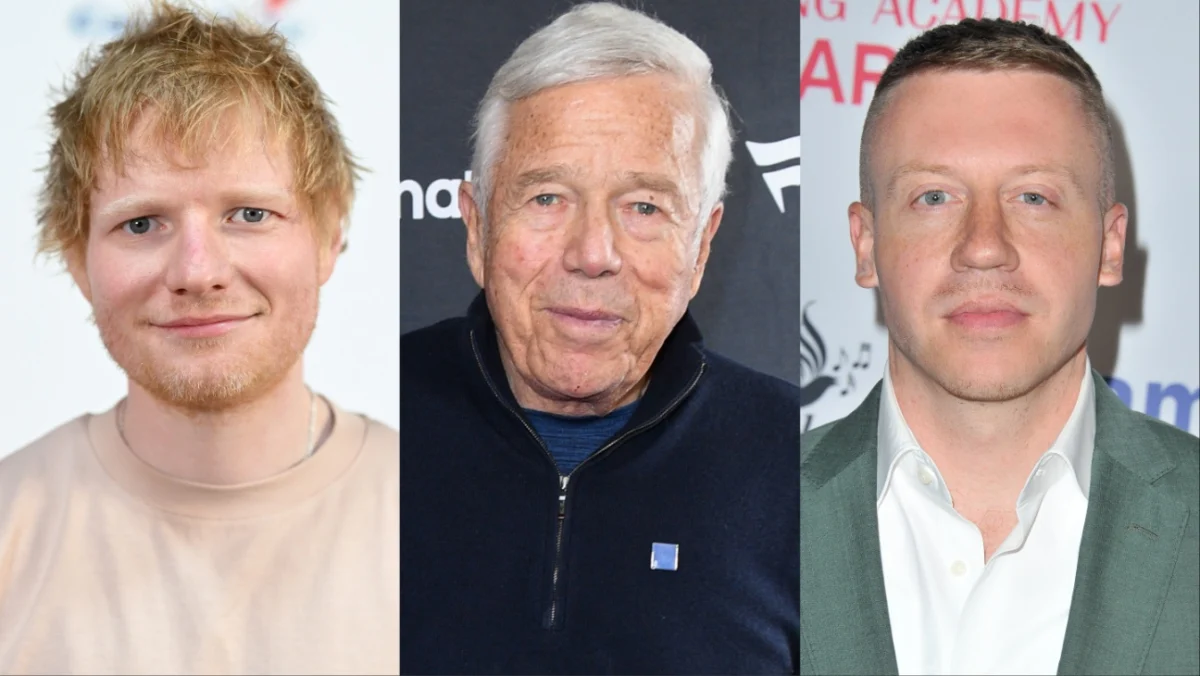
New reports allege that Grammy-winning artist Macklemore continued to make pro-Palestinian statements during his performances as an opening act for Ed Sheeran’s "Loop Tour," directly contradicting assurances reportedly given by tour promoters to a consortium of influential NFL stadium owners. This alleged breach of agreement ultimately led to Macklemore’s removal from the remaining U.S. tour dates, casting a spotlight on the volatile intersection of celebrity activism, commercial interests, and geopolitical sensitivities. The controversy, detailed in a recent Wall Street Journal investigation, underscores the immense pressure faced by artists, promoters, and venue operators when political declarations ignite public and industry backlash.
The Genesis of Controversy: MetLife Stadium Incident
The friction began to surface following Macklemore’s performance at MetLife Stadium on September 4. As the opening act for global superstar Ed Sheeran, the rapper, known for his socially conscious lyrics, used the high-profile platform to vocalize his support for Palestine. During his set, Macklemore openly declared “Free Palestine” to the audience. He then proceeded to perform his song “Hind’s Hall,” a track explicitly crafted to express pro-Palestinian sentiments. The song, released amid heightened tensions in the region, quickly became an anthem for many advocates, but its public performance in a major American stadium immediately drew the attention of powerful figures within the sports and entertainment industries.
Initial Outcry and Venue Concerns
The incident at MetLife Stadium on September 4 did not go unnoticed by the tour’s key stakeholders. Owners of NFL stadiums, which serve as crucial venues for large-scale musical tours like Sheeran’s "Loop Tour," reportedly expressed significant concerns. Among those who reached out to Messina Touring Group, the promoters of the tour, were prominent figures such as Robert Kraft, owner of the New England Patriots and Gillette Stadium, as well as David Tepper of the Carolina Panthers, Arthur Blank of the Atlanta Falcons, and Jeffrey Lurie of the Philadelphia Eagles. These stadium owners represent not just sports franchises but also major entertainment complexes, holding substantial leverage over the logistics and financial viability of national concert tours. Their collective apprehension signaled a potential threat to the tour’s future access to these essential venues.
Alleged Assurances and a Second Defiance
In response to the stadium owners’ initial concerns regarding Macklemore’s overtly political comments, Messina Touring Group reportedly provided assurances. According to The Wall Street Journal report, these owners were informed that Macklemore, originally scheduled for ten dates on the Sheeran tour, would refrain from further public comments on the issue of Palestine during his subsequent performances. This promise was seemingly intended to de-escalate the situation and safeguard the tour’s ability to proceed as planned across various NFL venues. However, the very next day, at the second MetLife Stadium concert on September 5, Macklemore directly challenged these alleged assurances. From the stage, he reiterated his stance, stating, "One of the reasons why I wanted to come on this tour was because I wanted to stand up here on stages and stadiums across America and say two words that are very near and dear to my heart: Free Palestine!" He further clarified his position, addressing potential misinterpretations: "I want to say this to all of my Jewish brothers and sisters. Criticism of Israel, criticism of apartheid, being against genocide in no way is a criticism of you." This defiant repeat performance amplified the controversy, signaling a direct challenge to the implicit, or explicit, conditions set for his continued participation.
The Standoff: Free Speech vs. Commercial Interests
Macklemore’s repeated and clarified statements ignited a broader debate about artistic freedom of speech versus the commercial and reputational interests of major entertainment enterprises. For the stadium owners and tour promoters, the concern was multifaceted: potential backlash from various advocacy groups, possible boycotts, and the perception of the tour endorsing a particular political stance, which could alienate a segment of their audience or corporate partners. Macklemore, conversely, framed his actions as a moral imperative, utilizing his platform to address what he viewed as critical humanitarian issues. This created a profound dilemma for the tour organizers, caught between an artist’s desire for expression and the complex web of business relationships that underpin a large-scale musical tour.
The Pressure Mounts: Activism and Industry Response
Following Macklemore’s second MetLife Stadium declaration, the public and industry pressure intensified dramatically. News outlets widely reported on the comments, particularly after the Israeli-American Council launched a petition urging Ed Sheeran to remove the rapper from his tour. This petition quickly gained traction, adding significant weight to the growing calls for Macklemore’s ousting. Other influential advocacy groups, including StopAntisemitism and the Combat Antisemitism Movement, also publicly condemned Macklemore’s statements and demanded his removal. The chorus of criticism extended beyond these organizations, reaching into the celebrity sphere, with singer Pink also publicly calling for the rapper’s dismissal from the tour. The collective force of these voices put immense pressure on Sheeran, Messina Touring Group, and the venues, highlighting the sensitive and often polarizing nature of the Israel-Palestine conflict in public discourse.
Key Figures and Organizations Weigh In
The intervention of such prominent figures and organizations underscored the high stakes involved. Robert Kraft, a billionaire businessman and philanthropist with significant ties to both the NFL and various pro-Israel causes, became a central figure in the discussions. His concerns, along with those of other powerful stadium owners, were not merely symbolic; they represented a direct threat to the tour’s access to critical infrastructure. The coordinated efforts of advocacy groups to mobilize public opinion and pressure industry stakeholders demonstrated the increasing power of organized campaigns in shaping outcomes in the entertainment world. This confluence of corporate power, celebrity influence, and activist mobilization created an environment where the tour’s viability hung precariously in the balance.
Behind the Scenes: High-Stakes Negotiations
Amidst the escalating public outcry, intense behind-the-scenes negotiations unfolded. The Wall Street Journal detailed a critical 40-minute phone call between Robert Kraft and Ed Sheeran regarding the Macklemore controversy. During this conversation, Kraft reportedly conveyed his perspective to Sheeran, acknowledging sympathy for the Palestinian people but asserting that Macklemore’s comments, in his estimation, crossed a line into hate speech, distinguishing them from a simple exercise of free speech. This direct intervention from a powerful stadium owner to the headlining artist highlighted the severity of the situation and the immense pressure Sheeran was under. The conversation likely underscored the potential for severe repercussions, including the cancellation of future tour dates at NFL venues, which would have devastating financial implications for Messina Touring Group and Sheeran himself.
Tour in Jeopardy: The Promoter’s Dilemma
For Messina Touring Group, the tour promoters, the situation presented a profound dilemma. On one hand, they had an artist whose contract allowed for a certain degree of creative and personal expression. On the other, they faced an existential threat to the tour’s continuity. Losing access to NFL stadiums would mean canceling multiple high-capacity shows, resulting in millions of dollars in lost revenue, breach of contract penalties, and immense logistical headaches involving hundreds of thousands of ticket holders. The promoters were effectively caught between satisfying artist demands for freedom of speech and protecting the commercial integrity and financial stability of a massive, multi-million-dollar international tour. This delicate balance ultimately tipped towards prioritizing the tour’s survival and its contractual obligations to venues.
Macklemore’s Removal and Aftermath
The mounting pressure culminated in the official announcement on September 14: Macklemore was dropped from the remaining eight U.S. tour dates of Ed Sheeran’s "Loop Tour." Messina Touring Group issued a statement to Rolling Stone, clarifying the difficult decision. The promoter stated, "As the concert promoter for Ed Sheeran’s U.S. Loop Tour, we have been notified by venues on the upcoming U.S. tour dates that they will not allow a concert to take place with Macklemore on the lineup, which would result in the cancellation of the tour and impact hundreds of thousands of fans." The statement further concluded, "After discussions with stakeholders, Macklemore will not be performing on the remaining support dates." This decision, while a significant blow to Macklemore’s touring schedule, effectively saved the "Loop Tour" from a potential catastrophic collapse, illustrating the immense power wielded by venue owners in the touring ecosystem.
Macklemore’s Unapologetic Stance
In the wake of his removal, Macklemore issued a lengthy and defiant statement on Instagram, rejecting any notion of victimhood. "Before I get into it, I want to say something that should be obvious. In this moment I think it matters. I am not a victim," Macklemore wrote. He extended this sentiment to others involved, adding, "Ed Sheeran is not a victim. Pink is not a victim. We have careers, money, opportunities, safety and audiences around the world. Whatever consequences any of us face for what we say, we get to go home to our families. The victims are the Palestinian people." His statement reaffirmed his commitment to the cause, framing his personal consequences as negligible compared to the suffering of those he sought to champion. This unapologetic response solidified his stance and resonated with his supporters, further fueling the public debate.
Ed Sheeran’s Perspective and Solidarity Walkouts
Ed Sheeran, the tour’s headliner, also released a comprehensive statement following Macklemore’s removal, seeking to clarify his position and the sequence of events. Sheeran stated, "After Macklemore’s performances at my New Jersey shows, venues on my upcoming tour dates communicated that they would pull the shows if he was still supporting. I was informed that this stance was based on how Macklemore conveyed part of his message during his performance, rather than on everything that was said." He acknowledged his efforts to mediate, including speaking with Robert Kraft and engaging in "direct talks with promoters along with activists on both sides to try and find a mutual resolution for all," but ultimately conceded that "the venue’s and promoter’s decision was final." Sheeran explicitly distanced himself from the decision, reiterating, "Macklemore coming off tour was the promoter’s decision, it was not mine. Macklemore’s contract for the tour was with the promoter, not me." Despite Sheeran’s clarifications, Macklemore’s removal sparked a wave of solidarity among other artists scheduled to open for the "Loop Tour." Finneas, Lukas Graham, Aaron Rowe, and Sheeran’s backing band Beoga all subsequently announced their withdrawal from the remaining tour dates. This collective walkout underscored the strong artistic support for Macklemore’s right to free expression and demonstrated a willingness among some artists to sacrifice touring opportunities in solidarity with a peer facing repercussions for political speech.
Ripples Across the Music Industry
The solidarity walkouts sent a clear message across the music industry: while commercial pressures are immense, a segment of the artistic community prioritizes principles of free expression and solidarity. This incident highlighted the potential for internal dissent within large-scale productions when political issues intersect with contractual obligations. It also put a spotlight on the often-unseen power dynamics between headliners, opening acts, promoters, and venue owners, revealing how swiftly a tour’s delicate balance can be disrupted by external pressures and an artist’s personal convictions. The ripple effect of Macklemore’s removal demonstrated that the consequences extended far beyond a single artist, impacting multiple careers and challenging the traditional hierarchical structure of major concert tours.
A Million-Dollar Statement and Philanthropic Challenge
In a powerful demonstration of his commitment to the Palestinian cause, Macklemore announced on September 16 that he would donate his entire earnings from the "Loop Tour," estimated at approximately $1 million, to six organizations dedicated to supporting Palestinians. This act of philanthropy transformed his personal financial gain from the tour into a direct contribution to the cause he championed. Going a step further, Macklemore issued a public challenge to Robert Kraft, calling on the NFL owner to match his donation. Kraft responded to the challenge by donating $2 million, effectively doubling Macklemore’s contribution. This exchange of philanthropic gestures added another layer to the controversy, shifting some of the focus from the initial conflict over speech to tangible financial support for humanitarian efforts.
From Stage to Philanthropy: The Financial Aftermath
The philanthropic challenge and subsequent donations provided a unique conclusion to the immediate fallout. It underscored that while the debate over free speech and political expression in public venues was intense, it could also lead to significant material aid. Macklemore’s decision to forgo his earnings and Kraft’s matching donation, albeit with different stated motivations, channeled the energy of the controversy into a direct benefit for the Palestinian people. This move, while not resolving the underlying tensions, offered a tangible outcome beyond the usual industry back-and-forth, leaving a lasting impact that transcended the concert stages.
Broader Implications and The Future of Artist Activism
The Macklemore controversy serves as a stark reminder of the increasing challenges faced by artists who choose to use their platforms for political expression, especially concerning highly sensitive geopolitical issues. The incident highlights the intricate web of dependencies in the modern music industry, where an artist’s message can quickly clash with the commercial interests of promoters, venue owners, and corporate sponsors. It raises critical questions about the boundaries of free speech in private contracts, the definition of "hate speech" in public discourse, and the moral obligations of celebrities to address global events. As political polarization intensifies, the music industry will likely continue to grapple with how to balance artistic integrity and freedom of expression with the immense financial stakes and diverse audience expectations that accompany large-scale tours.
Navigating Political Expression in Public Forums
The saga of Macklemore and the Ed Sheeran "Loop Tour" is a case study in navigating the complex landscape of public political expression. It illustrates that while artists are often celebrated for their authenticity, the consequences of that authenticity can be severe when it challenges powerful commercial interests or provokes widespread public debate. The incident sets a precedent for how tour promoters and venue owners might react to similar situations in the future, potentially leading to more explicit clauses in artist contracts regarding political commentary. It also reinforces the idea that in today’s interconnected world, an artist’s words, especially on sensitive topics, can have immediate and far-reaching impacts, resonating across fan bases, boardrooms, and global political discussions. The core questions of artistic freedom, commercial responsibility, and the nature of public discourse remain at the forefront, enduring long after the final curtain falls on any given tour.