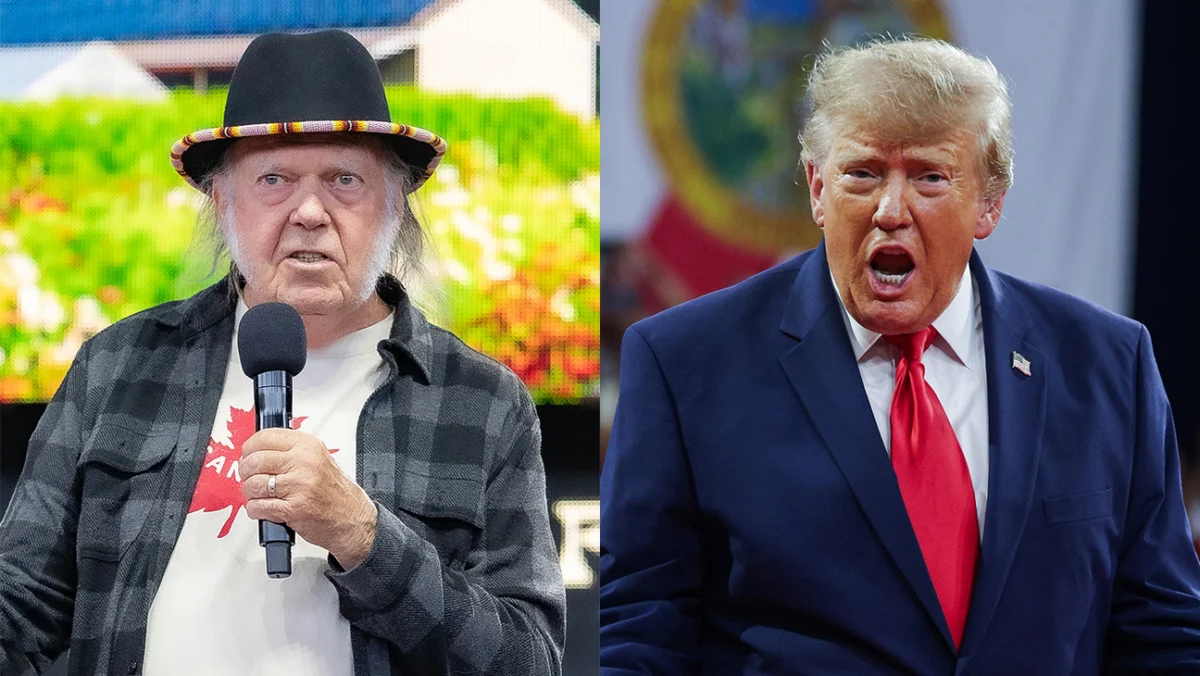
Veteran rock icon Neil Young has initiated a new federal lawsuit against former President Donald Trump’s political action coalition, the Trump 47 Coalition, alleging unauthorized use of his seminal anthem "Rockin’ in the Free World" at a recent political rally. This legal action marks the second time Young has pursued Donald Trump and his associated entities over the use of the iconic 1989 track in campaign settings, underscoring a persistent clash between the artist’s deeply held political views and the former president’s rallies.
Filed in federal court on Monday, the complaint from Young’s legal team frames "Rockin’ in the Free World" as far more than just a rock song. It describes the track as "a blistering anthem that contrasts the hollow promises of American political rhetoric with the harsh realities faced by the poor, homeless and forgotten." The suit elaborates on the song’s critical intent, stating, "The lyrics paint vivid street-level portraits – a mother discarding her baby, addicts lost in despair, garbage piling in the shadows of prosperity – while the repeated chorus delivers a savage irony, celebrating freedom that clearly isn’t shared by all." In a direct challenge to the former president’s platform, the lawsuit asserts, "In short, the Song is the opposite of everything that Donald J. Trump stands for."
Young is seeking $10 million in damages for copyright infringement, contending that Trump’s campaign lacked the necessary license or permission to use the track. As of the filing, the White House had not issued an immediate response to the allegations. The renewed legal battle highlights the ongoing tension between artists and political campaigns over the appropriation of intellectual property for political purposes.
The Genesis of "Rockin’ in the Free World"
Released in 1989 on the album "Freedom," "Rockin’ in the Free World" quickly became one of Neil Young’s most recognizable and enduring songs. Written during a period of significant global change, including the fall of the Berlin Wall and the George H.W. Bush presidency, the song is widely interpreted as a scathing critique of American society and its perceived failings, particularly regarding environmental degradation and social inequality.
The lyrics vividly depict scenes of urban decay, poverty, and environmental neglect, juxtaposing these harsh realities with a seemingly celebratory, yet ironically delivered, chorus. Young’s composition has been analyzed by critics as a lament for a dream deferred, questioning the true meaning of "freedom" when so many societal problems persist. Its powerful guitar riffs and anthemic quality have, ironically, led to its adoption by various groups, sometimes misunderstanding its original critical message. Young has consistently sought to reclaim the song’s narrative, especially when it is used by political figures whose ideologies he opposes.
Neil Young’s Unwavering Political Stance
Neil Young has a long and well-documented history of political activism, advocating for environmental causes, social justice, and democratic principles. His music often reflects these convictions, making him one of the most outspoken artists of his generation. His opposition to Donald Trump’s policies and presidency has been particularly fervent and consistent.
Throughout Trump’s political career, Young has publicly criticized the former president, calling his administration "a disgrace to our country." A dual citizen of both America and Canada, Young had previously voiced concerns about whether the Trump administration might bar him from re-entering the United States while on a European tour, underscoring the depth of his apprehension regarding the political climate. This deep ideological chasm has fueled Young’s determination to prevent his art from being associated with Trump’s political message.
A Pattern of Disputes: The 2020 Settlement
This is not the first instance of Neil Young suing Trump over the unauthorized use of "Rockin’ in the Free World." In 2020, Young took similar legal action against another Trump-affiliated group, "Donald J. Trump for President." That lawsuit stemmed from the song’s repeated play at numerous Trump rallies.
According to Young’s recent filing, the 2020 suit resulted in a swift resolution. Trump’s team "asserted no defense and immediately settled shortly after it was served, promising that it would never again use ‘Rockin’ in the Free World’ without a license and permission from Young." This alleged prior settlement and promise form a crucial element of the current legal battle, suggesting not just copyright infringement but a potential breach of a prior agreement. The new lawsuit specifically names the Trump 47 Coalition, indicating a distinction in the legal entities, but the underlying issue remains the same: the unauthorized use of Young’s music.
The Nuances of Music Licensing and Political Campaigns
The dispute between Neil Young and Donald Trump highlights a recurring challenge for musicians and political campaigns alike: the complex landscape of music licensing. While many venues and events secure blanket performance licenses from organizations like ASCAP and BMI (American Society of Composers, Authors and Publishers, and Broadcast Music, Inc.), these licenses typically cover the public performance of copyrighted music but do not inherently grant political campaigns the right to use songs in a manner that implies endorsement or that goes against the artist’s explicit wishes.
Many artists argue that allowing a political campaign to use their music without specific consent implies their endorsement of that candidate or party, which can be damaging to their artistic integrity and public image, especially when their views diametrically oppose those of the politician. While campaigns might argue fair use or the breadth of public performance licenses, artists frequently contend that the specific context of a political rally, especially after a clear objection, constitutes unauthorized use and copyright infringement. This legal gray area often leads to protracted disputes, with artists seeking to protect their artist rights and intellectual property.
Free Speech Versus Copyright: A Recurring Theme
The clash between artists and political campaigns is not unique to Neil Young and Donald Trump. Over the years, numerous musicians have publicly objected to politicians using their songs. Bruce Springsteen, Jack White, R.E.M., Tom Petty’s estate, and others have all sent cease-and-desist letters or initiated legal action against campaigns, often citing a misalignment of values or an implicit endorsement that was never given.
These cases often pit the campaign’s claim of free speech or fair use against the artist’s intellectual property rights and their right to control how their creative work is used. Courts generally lean towards protecting copyright holders, especially when an artist explicitly objects and can demonstrate that the use implies endorsement or causes reputational harm. The legal precedents established in these cases continue to shape the guidelines for how political rallies and campaigns can incorporate music.
Broader Implications for the Music Industry and Politics
The renewed lawsuit from Neil Young suing Trump carries significant implications for both the music industry and political campaign practices. For artists, it reinforces the message that they retain control over their creative output and can challenge its use when it conflicts with their values. It encourages other artists to stand firm in protecting their artist rights and preventing the appropriation of their work for political ends they do not support.
For political campaigns, this case serves as another stark reminder of the necessity for diligent music licensing and, more importantly, the importance of respecting artists’ wishes. Relying solely on general public performance licenses without considering potential artist objections can lead to legal entanglements, negative publicity, and substantial financial penalties. The $10 million in damages sought by Young underscores the financial risks involved in such disputes.
Reactions and Next Steps
The lawsuit will likely draw considerable attention from the public, legal scholars, and the entertainment industry. Neil Young’s consistent and vocal opposition to Donald Trump has made him a prominent figure in the celebrity activism landscape, and this legal action further solidifies his commitment to his principles. The outcome of the case could set new precedents or at least reinforce existing ones regarding the boundaries of music use in political contexts.
As the legal proceedings unfold, Trump’s legal team will need to respond to the allegations of copyright infringement and address the claim of a broken prior settlement. The resolution could involve another out-of-court settlement, a court injunction preventing further use of the song, or a full trial to determine damages. Regardless of the immediate outcome, this high-profile legal battle ensures that the debate over artists’ rights, political appropriation, and the true meaning of "Rockin’ in the Free World" will continue to resonate across the cultural and political landscape.