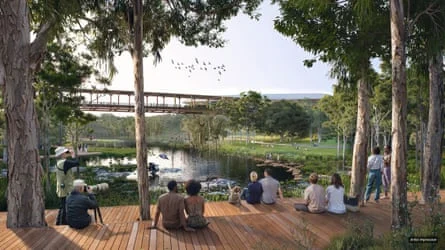
The Queensland government has unveiled its much-anticipated draft master plan for the Victoria Park precinct, seeking to transform the massive inner-city green space into the primary hub for the 2032 Olympic and Paralympic Games. The release includes a series of high-resolution concept images intended to reassure a skeptical public that the construction of a massive sporting infrastructure will not result in the permanent loss of Brisbane’s most vital recreational parkland. However, the proposal has immediately drawn fire from community advocates and urban planners who argue the illustrations represent a sanitized, "greenwashed" version of reality that ignores the grueling logistical requirements of a global sporting event.
The centerpiece of the plan is a state-of-the-art, 63,000-seat oval stadium designed to host the opening and closing ceremonies as well as track and field events. Accompanying the stadium is a new national aquatic center, which the government promises will serve as a premier training and competition facility for decades. Despite the scale of these structures, Premier David Crisafulli’s administration maintains that two-thirds of the heritage-listed Victoria Park will remain dedicated green space. The government’s draft legacy plan emphasizes that the site, known as Barrambin to its traditional owners, will be more accessible to the general public than it was during its previous life as a commercial golf course.
Infrastructure and Connectivity in the Brisbane Olympic Stadium Precinct
The newly released concept images for the Brisbane Olympic stadium precinct highlight several major architectural and environmental interventions. One of the most significant features is the proposed construction of two wide pedestrian bridges spanning the Brisbane Inner City Bypass. This major roadway currently acts as a physical barrier, severing the parkland from the residential and commercial districts of Spring Hill and the Brisbane Central Business District. By bridging this gap, planners hope to integrate the park more seamlessly into the city’s urban fabric, allowing spectators and residents to walk directly from the downtown core to the stadium gates.
In addition to the transportation links, the draft plan proposes a significant ecological overhaul of the site. This includes the deliberate flooding of areas currently occupied by community football fields to facilitate the expansion of the York’s Hollow wetland system. The government argues that this will improve local biodiversity and provide a natural cooling effect for the precinct. Adjacent to the stadium, the plans also depict a large public amphitheater intended for outdoor concerts and community gatherings, further reinforcing the narrative that the site will remain a "people’s park" long after the 2032 Games conclude.
Political Stakes and the Quest for a Lasting Legacy
Premier David Crisafulli has positioned the Victoria Park project as a "state-shaping" endeavor, comparing its potential impact to that of South Bank, the riverside precinct created for the World Expo ’88. Speaking at a press conference on Sunday, Crisafulli framed the development as a gift to future generations of Queenslanders. "Just as South Bank defined a city as the gift for Expo ’88, Victoria Park will be the legacy of 2032—a place that belongs to Queenslanders once the flame is extinguished," the Premier stated. He emphasized that the goal is to unlock a "world-class free precinct" that remains functional and vibrant for decades.
The political pressure to deliver a successful Olympic plan is immense. The choice of Victoria Park as the primary stadium site followed a period of intense public debate and a series of independent reviews. Previous iterations of the Olympic plan had focused on a multi-billion-dollar redevelopment of the Brisbane Cricket Ground, known as the Gabba. However, that plan was eventually scrapped due to soaring costs and the logistical nightmare of rebuilding a stadium in a land-locked, high-density neighborhood. The shift to Victoria Park was intended to be a more cost-effective and environmentally friendly alternative, though it has brought its own set of unique challenges.
Critics Label Draft Plans a ‘Fantasy Vision’
Despite the government’s optimistic presentation, the "Save Victoria Park" advocacy group and other local critics have denounced the concept images as misleading. Sue Bremner, a spokesperson for the group, characterized the release as a "fantasy vision" designed to distract from the reality of massive construction and budget overruns. Critics argue that the artist’s impressions conveniently omit the less aesthetic requirements of a 63,000-seat venue, such as massive parking structures, security perimeters, service roads, and the heavy-duty transport links required to move tens of thousands of people in a short window of time.

"What we saw today was not a plan. It was another insulting fantasy vision with no details," Bremner said in a scathing response to the announcement. She questioned the feasibility of the project, pointing out the lack of information regarding crowd-holding plazas and the necessary ramps connecting the site to the Inner City Bypass. "Where are the car parks? Where are the roads? Where’s the connection to the train station?" Bremner asked, suggesting that the government is "greenwashing" the project to make a massive industrial construction site look like a tranquil botanical garden.
Logistical Hurdles and Environmental Concerns
The geographical complexity of Victoria Park presents significant hurdles for engineers and urban designers. The site is characterized by undulating terrain and is bisected by major rail and road corridors. Transforming this landscape into a high-capacity Brisbane Olympic stadium precinct requires more than just aesthetic landscaping; it demands a total overhaul of the region’s utility and transport infrastructure. Opponents argue that the cost of leveling portions of the park and installing the necessary structural supports for a stadium of this size will far exceed current government estimates.
Furthermore, environmental and cultural concerns continue to cloud the project. While the government touts the expansion of the York’s Hollow wetlands, some environmentalists worry that the sheer volume of concrete and the influx of human traffic will permanently damage the local ecosystem. For First Nations people, the site of Barrambin holds deep cultural significance. Indigenous leaders have expressed concern that the construction will desecrate an area that has served as a meeting place and ceremonial ground for thousands of years. While the government has promised to incorporate traditional designs and consultation into the final build, critics remain skeptical that a massive stadium can coexist with the site’s cultural heritage.
The Road to 2032: Budgetary and Planning Pressures
The debate over the Brisbane Olympic stadium precinct comes at a time when the 2032 Games are facing increased scrutiny over their financial viability. Like many previous Olympic hosts, Brisbane is grappling with the rising costs of raw materials, labor shortages, and the inherent risks of large-scale infrastructure projects. The decision to move the stadium to Victoria Park was partially a response to these fiscal pressures, yet the lack of granular detail in the current concept plans has led to accusations of "budget lowballing."
Economists and industry analysts have noted that the "legacy" promised by the government is often difficult to quantify. While South Bank is frequently cited as a success story, many other Olympic cities have been left with "white elephant" stadiums that are expensive to maintain and rarely used after the closing ceremonies. The Queensland government insists that by integrating the stadium into a larger parkland and aquatic center, they are ensuring the facility remains a community asset. However, without a clear plan for how the stadium will be utilized by professional sports teams or entertainment promoters on a weekly basis, the long-term financial burden remains a point of contention.
Public Reaction and Next Steps
The release of the draft precinct plan has sparked a fresh wave of public discourse across Brisbane. Residents of the inner-north suburbs are particularly concerned about the impact of construction noise, traffic congestion, and the potential loss of their local recreational space. For years, Victoria Park has served as a sanctuary for dog walkers, joggers, and families, and the prospect of a decade of construction is a bitter pill for many to swallow.
The Queensland government has announced a period of public consultation, during which citizens are encouraged to provide feedback on the draft master plan. Officials state that the designs will be refined based on this input before moving into the final engineering and procurement phases. However, with the 2032 deadline looming, the window for major changes is rapidly closing. The government must find a way to balance the ambitious requirements of the International Olympic Committee with the domestic demands of a public that is increasingly wary of "state-shaping" projects that come with a high price tag and uncertain benefits.
As the early construction phase begins to take shape, the tension between the government’s "legacy" narrative and the critics’ "fantasy vision" is likely to intensify. The success of the Brisbane Olympic stadium precinct will ultimately be judged not by the beauty of its concept art, but by its ability to function as a world-class venue while preserving the spirit and accessibility of the parkland it inhabits. For now, the images serve as a Rorschach test for the city: a glimpse into a bold future for some, and a cautionary tale of urban overreach for others.