The United States Supreme Court on Tuesday issued a stay that allows the Trump administration to resume its practice of deporting migrants to third countries while legal challenges against the policy continue to work through the federal court system. The decision marks a significant victory for the administration’s immigration crackdown, effectively restoring a high-speed expulsion tool that had been briefly paused by a lower court.
The justices granted a request from the Department of Justice to halt a ruling by Boston-based U.S. District Judge Brian Murphy, who had previously declared the Department of Homeland Security policy unlawful. By lifting the injunction, the Supreme Court enables the administration to remove migrants to nations other than their own without first providing them an opportunity to demonstrate the potential harms or persecution they might face in those jurisdictions.
The court’s three liberal justices—Sonia Sotomayor, Elena Kagan, and Ketanji Brown Jackson—dissented from the decision. The majority, however, indicated that the policy may remain in effect while the administration pursues its appeal. The Supreme Court has also scheduled formal arguments in the case for December, with a final ruling on the legality of third-country deportations expected to follow in the spring.
Expansion of Third-Country Deportation Policies
The Department of Justice argued that the lower-court injunction had caused immediate operational disruptions, including the forced cancellation of a deportation flight carrying approximately 70 individuals destined for three different countries. Administration officials have maintained that these flights are essential for maintaining border security and managing the influx of migrants.
This is not the first time the high court has intervened in this specific legal battle. Last year, the justices allowed the deportation flights to continue on a temporary basis when the case first reached them. In a related ruling, the Supreme Court also lifted restrictions that Judge Murphy had imposed to prevent the government from sending a group of men to South Sudan, a nation currently grappling with severe internal instability.
Human rights organizations have tracked the impact of this policy since its implementation last year. According to their data, more than 25,000 people have been deported to 29 different countries under the program. While the vast majority of these individuals have been sent to Mexico, the administration has also utilized the policy to remove people to much more volatile regions.
The U.S. State Department currently maintains travel advisories urging Americans to avoid South Sudan due to the extreme risks of kidnapping, armed conflict, and violent crime. Despite these warnings, the administration continues to facilitate third-country deportations to South Sudan, as well as Uganda, Equatorial Guinea, Liberia, and the Central African Republic.
The White House Accord on Super Intelligence
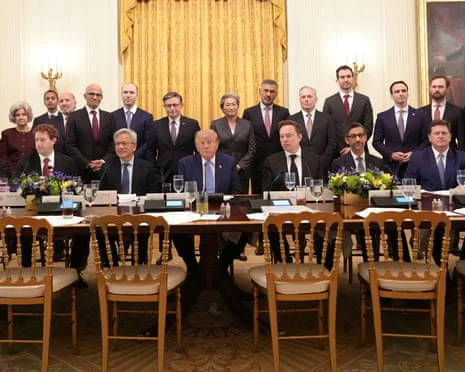
As the legal battle over immigration unfolded, President Donald Trump shifted his focus to the technology sector, hosting a high-profile luncheon at the White House with the leaders of the world’s most prominent artificial intelligence firms. Following the meeting, the president announced that the executives had signed what he described as a "morally binding" agreement to implement internal controls on the development of AI.
The document, titled the "White House Accord on Super Intelligence," reflects the president’s preference for the term "superintelligence" over "artificial intelligence." The agreement was signed by a "who’s who" of Silicon Valley, including Meta CEO Mark Zuckerberg, xAI founder Elon Musk, Nvidia CEO Jensen Huang, Anthropic CEO Dario Amodei, Google’s Sundar Pichai, and OpenAI’s Greg Brockman.
"It’s almost like a Constitution in a way," Trump told reporters in the East Room. "The biggest people in the world signed that, and I signed it as president. It really is a form of protection." The president suggested that the deal would allow these companies to largely "self-police" their products, a move that aligns with his long-standing opposition to federal regulation of the tech industry.
The accord outlines four primary layers of internal controls: the implementation of robust internal safety protocols, the empowerment of internal teams to audit those controls, the engagement of independent external auditors, and the designation of an independent board committee to oversee safety. Critics, however, argue that "morally binding" agreements lack the enforcement mechanisms necessary to protect the public from the potential risks of unregulated AI development.
Contentious Senate Hearing for Former Special Counsel Jack Smith
On Capitol Hill, the political atmosphere was equally charged as former Special Counsel Jack Smith appeared before the Senate Judiciary Committee. The hearing, which lasted several hours, was marked by aggressive questioning from Republican lawmakers who have long accused Smith of conducting a politically motivated "witch-hunt" against the president.
Senator Eric Schmitt of Missouri delivered some of the most pointed attacks, accusing Smith of committing perjury. Schmitt claimed to have obtained staff text messages suggesting Smith attended a professional basketball game in Atlanta in February 2024, a claim Smith said he did not recall. Schmitt ended his time by calling the former prosecutor a "dirtbag" and stating he was "not a hero."

Other Republican senators, including Ted Cruz of Texas and Josh Hawley of Missouri, echoed these sentiments. Cruz compared Smith to Inspector Javert from Les Misérables, suggesting his pursuit of the president was obsessive and weaponized. Senator John Kennedy of Louisiana was similarly blunt, telling Smith, "You make me want to throw up in my mouth," following an exchange about whether Smith consulted with the Attorney General before pursuing indictments.
Smith remained largely unfazed throughout the proceedings, standing by the integrity of his investigations. He told the committee that his team had found "proof beyond a reasonable doubt" of criminal activity regarding the efforts to overturn the 2020 election and the mishandling of classified documents. Smith emphasized that his work followed Department of Justice protocols and was entirely independent of political influence.
RFK Jr. and the Vision for National Health Data
While the Senate debated legal ethics, Health and Human Services Secretary Robert F. Kennedy Jr. addressed the "Make America Healthy Again" (MAHA) summit in Washington. Kennedy, a prominent vaccine skeptic, outlined an expansive plan to centralize and analyze the health data of all Americans using artificial intelligence.
Kennedy proposed connecting medical records, doctor visit logs, and lifestyle data—such as exercise habits—into a massive federal database. He argued that this information should be available to the government and independent researchers to investigate potential links between vaccines, food additives, and the "chronic disease epidemic" in the United States.
"We need to use America’s health data to determine whether the food we eat, the chemicals we encounter, and the vaccines that we’re administering are contributing to chronic disease," Kennedy said. The proposal has raised significant concerns among privacy advocates and medical ethics experts, who worry about the potential for government surveillance and the misuse of sensitive health information.
The MAHA summit itself was a source of controversy. Several prominent health reporters from The New York Times, The Washington Post, and The Wall Street Journal were denied entry to the event, with organizers citing "limited space" despite reports of empty seats in the press section. Those who were allowed inside reported a heavy security presence and strict limitations on their movement.
Military Restructuring and International Withdrawals
In a move that signals further shifts in the administration’s domestic and foreign policy, Defense Secretary Pete Hegseth is expected to announce a second round of significant cuts to the military’s top leadership. Reports indicate that Hegseth will order a 10% reduction in the number of generals and admirals, bringing the total reduction since he took office to 20%.
The cuts are part of a broader effort by the administration to "streamline" the Pentagon and remove leaders who are perceived as being out of alignment with the president’s agenda. Since January 2025, more than two dozen military leaders have already been fired or forced into retirement.
Simultaneously, the administration confirmed that the United States has withdrawn from the Group of States against Corruption (GRECO), a European-led anti-corruption monitoring body. The U.S. had been a member of the organization since 2000. The withdrawal follows a recent decision by the administration to bar international observers from the Organization for Security and Cooperation from monitoring the upcoming midterm elections.
The decision to leave GRECO has been criticized by international watchdogs, who argue it undermines global efforts to uphold the rule of law. Only Russia and Belarus have previously withdrawn from the group, leading to concerns about the United States’ standing in the international community regarding anti-corruption standards.
Legal and Political Friction Ahead of Midterms
The shooting of a Venezuelan delivery driver by ICE agents in Texas has added another layer of tension to the national immigration debate. Federal prosecutors have charged the driver, Wilber Rafael Garcés Pérez, with assaulting a federal officer, alleging he struck an agent with his mirror while attempting to flee a traffic stop. Garcés Pérez has remained in detention for nine days with a bullet lodged in his back after being removed from a hospital by federal agents.
In Congress, the partisan divide continues to widen over a variety of issues, ranging from the preservation of national monuments to the war in Iran. Senator Mike Lee of Utah recently blocked a bipartisan bill intended to prevent the president from demolishing the Kennedy Center without congressional approval. Supporters of the bill argued that the president’s threat to destroy the building was an authoritarian overreach triggered by a law preventing him from placing his own name on the structure.
As the midterm elections approach, the administration remains focused on its core policies of immigration enforcement, deregulation of the tech industry, and the restructuring of federal agencies. The Supreme Court’s decision to allow third-country deportations provides the president with a powerful tool to continue his immigration crackdown, even as the legal and ethical implications of these actions continue to be debated in the courts and the halls of Congress.