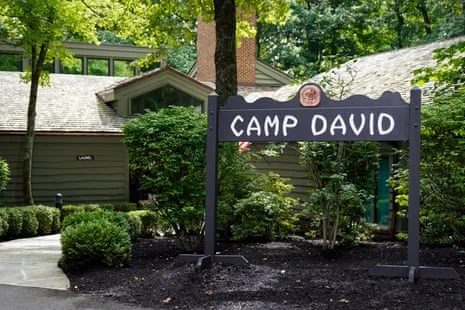
President Donald Trump is scheduled to convene a high-level cabinet meeting at the Camp David presidential retreat today, marking a pivotal moment in his second term as the administration struggles to navigate an escalating conflict with Iran. The gathering at the mountaintop facility in western Maryland comes as the White House faces mounting pressure over a military engagement that has significantly exceeded its original timeline and triggered economic volatility across the United States. While the administration initially projected that the military campaign against Iranian targets would conclude within weeks, the conflict has now entered its fifth month with no clear diplomatic or military resolution in sight.
The summit at the secluded wooded retreat represents only the third time President Trump has utilized Camp David since his second inauguration. Despite the historical significance of the site as a venue for high-stakes diplomacy and strategic planning, the president has largely preferred his private properties for official business during this term. White House Press Secretary Karoline Leavitt characterized the meeting as a "different experience" for the cabinet, noting it would be the 13th formal assembly of the cabinet since the start of the second term. However, the optics of a mountain retreat stand in sharp contrast to the increasingly grim geopolitical and domestic landscape facing the executive branch.
Trump to meet cabinet at Camp David to address regional instability
The primary objective of the Camp David summit is to refine the administration’s foreign policy approach toward Tehran. Since the onset of hostilities, the United States has been locked in a cycle of tit-for-tat strikes against Iranian assets and proxy groups throughout the Middle East. Military analysts have expressed concern that the lack of a defined exit strategy has allowed the conflict to stagnate into a war of attrition. The president, who campaigned on a platform of ending "forever wars," now finds himself presiding over a conflict that has become the defining challenge of his second four-year mandate.
The meeting occurs as the Reuters-Ipsos tracking poll indicates a sharp decline in public enthusiasm for the military effort. Latest data suggests that only one in three Americans currently supports the ongoing war in Iran, the lowest approval rating recorded since the initial strikes were launched five months ago. This erosion of public trust is particularly concerning for the White House as the Republican Party prepares for the critical November midterm elections. Internal GOP polling suggests that the conflict, and its subsequent economic fallout, could threaten the party’s control of both chambers of Congress.
Economic consequences of the Iran war and gasoline price volatility
Beyond the battlefield, the administration is grappling with the severe economic repercussions of the regional instability. The conflict in the Persian Gulf has disrupted global energy markets, leading to a sustained spike in crude oil prices. For the average American consumer, this has translated into a dramatic rise in gasoline prices at the pump, a development that traditionally serves as a harbinger of political trouble for an incumbent administration.
As Trump meets with his cabinet at Camp David, a significant portion of the agenda is expected to be dedicated to domestic energy policy and potential interventions to stabilize the market. The president has reportedly grown increasingly frustrated with the pace of domestic oil production increases and the inability of international partners to offset the loss of Iranian and regional supply. Lowering energy costs is viewed by senior advisors as a mandatory prerequisite for maintaining a competitive edge in the upcoming midterms.
The Board of Peace and the Gaza disarmament proposal
In a late-night announcement preceding the Camp David summit, President Trump revealed that his administration’s "Board of Peace" has purportedly reached a landmark agreement regarding the Gaza Strip. According to the White House, the deal outlines a framework for the complete disarmament of Hamas militants and other armed factions operating within the Palestinian enclave. This "Board of Peace," a specialized diplomatic task force established during Trump’s second term, has been working behind the scenes to secure regional concessions that have eluded previous administrations.

However, the announcement has been met with a measure of skepticism by international observers. As of Friday morning, the Israeli government had not issued an official response to the disarmament plan. The silence from Jerusalem suggests that the details of the arrangement may still be subject to intense negotiation or that the security guarantees provided in the proposal have yet to satisfy Israeli defense requirements. The outcome of this initiative is expected to be a major topic of discussion during today’s cabinet sessions, as the administration seeks to leverage any diplomatic victory in Gaza to offset the difficulties faced in the Iranian theater.
Legislative hurdles and the War Powers resolution
The executive branch’s handle on the war was recently challenged in the halls of the U.S. Senate. In a razor-thin 49-50 vote, the Senate narrowly rejected a War Powers resolution that would have directed the president to cease hostilities against Iran. The failure of the resolution provides the White House with a temporary reprieve, but the narrowness of the margin underscores the growing bipartisan unease regarding the legality and duration of the military campaign.
The legislative tension is compounded by a standoff over high-level personnel. President Trump has indicated he may withdraw the nomination of Todd Blanche for the position of Attorney General. This potential move is tied to a conflict with two prominent Republican senators, John Cornyn of Texas and Thom Tillis of North Carolina. The senators have withheld their support, demanding written assurances and transparency regarding the settlement of the president’s personal lawsuit against the Internal Revenue Service (IRS).
The friction between the White House and these veteran lawmakers comes at a time of transition for the GOP leadership in the Senate. Senator Cornyn recently lost a primary challenge in his home state of Texas, and Senator Tillis has announced he will not seek reelection. The lame-duck status of these influential Republicans has created a vacuum of cooperation, complicating the administration’s efforts to fill the nation’s top law enforcement post during a time of war.
Political shifts and the 2026 midterm landscape
As the cabinet deliberates at Camp David, the domestic political map appears to be shifting. New polling commissioned by Fox News has sent shockwaves through the Republican establishment, particularly regarding the U.S. Senate race in Texas. The data shows Democratic challenger James Talarico holding a narrow lead over the Trump-backed incumbent Attorney General, Ken Paxton. Texas has long been a cornerstone of the Republican electoral strategy, and a potential loss in the Lone Star State would signal a massive shift in the national political alignment.
Simultaneously, the House of Representatives is facing its own internal turmoil. The House Democratic Women’s Caucus has formally requested an Ethics Committee investigation into Republican Congressman Max Miller of Ohio. Miller, a former aide to the president, has been hit with allegations of domestic abuse from both his ex-wife and a former girlfriend. The controversy surrounding Miller adds another layer of complexity to the GOP’s efforts to maintain a unified front as they head into a difficult election cycle defined by foreign conflict and economic anxiety.
Strategic outcomes and the path forward from Camp David
The discussions held today at the Maryland retreat will likely dictate the trajectory of the Trump administration for the remainder of the year. With the November elections looming, the president is under immense pressure to deliver a "win" that can be communicated to a weary electorate. Whether that victory comes through a breakthrough in the Iran conflict, a successful implementation of the Gaza disarmament plan, or a sudden drop in energy prices remains to be seen.
The choice of Camp David—a place synonymous with the 1978 accords and other historic diplomatic feats—suggests that the administration is attempting to project an image of gravity and statesmanship. However, the reality of the 13th cabinet meeting of the second term is one of a presidency at a crossroads. As the sun sets over the Catoctin Mountains, the decisions made within the secured perimeter of the retreat will determine if the administration can regain its footing or if the "weeks-long" war will continue to cast a shadow over the American political and economic future.