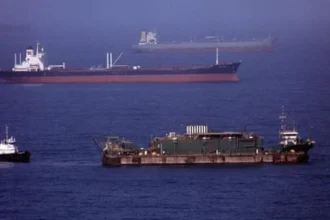
The United States military conducted a seventh consecutive night of aerial bombardments against Iranian targets late Friday, marking a significant intensification of a conflict that has paralyzed the Strait of Hormuz and threatened global energy stability. U.S. Central Command (CENTCOM) confirmed the latest wave of operations began at approximately 7:00 p.m. GMT, describing the mission as a continued effort to degrade the Islamic Revolutionary Guard Corps’ (IRGC) ability to launch attacks against international shipping. The strikes come amid a rapidly deteriorating security situation in the Persian Gulf, where a U.S.-led naval blockade has met with fierce Iranian resistance and retaliatory missile strikes against neighboring Gulf states.
Military officials in Washington stated that the Friday night sorties targeted specific logistical nodes and command centers used by the IRGC to coordinate maritime disruptions. These latest actions follow a day of heavy bombardment in southern Iran, where state-run media reported that U.S. missiles destroyed several bridges in the Hormozgan province. These bridges served as vital transit routes for Bandar Abbas, the nation’s primary commercial port. Iranian health officials, led by ministry spokesperson Hossein Kermanpour, claimed that at least 38 people have been killed and over 400 wounded since the renewed campaign began earlier this week.
Infrastructure Targeted as US Launches Seventh Night of Iran Strikes as Hormuz Conflict Escalates
The scope of the American air campaign has expanded from strictly military sites to dual-use infrastructure, a move the Trump administration signaled earlier this week. Beyond the destruction of transit bridges, U.S. forces targeted a surveillance tower in the port of Chabahar on the Gulf of Oman. CENTCOM officials alleged the tower was a critical asset for the IRGC, allowing them to monitor and facilitate attacks on commercial vessels navigating the narrow entrance to the Persian Gulf. In a further escalation of the economic pressure campaign, the U.S. also struck Iranshahr airport and key electrical nodes, causing widespread blackouts across southern Iran.
The Iranian energy ministry has issued urgent appeals to citizens to drastically reduce electricity consumption, particularly the use of air conditioning, as the national power grid buckles under the strain of the attacks. This infrastructure damage coincides with a period of extreme seasonal heat in the region, raising concerns among international observers about a burgeoning humanitarian crisis. Human rights experts have noted that the targeting of civilian infrastructure not explicitly used for military operations could be scrutinized under international law as potential war crimes, though Washington maintains that all targets are linked to the IRGC’s "hostile maritime architecture."

Regional Retaliation and the Threat to Gulf Neighbors
As the US launches seventh night of Iran strikes as Hormuz conflict escalates, the IRGC has responded by broadening the theater of war. In a stern communiqué issued on Friday, the Iranian military warned that any nation hosting American bases would pay a "devastating price" if the strikes on Iranian soil continued. This threat was punctuated by a series of missile and drone launches targeting Bahrain, Kuwait, Jordan, Oman, and Qatar. While many of these projectiles were intercepted by regional air defense systems, the psychological and physical impact on the Gulf monarchies has been profound.
In Kuwait, authorities reported that an Iranian strike successfully hit a power and desalination plant. This attack is particularly critical given that Kuwait relies on desalinated water for approximately 90% of its potable water supply. Engineers are currently assessing whether the facility can be salvaged or if the nation will face a severe water shortage in the coming days. Meanwhile, in Qatar—a nation that has traditionally served as a neutral mediator between Washington and Tehran—falling debris from an intercepted missile reportedly wounded a child. The inclusion of Qatar in the list of targets suggests that Tehran is no longer honoring traditional diplomatic channels as the conflict enters a total-war footing.
The Collapse of Diplomacy and the Naval Blockade
The current hostilities represent the definitive collapse of an interim memorandum of understanding signed last month. That agreement was intended to keep the Strait of Hormuz open to commercial traffic while providing a framework for long-term truce negotiations. However, differing interpretations of the deal led to immediate friction. Washington accused Tehran of using the agreement to smuggle weapons, while Iran claimed the U.S. was using "freedom of navigation" operations to mask an illegal blockade. By Wednesday, the U.S. had officially reimposed a total blockade on Iranian ports, leading to the current cycle of tit-for-tat violence.
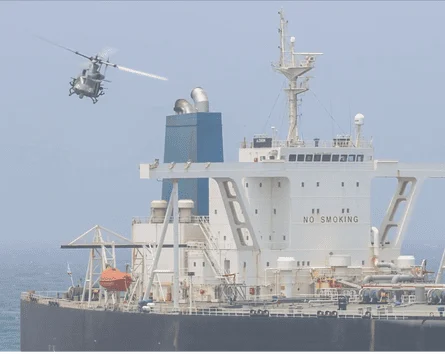
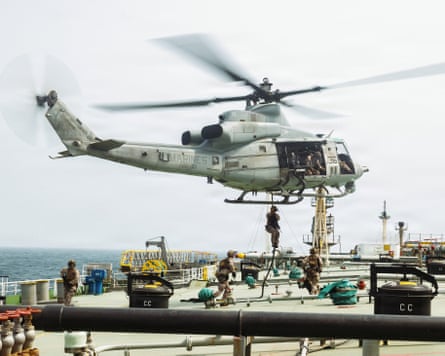
On Thursday, U.S. Marines conducted a high-stakes boarding operation on the M/T Wen Yao in the Gulf of Oman. The vessel was allegedly attempting to run the American blockade. CENTCOM reported that it has "redirected" at least three other commercial ships attempting to reach Iranian docks since the blockade went into effect on Tuesday. This followed an incident on Wednesday where a U.S. aircraft fired upon and disabled an unladen oil tanker that refused to change course. Iran has responded by targeting ships that follow U.S.-designated transit lanes, including a Thai-flagged vessel that was reportedly intercepted and fired upon by the IRGC navy on Friday for failing to seek Iranian permission to pass.
Economic Consequences of the US Launches Seventh Night of Iran Strikes as Hormuz Conflict Escalates
The economic fallout of the conflict is reverberating through global markets. The Strait of Hormuz is the world’s most important oil transit chokepoint, historically handling one-fifth of the global petroleum supply. Data from Lloyd’s List Intelligence indicates that cargo shipments through the waterway plummeted by nearly 25% in the first half of the month, and that figure is expected to drop further following this week’s escalation. Many shipping firms have ordered their tankers to remain in port, while those still brave enough to navigate the strait are reportedly doing so with their Automatic Identification System (AIS) transponders turned off to avoid detection.
While some regional energy exports have been diverted to overland pipelines, analysts warn that these alternatives lack the capacity to compensate for the closure of the strait. The risk of a global energy "paralysis" grew more acute following reports that Iran has requested its Houthi allies in Yemen to prepare for the closure of the Red Sea oil routes. If the Houthis successfully target the Bab al-Mandab strait, the two primary arteries for Middle Eastern oil would be severed simultaneously. Houthi leader Abdulmalik al-Houthi has already threatened to strike Saudi Arabian oil facilities if Riyadh intervenes in the conflict, further complicating the regional security matrix.
Political Posture and the Path Forward
Despite the mounting casualties and the threat of a global recession, President Donald Trump remains defiant. In a televised address from the White House on Thursday evening, the President told the American public that the military campaign is achieving its objectives. "We are winning big in Iran," Trump stated, asserting that the pressure campaign would soon force Tehran to capitulate to U.S. demands. The President reportedly met with his top national security advisors this week to discuss even further expansions of the aerial campaign, with some sources suggesting that Iranian oil refineries and nuclear sites could be next on the target list.
International efforts to de-escalate the situation appear to be stalling. Pakistan’s foreign ministry acknowledged on Thursday that while they are attempting to bring both parties back to the negotiating table, the "rapidly evolving military situation" has made diplomatic breakthroughs nearly impossible. As the US launches seventh night of Iran strikes as Hormuz conflict escalates, the window for a peaceful resolution is closing. Both Washington and Tehran seem entrenched in their respective strategies: the U.S. betting on economic and military exhaustion, and Iran betting on its ability to inflict enough regional pain to force an American withdrawal. With the IRGC vowing that "red lines" have been crossed, the coming days are likely to see an even more volatile phase of this maritime war.