Former President Donald Trump launched a scathing critique of the Super Bowl LX halftime show on Monday, labeling the historic performance by Puerto Rican superstar Bad Bunny as an insult to American values. Writing on his social media platform, Truth Social, the former president characterized the set—which celebrated Latino heritage and featured nearly entirely Spanish-language lyrics—as a "slap in the face" to the country. The criticism comes despite the performance receiving widespread acclaim from music critics and setting new benchmarks for cultural representation on the world’s largest sporting stage.
The halftime show, held at Levi’s Stadium in Santa Clara, California, was headlined by Benito Antonio Martínez Ocasio, known professionally as Bad Bunny. The 31-year-old artist made history as the first performer to lead a Super Bowl halftime show primarily in Spanish, a move that reflected the growing influence of Latino culture within the United States. Trump’s reaction, however, focused on the lack of English and the nature of the choreography, which he described as inappropriate for a general audience.
Trump’s lengthy social media post did not mince words, calling the event one of the "worst" in the history of the NFL’s championship game. He argued that the production did not align with "our standards of Success, Creativity, or Excellence," and suggested that the performance was incomprehensible to the average American viewer. The former president also took the opportunity to pivot to economic themes, contrasting the entertainment spectacle with his own claims regarding the performance of the stock market and retirement accounts.
Trump Calls Bad Bunny’s Super Bowl Performance ‘Absolutely Terrible’ in Social Media Blast
In his post-game analysis shared with his followers, Trump expressed deep dissatisfaction with the aesthetic and linguistic choices of the production. "The Super Bowl Halftime Show is absolutely terrible, one of the worst, EVER!" Trump wrote. He continued by asserting that the show "makes no sense" and constitutes an "affront to the Greatness of America." The critique specifically targeted the use of Spanish, with Trump claiming that "nobody understands a word this guy is saying."
The former president also directed his ire toward the dancing and stagecraft of the 14-minute set. He described the choreography as "disgusting," particularly for "young children that are watching from throughout the U.S.A., and all over the World." This rhetoric mirrors past criticisms leveled by conservative commentators against other diverse halftime performances, such as the 2020 show featuring Jennifer Lopez and Shakira, which also drew complaints regarding its suggestive nature and cultural focus.
Trump concluded his remarks by predicting that the "Fake News Media" would provide positive reviews of the "mess" because they are out of touch with what he termed the "REAL WORLD." He argued that the country is currently setting "new standards and records every single day," citing the stock market and 401(k) performances as the true markers of American success, rather than cultural milestones in the entertainment industry.
A Landmark Performance for Latino Culture and the Spanish Language
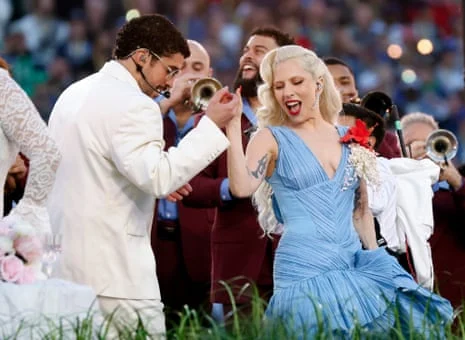
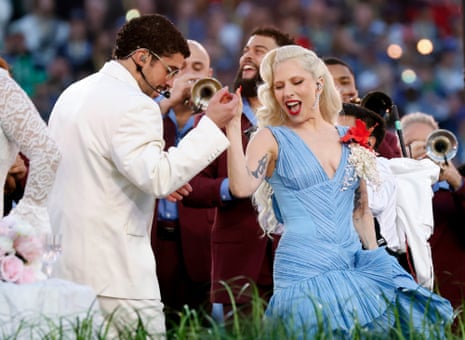
Despite the political backlash, music industry analysts and cultural historians are viewing Bad Bunny’s performance as a watershed moment for American media. The show featured guest appearances by Lady Gaga and Ricky Martin, blending contemporary pop with traditional Caribbean rhythms. The stage design was particularly notable, utilizing a centerpiece that resembled sugar plantation fields—a poignant nod to the complex history of the Caribbean and the labor of Latino ancestors.

The performance included a high-profile "wedding" ceremony on stage, adding a theatrical element that celebrated community and love. Bad Bunny, who has consistently broken records on streaming platforms like Spotify and Apple Music, used the platform to highlight the breadth of the Americas. Toward the end of the set, he shouted "God bless America!" before conducting a "roll call" of nations, including Uruguay, Colombia, Venezuela, Cuba, Canada, and the United States.
A vibrant parade of flags representing these countries marched through the stadium, emphasizing a pan-American identity. This inclusivity was a central theme of the night, coming just one week after Bad Bunny’s album "Debí Tirar Más Fotos" made history as the first Spanish-language project to win the Grammy for Album of the Year. The momentum from that victory had created immense anticipation for the Super Bowl show, which remains a cornerstone of the American cultural calendar.
Political Friction and Right-Wing Criticism
The selection of Bad Bunny as the headliner had been a point of contention in right-wing media circles long before the first whistle blew in Santa Clara. Commentators had pointed to the artist’s history of political activism as a reason for concern. Bad Bunny has been a vocal critic of the U.S. Immigration and Customs Enforcement (ICE) agency and has previously spoken out against the immigration policies of the Trump administration, which he has characterized as authoritarian.
For many of Trump’s supporters, the halftime show represented a continuation of the "culture wars" that have increasingly permeated professional sports. The use of Spanish as the primary language for a quintessentially American event was viewed by some as a rejection of national tradition. This sentiment was echoed in Trump’s Truth Social post, where he framed the show as being disconnected from the "Greatness of America."
However, defenders of the performance point to the demographic reality of the United States, where the Latino population is the fastest-growing major ethnic group. Proponents argue that a halftime show reflecting this reality is not an "affront" but a modernization of American standards. The five-star reviews from major outlets, which Trump predicted would occur, emphasized the show’s energy, production value, and the artist’s ability to command a global stage while remaining true to his roots.
The Intersection of Sports, Entertainment, and the 2026 Political Landscape
As the United States moves further into the 2026 political cycle, the reaction to the Super Bowl halftime show serves as a barometer for the nation’s deep cultural divisions. Trump’s decision to link the performance to economic metrics like 401(k)s suggests that his campaign continues to view cultural grievances as a powerful tool for mobilizing his base. By framing the show as "disgusting" and "terrible," he reinforces a narrative of national decline that he promises to reverse.
On the other side of the aisle, the performance is being celebrated as a victory for representation. Political strategists note that the Latino vote remains a critical and highly contested demographic in battleground states. While Trump’s rhetoric may appeal to those concerned about cultural shifts, it also risks alienating younger, Spanish-speaking voters who see Bad Bunny as a symbol of pride and success.
The contrast between the "Real World" cited by Trump and the cultural celebration seen by millions of viewers highlights the difficulty of finding common ground in the modern American landscape. For many, the Super Bowl is a rare moment of national unity, but as the fallout from Sunday’s show demonstrates, even the most popular musical performances are now subject to the same polarization that defines the halls of Congress.
The Evolution of the Super Bowl Halftime Show
The controversy surrounding Bad Bunny’s set is the latest chapter in the long evolution of the Super Bowl halftime show. In its early decades, the intermission typically featured university marching bands and safe, family-friendly acts like Up with People. It was not until the 1990s, starting with Michael Jackson’s 1993 performance, that the NFL transformed the slot into a global pop culture event designed to keep viewers from changing the channel.
In recent years, the NFL has made a concerted effort to diversify its musical offerings, partnering with Jay-Z’s Roc Nation to produce the show. This partnership has led to a string of performances by hip-hop, R&B, and Latino artists, reflecting a broader shift in the American musical mainstream. While these choices have often been met with high ratings and critical praise, they have also consistently drawn fire from those who prefer a more traditional or "classic rock" approach to the event.
Bad Bunny’s 14-minute set, with its plantation imagery and multi-national roll call, was perhaps the most explicitly political and culturally specific show to date. By choosing to perform in Spanish, he challenged the notion that English is the only language of the American experience. This challenge clearly resonated with Donald Trump, whose response ensured that the conversation surrounding Super Bowl LX would remain focused as much on the political stage as the football field.
Broader Consequences for the Entertainment Industry
The fallout from Trump’s comments may have lasting effects on how major corporations and leagues approach high-profile entertainment. The NFL, which has navigated numerous controversies regarding social justice and player protests over the last decade, now finds its flagship entertainment property at the center of a presidential-level critique. The league must balance the desire to reach a younger, more diverse audience with the risk of alienating a segment of its traditional fanbase that shares Trump’s views.
For artists like Bad Bunny, the criticism from such a prominent political figure often serves to solidify their status as cultural icons. The Puerto Rican singer’s ability to generate a response from a former president is a testament to his reach and influence. As the music industry continues to globalize, the tension between local traditions and international stardom is likely to increase, with the Super Bowl serving as the primary arena for these clashing perspectives.
Ultimately, the debate over whether the show was "absolutely terrible" or a "historic masterpiece" depends largely on the lens through which the viewer watches. For those who see the United States as a melting pot of languages and cultures, Bad Bunny’s performance was an inspirational success. For those who share Donald Trump’s vision of a country defined by specific, traditional standards, it was an unwelcome departure from the norm. As the 2026 political season progresses, this divide is expected to remain a central theme in the national discourse.